

Appendix 1: Isotropic Form of the Metric, Eddington Parameters
139
Appendix 1: Isotropic Form of the Metric, Eddington
Parameters
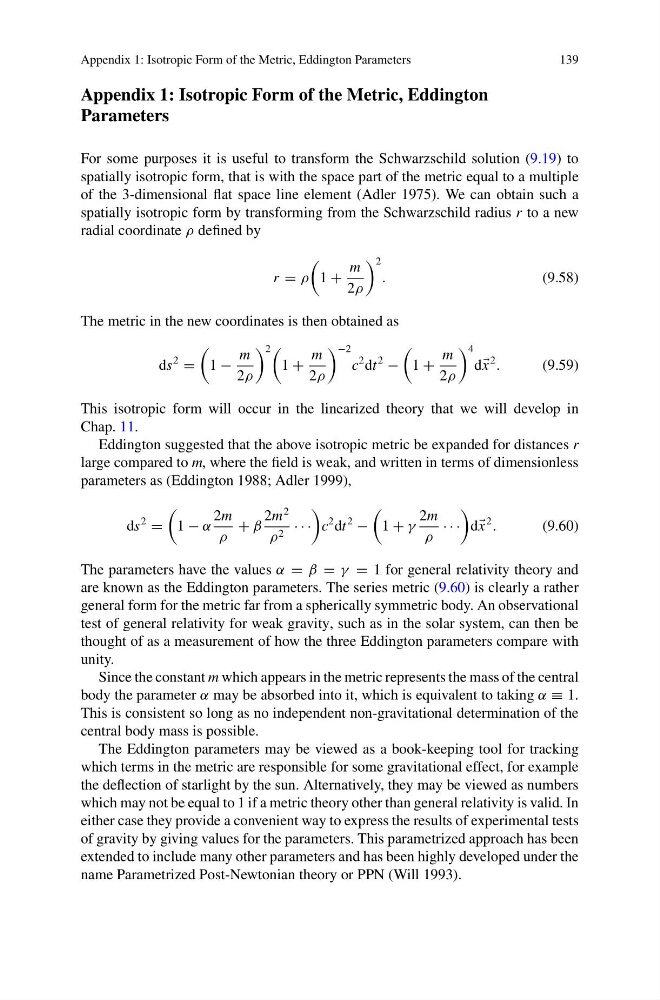
For some purposes it is useful to transform the Schwarzschild solution (9.19) to
spatially isotropic form, that is with the space part of the metric equal to a multiple
of the 3-dimensional flat space line element (Adler 1975). We can obtain such a
spatially isotropic form by transforming from the Schwarzschild radius r to a new
radial coordinate ρ defined by
r = ρ
1 +
m
2ρ
2
.
(9.58)
The metric in the new coordinates is then obtained as
ds
2
=
1 −
m
2ρ
2
1 +
m
2ρ
−2
c
2 dt
2
−
1 +
m
2ρ
4
d x
2
.
(9.59)
This isotropic form will occur in the linearized theory that we will develop in
Chap. 11.
Eddington suggested that the above isotropic metric be expanded for distances r
large compared to m, where the field is weak, and written in terms of dimensionless
parameters as (Eddington 1988; Adler 1999),
ds
2
=
1 − α
2m
ρ
+ β
2m
2
ρ 2 · · ·
c
2 dt
2
−
1 + γ
2m
ρ
· · ·
d x
2
.
(9.60)
The parameters have the values α = β = γ = 1 for general relativity theory and
are known as the Eddington parameters. The series metric (9.60) is clearly a rather
general form for the metric far from a spherically symmetric body. An observational
test of general relativity for weak gravity, such as in the solar system, can then be
thought of as a measurement of how the three Eddington parameters compare with
unity.
Since the constant m which appears in the metric represents the mass of the central
body the parameter α may be absorbed into it, which is equivalent to taking α ≡ 1.
This is consistent so long as no independent non-gravitational determination of the
central body mass is possible.
The Eddington parameters may be viewed as a book-keeping tool for tracking
which terms in the metric are responsible for some gravitational effect, for example
the deflection of starlight by the sun. Alternatively, they may be viewed as numbers
which may not be equal to 1 if a metric theory other than general relativity is valid. In
either case they provide a convenient way to express the results of experimental tests
of gravity by giving values for the parameters. This parametrized approach has been
extended to include many other parameters and has been highly developed under the
name Parametrized Post-Newtonian theory or PPN (Will 1993).
139
Appendix 1: Isotropic Form of the Metric, Eddington
Parameters
For some purposes it is useful to transform the Schwarzschild solution (9.19) to
spatially isotropic form, that is with the space part of the metric equal to a multiple
of the 3-dimensional flat space line element (Adler 1975). We can obtain such a
spatially isotropic form by transforming from the Schwarzschild radius r to a new
radial coordinate ρ defined by
r = ρ
1 +
m
2ρ
2
.
(9.58)
The metric in the new coordinates is then obtained as
ds
2
=
1 −
m
2ρ
2
1 +
m
2ρ
−2
c
2 dt
2
−
1 +
m
2ρ
4
d x
2
.
(9.59)
This isotropic form will occur in the linearized theory that we will develop in
Chap. 11.
Eddington suggested that the above isotropic metric be expanded for distances r
large compared to m, where the field is weak, and written in terms of dimensionless
parameters as (Eddington 1988; Adler 1999),
ds
2
=
1 − α
2m
ρ
+ β
2m
2
ρ 2 · · ·
c
2 dt
2
−
1 + γ
2m
ρ
· · ·
d x
2
.
(9.60)
The parameters have the values α = β = γ = 1 for general relativity theory and
are known as the Eddington parameters. The series metric (9.60) is clearly a rather
general form for the metric far from a spherically symmetric body. An observational
test of general relativity for weak gravity, such as in the solar system, can then be
thought of as a measurement of how the three Eddington parameters compare with
unity.
Since the constant m which appears in the metric represents the mass of the central
body the parameter α may be absorbed into it, which is equivalent to taking α ≡ 1.
This is consistent so long as no independent non-gravitational determination of the
central body mass is possible.
The Eddington parameters may be viewed as a book-keeping tool for tracking
which terms in the metric are responsible for some gravitational effect, for example
the deflection of starlight by the sun. Alternatively, they may be viewed as numbers
which may not be equal to 1 if a metric theory other than general relativity is valid. In
either case they provide a convenient way to express the results of experimental tests
of gravity by giving values for the parameters. This parametrized approach has been
extended to include many other parameters and has been highly developed under the
name Parametrized Post-Newtonian theory or PPN (Will 1993).