

136
9 Spherically Symmetric Gravitational Fields
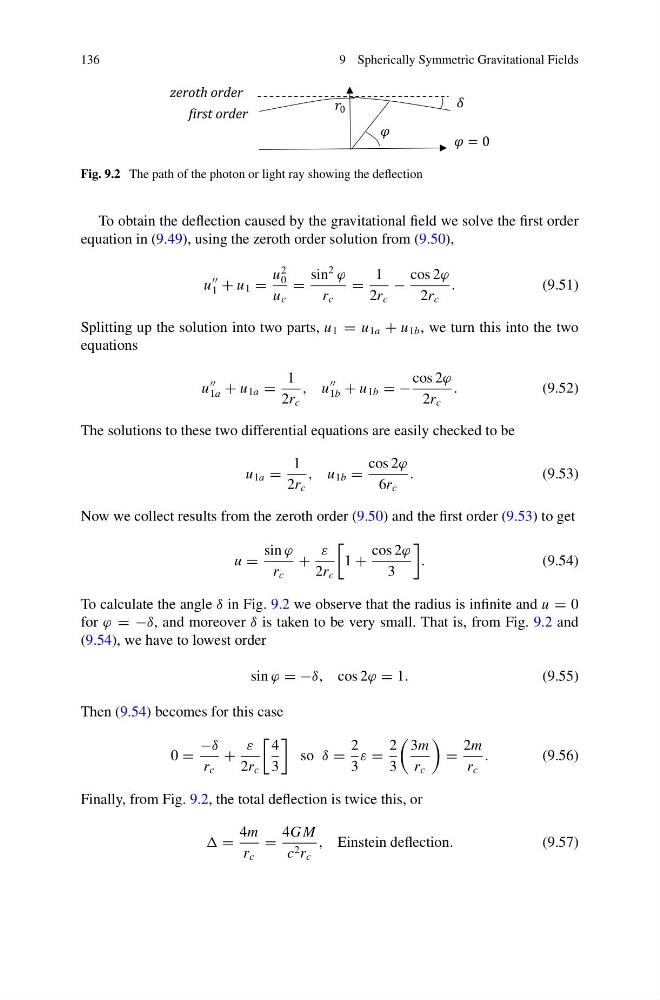
Fig. 9.2 The path of the photon or light ray showing the deflection
To obtain the deflection caused by the gravitational field we solve the first order
equation in (9.49), using the zeroth order solution from (9.50),
u
1 + u 1 =
u
2
0
u c
=
sin
2
ϕ
r c
=
1
2r c
−
cos 2ϕ
2r c
.
(9.51)
Splitting up the solution into two parts, u 1 = u 1a + u 1b , we turn this into the two
equations
u
1a + u 1a =
1
2r c
, u
1b + u 1b = −
cos 2ϕ
2r c
.
(9.52)
The solutions to these two differential equations are easily checked to be
u 1a =
1
2r c
, u 1b =
cos 2ϕ
6r c
.
(9.53)
Now we collect results from the zeroth order (9.50) and the first order (9.53) to get
u =
sin ϕ
r c
+
ε
2r c
1 +
cos 2ϕ
3
.
(9.54)
To calculate the angle δ in Fig. 9.2 we observe that the radius is infinite and u = 0
for ϕ = −δ, and moreover δ is taken to be very small. That is, from Fig. 9.2 and
(9.54), we have to lowest order
sin ϕ = −δ, cos 2ϕ = 1.
(9.55)
Then (9.54) becomes for this case
0 =
−δ
r c
+
ε
2r c
4
3
so δ =
2
3
ε =
2
3
3m
r c
=
2m
r c
.
(9.56)
Finally, from Fig. 9.2, the total deflection is twice this, or
=
4m
r c
=
4G M
c 2 r c
, Einstein deflection.
(9.57)
9 Spherically Symmetric Gravitational Fields
Fig. 9.2 The path of the photon or light ray showing the deflection
To obtain the deflection caused by the gravitational field we solve the first order
equation in (9.49), using the zeroth order solution from (9.50),
u
1 + u 1 =
u
2
0
u c
=
sin
2
ϕ
r c
=
1
2r c
−
cos 2ϕ
2r c
.
(9.51)
Splitting up the solution into two parts, u 1 = u 1a + u 1b , we turn this into the two
equations
u
1a + u 1a =
1
2r c
, u
1b + u 1b = −
cos 2ϕ
2r c
.
(9.52)
The solutions to these two differential equations are easily checked to be
u 1a =
1
2r c
, u 1b =
cos 2ϕ
6r c
.
(9.53)
Now we collect results from the zeroth order (9.50) and the first order (9.53) to get
u =
sin ϕ
r c
+
ε
2r c
1 +
cos 2ϕ
3
.
(9.54)
To calculate the angle δ in Fig. 9.2 we observe that the radius is infinite and u = 0
for ϕ = −δ, and moreover δ is taken to be very small. That is, from Fig. 9.2 and
(9.54), we have to lowest order
sin ϕ = −δ, cos 2ϕ = 1.
(9.55)
Then (9.54) becomes for this case
0 =
−δ
r c
+
ε
2r c
4
3
so δ =
2
3
ε =
2
3
3m
r c
=
2m
r c
.
(9.56)
Finally, from Fig. 9.2, the total deflection is twice this, or
=
4m
r c
=
4G M
c 2 r c
, Einstein deflection.
(9.57)