

130
9 Spherically Symmetric Gravitational Fields
d
ds
1 −
2m
r
˙
t
= 0, thus
1 −
2m
r
˙
t = = const.,
(9.21a)
d
ds
r
2 ˙
θ
= r
2 sin θ cos θ ˙
ϕ
2
,
(9.21b)
d
ds
r
2 sin
2
θ ˙
ϕ
= 0, thus r
2 sin
2
θ ˙
ϕ = h = const.
(9.21c)
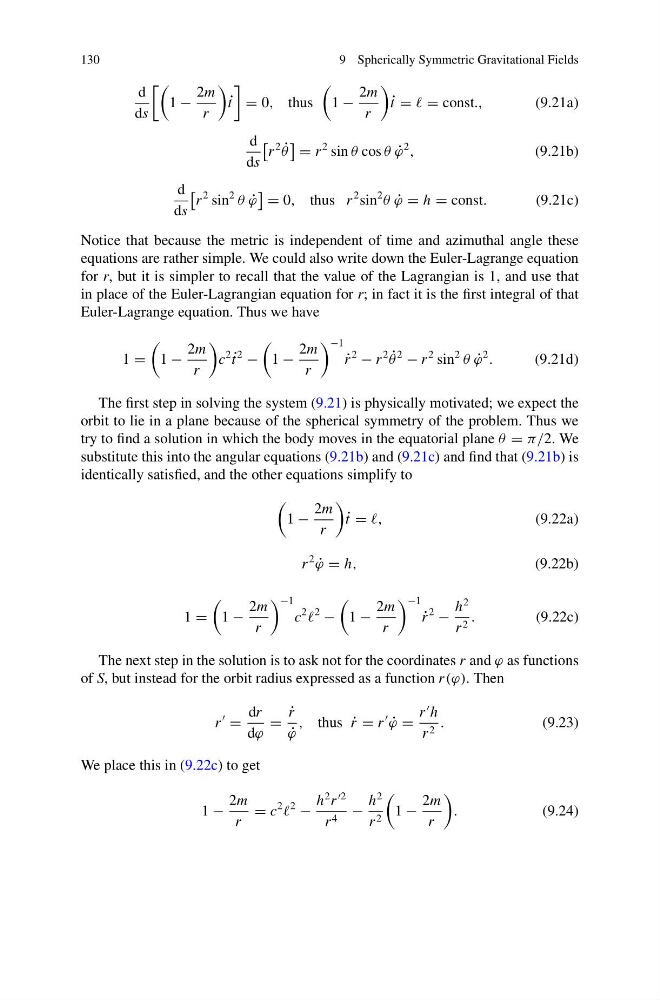
Notice that because the metric is independent of time and azimuthal angle these
equations are rather simple. We could also write down the Euler-Lagrange equation
for r, but it is simpler to recall that the value of the Lagrangian is 1, and use that
in place of the Euler-Lagrangian equation for r; in fact it is the first integral of that
Euler-Lagrange equation. Thus we have
1 =
1 −
2m
r
c
2 ˙
t
2
−
1 −
2m
r
−1
˙
r
2
− r
2 ˙
θ
2
− r
2 sin
2
θ ˙
ϕ
2
.
(9.21d)
The first step in solving the system (9.21) is physically motivated; we expect the
orbit to lie in a plane because of the spherical symmetry of the problem. Thus we
try to find a solution in which the body moves in the equatorial plane θ = π/2. We
substitute this into the angular equations (9.21b) and (9.21c) and find that (9.21b) is
identically satisfied, and the other equations simplify to
1 −
2m
r
˙
t = ,
(9.22a)
r
2
˙
ϕ = h,
(9.22b)
1 =
1 −
2m
r
−1
c
2
2
−
1 −
2m
r
−1
˙
r
2
−
h
2
r 2 .
(9.22c)
The next step in the solution is to ask not for the coordinates r and ϕ as functions
of S, but instead for the orbit radius expressed as a function r (ϕ). Then
r
=
dr
dϕ
=
˙
r
˙
ϕ
, thus ˙
r = r
˙
ϕ =
r
h
r 2 .
(9.23)
We place this in (9.22c) to get
1 −
2m
r
= c
2
2
−
h
2 r
2
r 4 −
h
2
r 2
1 −
2m
r
.
(9.24)
9 Spherically Symmetric Gravitational Fields
d
ds
1 −
2m
r
˙
t
= 0, thus
1 −
2m
r
˙
t = = const.,
(9.21a)
d
ds
r
2 ˙
θ
= r
2 sin θ cos θ ˙
ϕ
2
,
(9.21b)
d
ds
r
2 sin
2
θ ˙
ϕ
= 0, thus r
2 sin
2
θ ˙
ϕ = h = const.
(9.21c)
Notice that because the metric is independent of time and azimuthal angle these
equations are rather simple. We could also write down the Euler-Lagrange equation
for r, but it is simpler to recall that the value of the Lagrangian is 1, and use that
in place of the Euler-Lagrangian equation for r; in fact it is the first integral of that
Euler-Lagrange equation. Thus we have
1 =
1 −
2m
r
c
2 ˙
t
2
−
1 −
2m
r
−1
˙
r
2
− r
2 ˙
θ
2
− r
2 sin
2
θ ˙
ϕ
2
.
(9.21d)
The first step in solving the system (9.21) is physically motivated; we expect the
orbit to lie in a plane because of the spherical symmetry of the problem. Thus we
try to find a solution in which the body moves in the equatorial plane θ = π/2. We
substitute this into the angular equations (9.21b) and (9.21c) and find that (9.21b) is
identically satisfied, and the other equations simplify to
1 −
2m
r
˙
t = ,
(9.22a)
r
2
˙
ϕ = h,
(9.22b)
1 =
1 −
2m
r
−1
c
2
2
−
1 −
2m
r
−1
˙
r
2
−
h
2
r 2 .
(9.22c)
The next step in the solution is to ask not for the coordinates r and ϕ as functions
of S, but instead for the orbit radius expressed as a function r (ϕ). Then
r
=
dr
dϕ
=
˙
r
˙
ϕ
, thus ˙
r = r
˙
ϕ =
r
h
r 2 .
(9.23)
We place this in (9.22c) to get
1 −
2m
r
= c
2
2
−
h
2 r
2
r 4 −
h
2
r 2
1 −
2m
r
.
(9.24)