

128
9 Spherically Symmetric Gravitational Fields
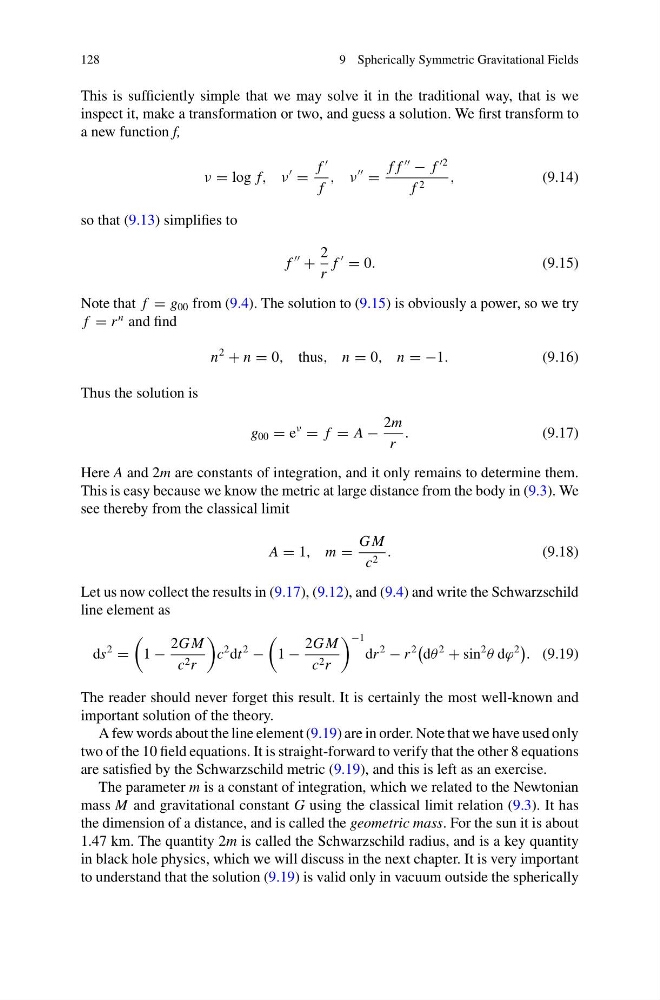
This is sufficiently simple that we may solve it in the traditional way, that is we
inspect it, make a transformation or two, and guess a solution. We first transform to
a new function f,
ν = log f, ν
=
f
f
, ν
=
f f
− f
2
f 2
,
(9.14)
so that (9.13) simplifies to
f
+
2
r
f
= 0.
(9.15)
Note that f = g 00 from (9.4). The solution to (9.15) is obviously a power, so we try
f = r
n and find
n
2
+ n = 0, thus, n = 0, n = −1.
(9.16)
Thus the solution is
g 00 = e
ν
= f = A −
2m
r
.
(9.17)
Here A and 2m are constants of integration, and it only remains to determine them.
This is easy because we know the metric at large distance from the body in (9.3). We
see thereby from the classical limit
A = 1, m =
G M
c 2 .
(9.18)
Let us now collect the results in (9.17), (9.12), and (9.4) and write the Schwarzschild
line element as
ds
2
=
1 −
2G M
c 2 r
c
2 dt
2
−
1 −
2G M
c 2 r
−1
dr
2
− r
2
dθ
2
+ sin
2
θ dϕ
2
. (9.19)
The reader should never forget this result. It is certainly the most well-known and
important solution of the theory.
A few words about the line element (9.19) are in order. Note that we have used only
two of the 10 field equations. It is straight-forward to verify that the other 8 equations
are satisfied by the Schwarzschild metric (9.19), and this is left as an exercise.
The parameter m is a constant of integration, which we related to the Newtonian
mass M and gravitational constant G using the classical limit relation (9.3). It has
the dimension of a distance, and is called the geometric mass. For the sun it is about
1.47 km. The quantity 2m is called the Schwarzschild radius, and is a key quantity
in black hole physics, which we will discuss in the next chapter. It is very important
to understand that the solution (9.19) is valid only in vacuum outside the spherically
9 Spherically Symmetric Gravitational Fields
This is sufficiently simple that we may solve it in the traditional way, that is we
inspect it, make a transformation or two, and guess a solution. We first transform to
a new function f,
ν = log f, ν
=
f
f
, ν
=
f f
− f
2
f 2
,
(9.14)
so that (9.13) simplifies to
f
+
2
r
f
= 0.
(9.15)
Note that f = g 00 from (9.4). The solution to (9.15) is obviously a power, so we try
f = r
n and find
n
2
+ n = 0, thus, n = 0, n = −1.
(9.16)
Thus the solution is
g 00 = e
ν
= f = A −
2m
r
.
(9.17)
Here A and 2m are constants of integration, and it only remains to determine them.
This is easy because we know the metric at large distance from the body in (9.3). We
see thereby from the classical limit
A = 1, m =
G M
c 2 .
(9.18)
Let us now collect the results in (9.17), (9.12), and (9.4) and write the Schwarzschild
line element as
ds
2
=
1 −
2G M
c 2 r
c
2 dt
2
−
1 −
2G M
c 2 r
−1
dr
2
− r
2
dθ
2
+ sin
2
θ dϕ
2
. (9.19)
The reader should never forget this result. It is certainly the most well-known and
important solution of the theory.
A few words about the line element (9.19) are in order. Note that we have used only
two of the 10 field equations. It is straight-forward to verify that the other 8 equations
are satisfied by the Schwarzschild metric (9.19), and this is left as an exercise.
The parameter m is a constant of integration, which we related to the Newtonian
mass M and gravitational constant G using the classical limit relation (9.3). It has
the dimension of a distance, and is called the geometric mass. For the sun it is about
1.47 km. The quantity 2m is called the Schwarzschild radius, and is a key quantity
in black hole physics, which we will discuss in the next chapter. It is very important
to understand that the solution (9.19) is valid only in vacuum outside the spherically