

110
8 Curved Space and Gravity
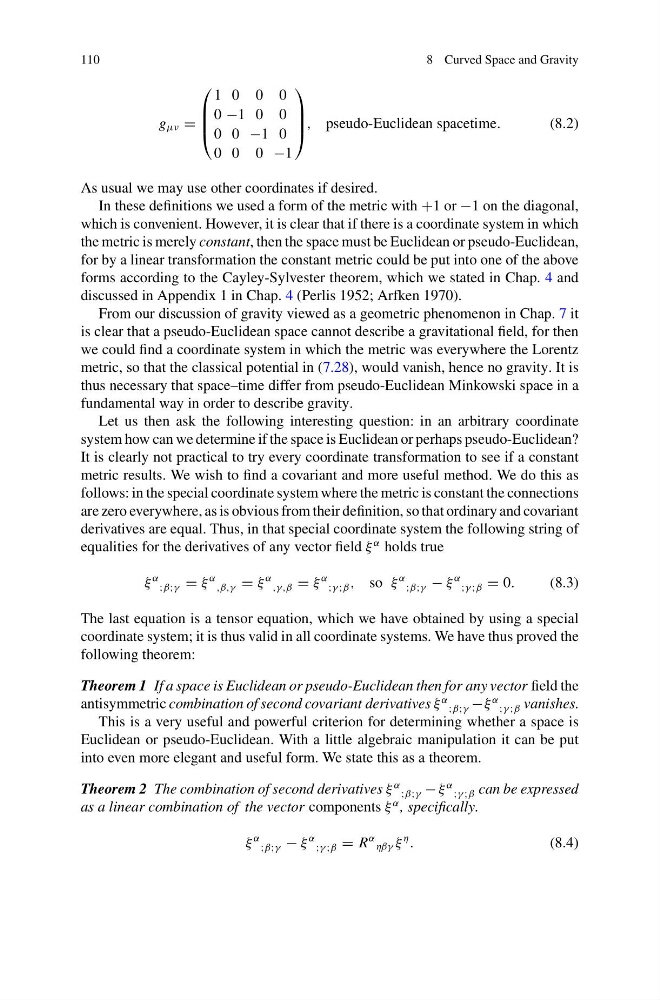
g μν =
⎛
⎜
⎜
⎝
1 0 0 0
0 −1 0 0
0 0 −1 0
0 0 0 −1
⎞
⎟
⎟
⎠ , pseudo-Euclidean spacetime.
(8.2)
As usual we may use other coordinates if desired.
In these definitions we used a form of the metric with +1 or −1 on the diagonal,
which is convenient. However, it is clear that if there is a coordinate system in which
the metric is merely constant, then the space must be Euclidean or pseudo-Euclidean,
for by a linear transformation the constant metric could be put into one of the above
forms according to the Cayley-Sylvester theorem, which we stated in Chap. 4 and
discussed in Appendix 1 in Chap. 4 (Perlis 1952; Arfken 1970).
From our discussion of gravity viewed as a geometric phenomenon in Chap. 7 it
is clear that a pseudo-Euclidean space cannot describe a gravitational field, for then
we could find a coordinate system in which the metric was everywhere the Lorentz
metric, so that the classical potential in (7.28), would vanish, hence no gravity. It is
thus necessary that space–time differ from pseudo-Euclidean Minkowski space in a
fundamental way in order to describe gravity.
Let us then ask the following interesting question: in an arbitrary coordinate
system how can we determine if the space is Euclidean or perhaps pseudo-Euclidean?
It is clearly not practical to try every coordinate transformation to see if a constant
metric results. We wish to find a covariant and more useful method. We do this as
follows: in the special coordinate system where the metric is constant the connections
are zero everywhere, as is obvious from their definition, so that ordinary and covariant
derivatives are equal. Thus, in that special coordinate system the following string of
equalities for the derivatives of any vector field ξ
α holds true
ξ
α ;β;γ = ξ
α ,β,γ = ξ
α ,γ ,β = ξ
α ;γ ;β , so ξ
α ;β;γ − ξ
α ;γ ;β = 0.
(8.3)
The last equation is a tensor equation, which we have obtained by using a special
coordinate system; it is thus valid in all coordinate systems. We have thus proved the
following theorem:
Theorem 1 If a space is Euclidean or pseudo-Euclidean then for any vector field the
antisymmetric combination of second covariant derivatives ξ
α ;β;γ −ξ
α ;γ ;β vanishes.
This is a very useful and powerful criterion for determining whether a space is
Euclidean or pseudo-Euclidean. With a little algebraic manipulation it can be put
into even more elegant and useful form. We state this as a theorem.
Theorem 2 The combination of second derivatives ξ
α ;β;γ − ξ
α ;γ ;β can be expressed
as a linear combination of the vector components ξ
α , specifically.
ξ
α ;β;γ − ξ
α ;γ ;β = R
α ηβγ ξ
η
.
(8.4)
8 Curved Space and Gravity
g μν =
⎛
⎜
⎜
⎝
1 0 0 0
0 −1 0 0
0 0 −1 0
0 0 0 −1
⎞
⎟
⎟
⎠ , pseudo-Euclidean spacetime.
(8.2)
As usual we may use other coordinates if desired.
In these definitions we used a form of the metric with +1 or −1 on the diagonal,
which is convenient. However, it is clear that if there is a coordinate system in which
the metric is merely constant, then the space must be Euclidean or pseudo-Euclidean,
for by a linear transformation the constant metric could be put into one of the above
forms according to the Cayley-Sylvester theorem, which we stated in Chap. 4 and
discussed in Appendix 1 in Chap. 4 (Perlis 1952; Arfken 1970).
From our discussion of gravity viewed as a geometric phenomenon in Chap. 7 it
is clear that a pseudo-Euclidean space cannot describe a gravitational field, for then
we could find a coordinate system in which the metric was everywhere the Lorentz
metric, so that the classical potential in (7.28), would vanish, hence no gravity. It is
thus necessary that space–time differ from pseudo-Euclidean Minkowski space in a
fundamental way in order to describe gravity.
Let us then ask the following interesting question: in an arbitrary coordinate
system how can we determine if the space is Euclidean or perhaps pseudo-Euclidean?
It is clearly not practical to try every coordinate transformation to see if a constant
metric results. We wish to find a covariant and more useful method. We do this as
follows: in the special coordinate system where the metric is constant the connections
are zero everywhere, as is obvious from their definition, so that ordinary and covariant
derivatives are equal. Thus, in that special coordinate system the following string of
equalities for the derivatives of any vector field ξ
α holds true
ξ
α ;β;γ = ξ
α ,β,γ = ξ
α ,γ ,β = ξ
α ;γ ;β , so ξ
α ;β;γ − ξ
α ;γ ;β = 0.
(8.3)
The last equation is a tensor equation, which we have obtained by using a special
coordinate system; it is thus valid in all coordinate systems. We have thus proved the
following theorem:
Theorem 1 If a space is Euclidean or pseudo-Euclidean then for any vector field the
antisymmetric combination of second covariant derivatives ξ
α ;β;γ −ξ
α ;γ ;β vanishes.
This is a very useful and powerful criterion for determining whether a space is
Euclidean or pseudo-Euclidean. With a little algebraic manipulation it can be put
into even more elegant and useful form. We state this as a theorem.
Theorem 2 The combination of second derivatives ξ
α ;β;γ − ξ
α ;γ ;β can be expressed
as a linear combination of the vector components ξ
α , specifically.
ξ
α ;β;γ − ξ
α ;γ ;β = R
α ηβγ ξ
η
.
(8.4)