

7.2 The Equivalence Principle
99
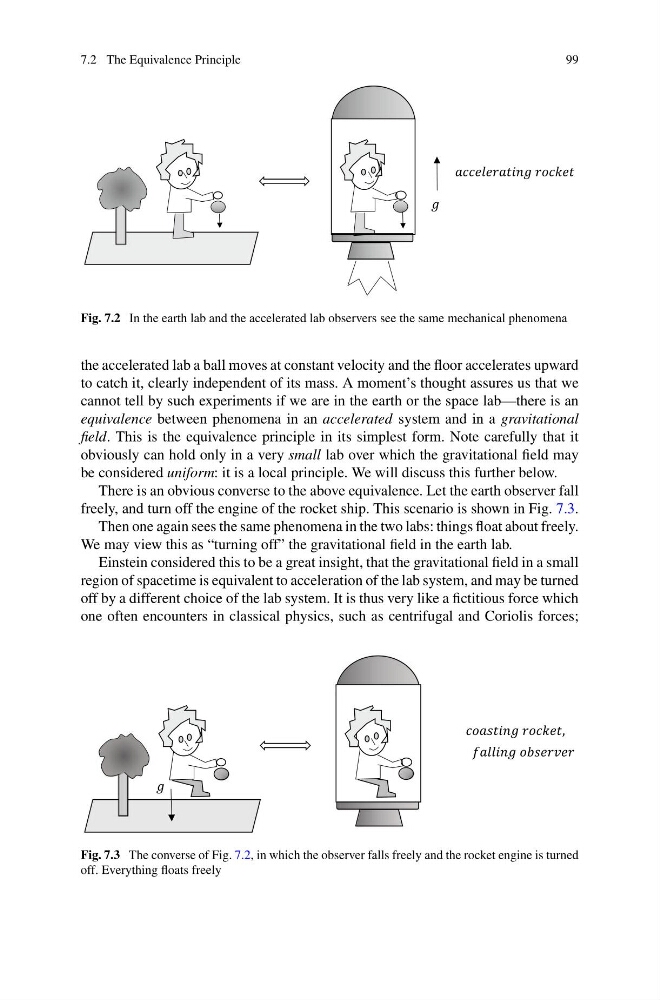
Fig. 7.2 In the earth lab and the accelerated lab observers see the same mechanical phenomena
the accelerated lab a ball moves at constant velocity and the floor accelerates upward
to catch it, clearly independent of its mass. A moment’s thought assures us that we
cannot tell by such experiments if we are in the earth or the space lab—there is an
equivalence between phenomena in an accelerated system and in a gravitational
field. This is the equivalence principle in its simplest form. Note carefully that it
obviously can hold only in a very small lab over which the gravitational field may
be considered uniform: it is a local principle. We will discuss this further below.
There is an obvious converse to the above equivalence. Let the earth observer fall
freely, and turn off the engine of the rocket ship. This scenario is shown in Fig. 7.3.
Then one again sees the same phenomena in the two labs: things float about freely.
We may view this as “turning off” the gravitational field in the earth lab.
Einstein considered this to be a great insight, that the gravitational field in a small
region of spacetime is equivalent to acceleration of the lab system, and may be turned
off by a different choice of the lab system. It is thus very like a fictitious force which
one often encounters in classical physics, such as centrifugal and Coriolis forces;
Fig. 7.3 The converse of Fig. 7.2, in which the observer falls freely and the rocket engine is turned
off. Everything floats freely
99
Fig. 7.2 In the earth lab and the accelerated lab observers see the same mechanical phenomena
the accelerated lab a ball moves at constant velocity and the floor accelerates upward
to catch it, clearly independent of its mass. A moment’s thought assures us that we
cannot tell by such experiments if we are in the earth or the space lab—there is an
equivalence between phenomena in an accelerated system and in a gravitational
field. This is the equivalence principle in its simplest form. Note carefully that it
obviously can hold only in a very small lab over which the gravitational field may
be considered uniform: it is a local principle. We will discuss this further below.
There is an obvious converse to the above equivalence. Let the earth observer fall
freely, and turn off the engine of the rocket ship. This scenario is shown in Fig. 7.3.
Then one again sees the same phenomena in the two labs: things float about freely.
We may view this as “turning off” the gravitational field in the earth lab.
Einstein considered this to be a great insight, that the gravitational field in a small
region of spacetime is equivalent to acceleration of the lab system, and may be turned
off by a different choice of the lab system. It is thus very like a fictitious force which
one often encounters in classical physics, such as centrifugal and Coriolis forces;
Fig. 7.3 The converse of Fig. 7.2, in which the observer falls freely and the rocket engine is turned
off. Everything floats freely