

7.1 Newtonian Gravity
97
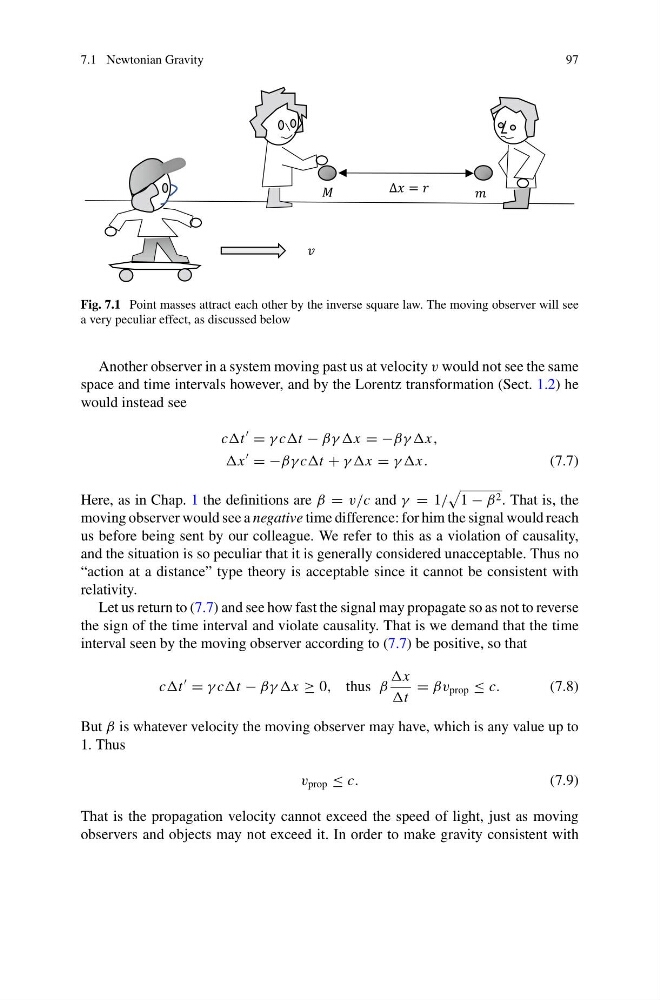
Fig. 7.1 Point masses attract each other by the inverse square law. The moving observer will see
a very peculiar effect, as discussed below
Another observer in a system moving past us at velocity v would not see the same
space and time intervals however, and by the Lorentz transformation (Sect. 1.2) he
would instead see
c
= γ c − βγ γx = −βγ x,
= −βγ c + γ γx = γ γx.
(7.7)
Here, as in Chap. 1 the definitions are β = v/c and γ = 1/
1 − β 2 . That is, the
moving observer would see a negative time difference: for him the signal would reach
us before being sent by our colleague. We refer to this as a violation of causality,
and the situation is so peculiar that it is generally considered unacceptable. Thus no
“action at a distance” type theory is acceptable since it cannot be consistent with
relativity.
Let us return to (7.7) and see how fast the signal may propagate so as not to reverse
the sign of the time interval and violate causality. That is we demand that the time
interval seen by the moving observer according to (7.7) be positive, so that
c
= γ c − βγ γx ≥ 0, thus β
t
= βv prop ≤ c.
(7.8)
But β is whatever velocity the moving observer may have, which is any value up to
1. Thus
v prop ≤ c.
(7.9)
That is the propagation velocity cannot exceed the speed of light, just as moving
observers and objects may not exceed it. In order to make gravity consistent with
97
Fig. 7.1 Point masses attract each other by the inverse square law. The moving observer will see
a very peculiar effect, as discussed below
Another observer in a system moving past us at velocity v would not see the same
space and time intervals however, and by the Lorentz transformation (Sect. 1.2) he
would instead see
c
= γ c − βγ γx = −βγ x,
= −βγ c + γ γx = γ γx.
(7.7)
Here, as in Chap. 1 the definitions are β = v/c and γ = 1/
1 − β 2 . That is, the
moving observer would see a negative time difference: for him the signal would reach
us before being sent by our colleague. We refer to this as a violation of causality,
and the situation is so peculiar that it is generally considered unacceptable. Thus no
“action at a distance” type theory is acceptable since it cannot be consistent with
relativity.
Let us return to (7.7) and see how fast the signal may propagate so as not to reverse
the sign of the time interval and violate causality. That is we demand that the time
interval seen by the moving observer according to (7.7) be positive, so that
c
= γ c − βγ γx ≥ 0, thus β
t
= βv prop ≤ c.
(7.8)
But β is whatever velocity the moving observer may have, which is any value up to
1. Thus
v prop ≤ c.
(7.9)
That is the propagation velocity cannot exceed the speed of light, just as moving
observers and objects may not exceed it. In order to make gravity consistent with