

67
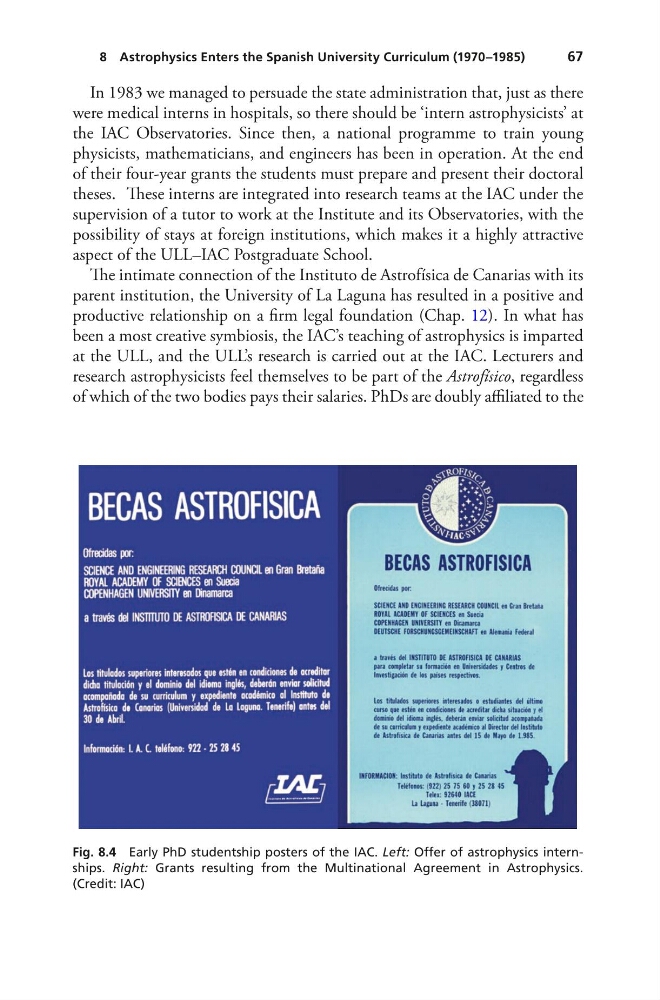
In 1983 we managed to persuade the state administration that, just as there
were medical interns in hospitals, so there should be ‘intern astrophysicists’ at
the IAC Observatories. Since then, a national programme to train young
physicists, mathematicians, and engineers has been in operation. At the end
of their four-year grants the students must prepare and present their doctoral
theses. These interns are integrated into research teams at the IAC under the
supervision of a tutor to work at the Institute and its Observatories, with the
possibility of stays at foreign institutions, which makes it a highly attractive
aspect of the ULL–IAC Postgraduate School.
The intimate connection of the Instituto de Astrofísica de Canarias with its
parent institution, the University of La Laguna has resulted in a positive and
productive relationship on a firm legal foundation (Chap. 12). In what has
been a most creative symbiosis, the IAC’s teaching of astrophysics is imparted
at the ULL, and the ULL’s research is carried out at the IAC. Lecturers and
research astrophysicists feel themselves to be part of the Astrofísico, regardless
of which of the two bodies pays their salaries. PhDs are doubly affiliated to the
Fig. 8.4 Early PhD studentship posters of the IAC. Left: Offer of astrophysics internships. Right: Grants resulting from the Multinational Agreement in Astrophysics.
(Credit: IAC)
8 Astrophysics Enters the Spanish University Curriculum (1970–1985)
In 1983 we managed to persuade the state administration that, just as there
were medical interns in hospitals, so there should be ‘intern astrophysicists’ at
the IAC Observatories. Since then, a national programme to train young
physicists, mathematicians, and engineers has been in operation. At the end
of their four-year grants the students must prepare and present their doctoral
theses. These interns are integrated into research teams at the IAC under the
supervision of a tutor to work at the Institute and its Observatories, with the
possibility of stays at foreign institutions, which makes it a highly attractive
aspect of the ULL–IAC Postgraduate School.
The intimate connection of the Instituto de Astrofísica de Canarias with its
parent institution, the University of La Laguna has resulted in a positive and
productive relationship on a firm legal foundation (Chap. 12). In what has
been a most creative symbiosis, the IAC’s teaching of astrophysics is imparted
at the ULL, and the ULL’s research is carried out at the IAC. Lecturers and
research astrophysicists feel themselves to be part of the Astrofísico, regardless
of which of the two bodies pays their salaries. PhDs are doubly affiliated to the
Fig. 8.4 Early PhD studentship posters of the IAC. Left: Offer of astrophysics internships. Right: Grants resulting from the Multinational Agreement in Astrophysics.
(Credit: IAC)
8 Astrophysics Enters the Spanish University Curriculum (1970–1985)