

27
Mascart, using mules to carry his telescopes, ascended Guajara and set up
camp on the same site used by Piazzi Smyth in the previous century.
Mascart was a celebrity in the Paris of that epoch. He reported his voyage
to Tenerife in stages in such newspapers as Le Figaro, Revue Générale des
Sciences, and Nature. He also wrote for the local newspapers, including
Nivaria, El País, and Diario de Tenerife. He even ended up being portrayed as
an eccentric savant in the form of the astronomer Scarmat (an anagram of
‘Mascart’) in a popular comic of the time, L’idée fixe du savant Cosinus (1899).
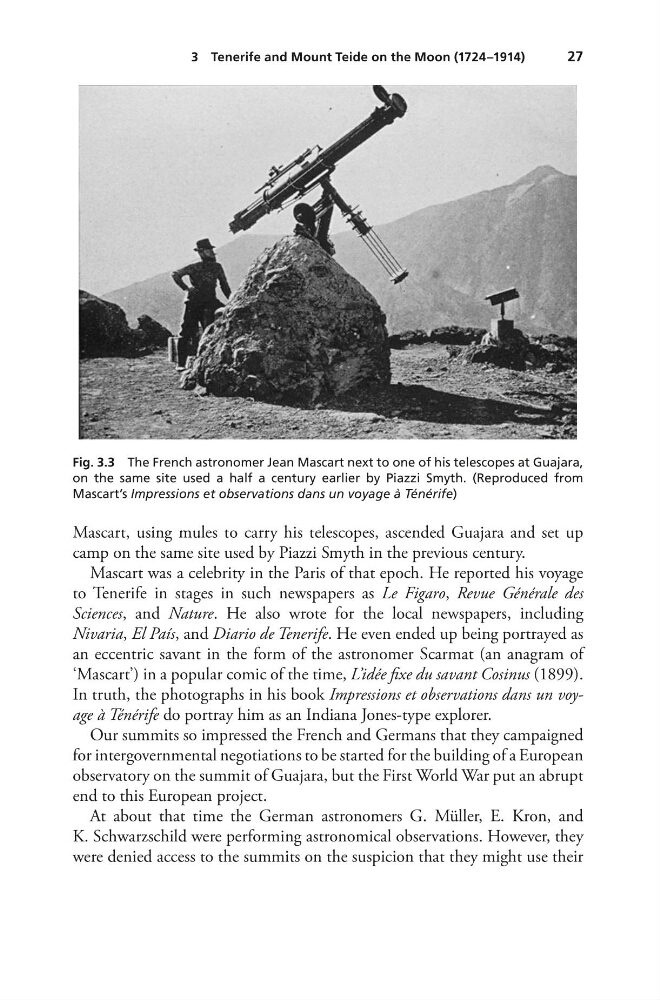
In truth, the photographs in his book Impressions et observations dans un voyage à Ténérife do portray him as an Indiana Jones-type explorer.
Our summits so impressed the French and Germans that they campaigned
for intergovernmental negotiations to be started for the building of a European
observatory on the summit of Guajara, but the First World War put an abrupt
end to this European project.
At about that time the German astronomers G. Müller, E. Kron, and
K. Schwarzschild were performing astronomical observations. However, they
were denied access to the summits on the suspicion that they might use their
Fig. 3.3 The French astronomer Jean Mascart next to one of his telescopes at Guajara,
on the same site used a half a century earlier by Piazzi Smyth. (Reproduced from
Mascart’s Impressions et observations dans un voyage à Ténérife)
3 Tenerife and Mount Teide on the Moon (1724–1914)
Mascart, using mules to carry his telescopes, ascended Guajara and set up
camp on the same site used by Piazzi Smyth in the previous century.
Mascart was a celebrity in the Paris of that epoch. He reported his voyage
to Tenerife in stages in such newspapers as Le Figaro, Revue Générale des
Sciences, and Nature. He also wrote for the local newspapers, including
Nivaria, El País, and Diario de Tenerife. He even ended up being portrayed as
an eccentric savant in the form of the astronomer Scarmat (an anagram of
‘Mascart’) in a popular comic of the time, L’idée fixe du savant Cosinus (1899).
In truth, the photographs in his book Impressions et observations dans un voyage à Ténérife do portray him as an Indiana Jones-type explorer.
Our summits so impressed the French and Germans that they campaigned
for intergovernmental negotiations to be started for the building of a European
observatory on the summit of Guajara, but the First World War put an abrupt
end to this European project.
At about that time the German astronomers G. Müller, E. Kron, and
K. Schwarzschild were performing astronomical observations. However, they
were denied access to the summits on the suspicion that they might use their
Fig. 3.3 The French astronomer Jean Mascart next to one of his telescopes at Guajara,
on the same site used a half a century earlier by Piazzi Smyth. (Reproduced from
Mascart’s Impressions et observations dans un voyage à Ténérife)
3 Tenerife and Mount Teide on the Moon (1724–1914)