

222
work is now being continued in La Palma with the observing teams currently
exploiting the full scientific potential of the telescope in the most precarious
economic circumstances. Every time I think of all this I want to go and congratulate these people all over again.
What fine people we have! Thanks to them, Spain has been able to build
this marvellous instrument and enter the world of Big Science through the
front door. For several years to come the GTC will remain the biggest and
most advanced optical–infrared telescope in the world.
On the night of 11 July 2007, the telescope officially saw ‘first light’, as a
telescope’s baptism by light is termed; that is, when it was launched into the
sea of photons without sinking—in other words, when it is rendered capable
of seeing the stars. First light occurs when the beam of photons collected by
the telescope’s objective is successfully concentrated in the focal plane to form
an image of a celestial body. It was a decisive and exciting moment.
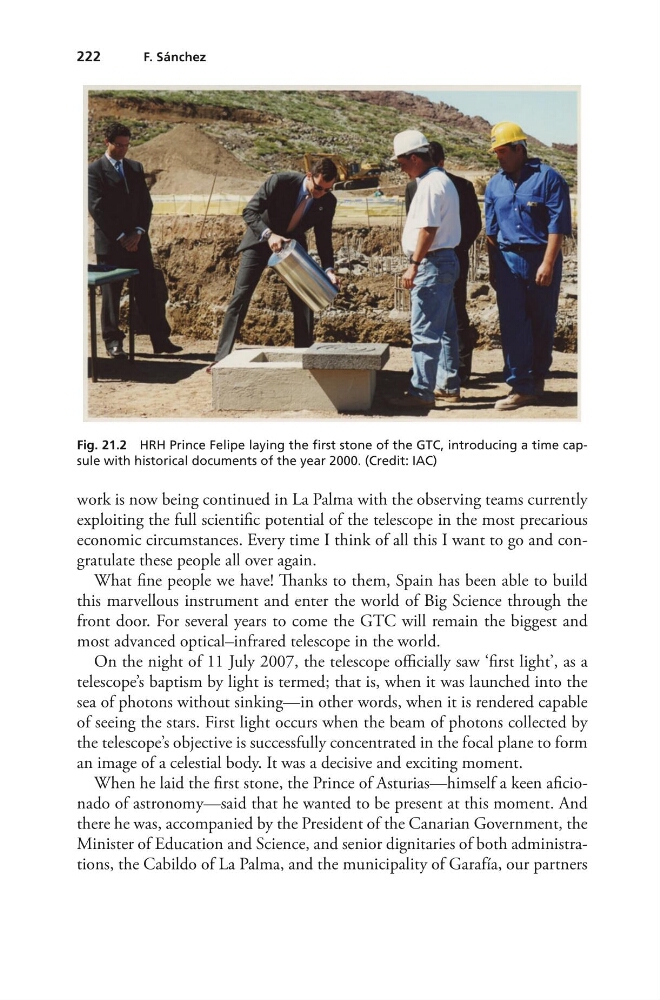
When he laid the first stone, the Prince of Asturias—himself a keen aficionado of astronomy—said that he wanted to be present at this moment. And
there he was, accompanied by the President of the Canarian Government, the
Minister of Education and Science, and senior dignitaries of both administrations, the Cabildo of La Palma, and the municipality of Garafía, our partners
Fig. 21.2 HRH Prince Felipe laying the first stone of the GTC, introducing a time capsule with historical documents of the year 2000. (Credit: IAC)
F. Sánchez
work is now being continued in La Palma with the observing teams currently
exploiting the full scientific potential of the telescope in the most precarious
economic circumstances. Every time I think of all this I want to go and congratulate these people all over again.
What fine people we have! Thanks to them, Spain has been able to build
this marvellous instrument and enter the world of Big Science through the
front door. For several years to come the GTC will remain the biggest and
most advanced optical–infrared telescope in the world.
On the night of 11 July 2007, the telescope officially saw ‘first light’, as a
telescope’s baptism by light is termed; that is, when it was launched into the
sea of photons without sinking—in other words, when it is rendered capable
of seeing the stars. First light occurs when the beam of photons collected by
the telescope’s objective is successfully concentrated in the focal plane to form
an image of a celestial body. It was a decisive and exciting moment.
When he laid the first stone, the Prince of Asturias—himself a keen aficionado of astronomy—said that he wanted to be present at this moment. And
there he was, accompanied by the President of the Canarian Government, the
Minister of Education and Science, and senior dignitaries of both administrations, the Cabildo of La Palma, and the municipality of Garafía, our partners
Fig. 21.2 HRH Prince Felipe laying the first stone of the GTC, introducing a time capsule with historical documents of the year 2000. (Credit: IAC)
F. Sánchez