

181
Granada had done his thesis and been working on these topics. It was high
time to leave the basement and get into space.
It was easy to persuade my friend Eduardo and the Instituto de Astrofísica
de Andalucía (IAA) to embark jointly with the IAC on a research project that
included the construction of simple payloads. These would be placed in the
empty nosecones of the rockets launched by INTA. The funding required
could be obtained from CONIE.
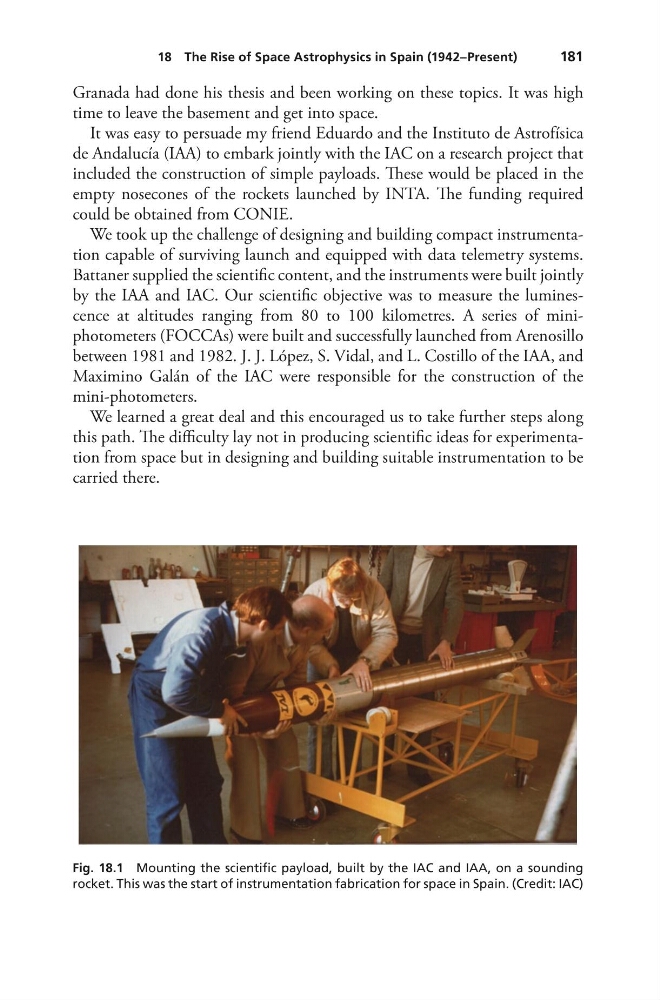
We took up the challenge of designing and building compact instrumentation capable of surviving launch and equipped with data telemetry systems.
Battaner supplied the scientific content, and the instruments were built jointly
by the IAA and IAC. Our scientific objective was to measure the luminescence at altitudes ranging from 80 to 100 kilometres. A series of miniphotometers (FOCCAs) were built and successfully launched from Arenosillo
between 1981 and 1982. J. J. López, S. Vidal, and L. Costillo of the IAA, and
Maximino Galán of the IAC were responsible for the construction of the
mini-photometers.
We learned a great deal and this encouraged us to take further steps along
this path. The difficulty lay not in producing scientific ideas for experimentation from space but in designing and building suitable instrumentation to be
carried there.
Fig. 18.1 Mounting the scientific payload, built by the IAC and IAA, on a sounding
rocket. This was the start of instrumentation fabrication for space in Spain. (Credit: IAC)
18 The Rise of Space Astrophysics in Spain (1942–Present)
Granada had done his thesis and been working on these topics. It was high
time to leave the basement and get into space.
It was easy to persuade my friend Eduardo and the Instituto de Astrofísica
de Andalucía (IAA) to embark jointly with the IAC on a research project that
included the construction of simple payloads. These would be placed in the
empty nosecones of the rockets launched by INTA. The funding required
could be obtained from CONIE.
We took up the challenge of designing and building compact instrumentation capable of surviving launch and equipped with data telemetry systems.
Battaner supplied the scientific content, and the instruments were built jointly
by the IAA and IAC. Our scientific objective was to measure the luminescence at altitudes ranging from 80 to 100 kilometres. A series of miniphotometers (FOCCAs) were built and successfully launched from Arenosillo
between 1981 and 1982. J. J. López, S. Vidal, and L. Costillo of the IAA, and
Maximino Galán of the IAC were responsible for the construction of the
mini-photometers.
We learned a great deal and this encouraged us to take further steps along
this path. The difficulty lay not in producing scientific ideas for experimentation from space but in designing and building suitable instrumentation to be
carried there.
Fig. 18.1 Mounting the scientific payload, built by the IAC and IAA, on a sounding
rocket. This was the start of instrumentation fabrication for space in Spain. (Credit: IAC)
18 The Rise of Space Astrophysics in Spain (1942–Present)