

132
It was impossible to reach an agreement among all the municipalities on
the island. I made a peregrination through all the towns in order to try and
convince municipal authorities of the advantages that astronomy would bring
for the island. To achieve this, I insisted, it was vital to maintain the clarity
and darkness of the sky, a task that was wholly compatible with other local
aspirations through intelligent lighting. But there was no way. In truth, I
could understand their point of view. No so long before there had been neither illumination nor public electricity. They knew how large and prosperous
cities throughout the world glowed; and now, to ascend a gorge and be able to
contemplate from afar how their own towns similarly glowed was for them
the greatest sign of modernity and progress.
We concluded that the only solution was a parliamentary law in
which protective measures were accompanied by large subsidies for public
lighting in accordance with the measures laid down. In the early eighties we
began a new battle to persuade the politicians of all parties to support the law.
This very balanced law was backed by the International Scientific Committee
of the Canarian Observatories, the International Astronomical Union, and
the International Commission on Illumination.
I refrain from wearying the reader with a detailed account of the stony path
trodden. What is important is that we finally reached our goal in 1988, and
the Sky Law is still a point of reference worldwide for the protection of the
night sky. It has served as a model in Spain and other countries for similar
protective measures. It is also the basis for night-sky protective initiatives and
recognition of their cultural and touristic value by the Starlight Foundation
(Chap. 23).
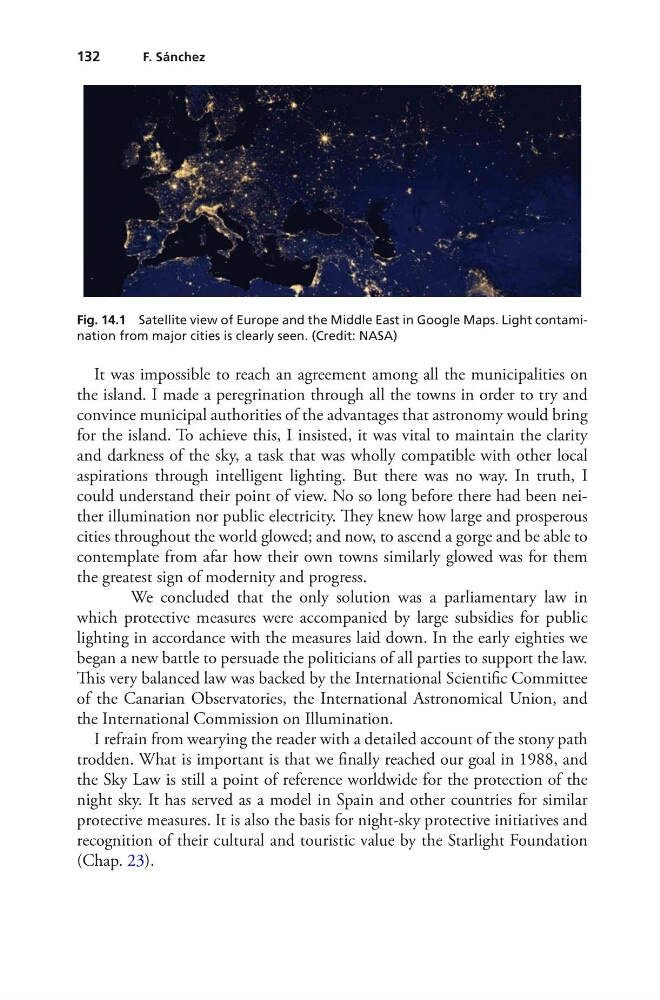
Fig. 14.1 Satellite view of Europe and the Middle East in Google Maps. Light contamination from major cities is clearly seen. (Credit: NASA)
F. Sánchez
It was impossible to reach an agreement among all the municipalities on
the island. I made a peregrination through all the towns in order to try and
convince municipal authorities of the advantages that astronomy would bring
for the island. To achieve this, I insisted, it was vital to maintain the clarity
and darkness of the sky, a task that was wholly compatible with other local
aspirations through intelligent lighting. But there was no way. In truth, I
could understand their point of view. No so long before there had been neither illumination nor public electricity. They knew how large and prosperous
cities throughout the world glowed; and now, to ascend a gorge and be able to
contemplate from afar how their own towns similarly glowed was for them
the greatest sign of modernity and progress.
We concluded that the only solution was a parliamentary law in
which protective measures were accompanied by large subsidies for public
lighting in accordance with the measures laid down. In the early eighties we
began a new battle to persuade the politicians of all parties to support the law.
This very balanced law was backed by the International Scientific Committee
of the Canarian Observatories, the International Astronomical Union, and
the International Commission on Illumination.
I refrain from wearying the reader with a detailed account of the stony path
trodden. What is important is that we finally reached our goal in 1988, and
the Sky Law is still a point of reference worldwide for the protection of the
night sky. It has served as a model in Spain and other countries for similar
protective measures. It is also the basis for night-sky protective initiatives and
recognition of their cultural and touristic value by the Starlight Foundation
(Chap. 23).
Fig. 14.1 Satellite view of Europe and the Middle East in Google Maps. Light contamination from major cities is clearly seen. (Credit: NASA)
F. Sánchez