

3 The Measurements of the Oxygen Reduction Reaction
81
Q H −adsor ption =
E h
E L
(I − I DL )d E
v
=
0.394
0.037 (I + 8.869 × 10
−5
)d E
0.05
=1.52 × 10
−3 C
(3.83)
ECSA Pt (m
2 g
- 1
Pt ) =
Q H −adsor ption (C)
210(μC cm
- 2
Pt )L Pt (mg Pt cm - 2 )A g (cm 2 )
× 10
5
=
152 × 10
−5
210 × 11.9 × 10 −3 × 10
5
=61
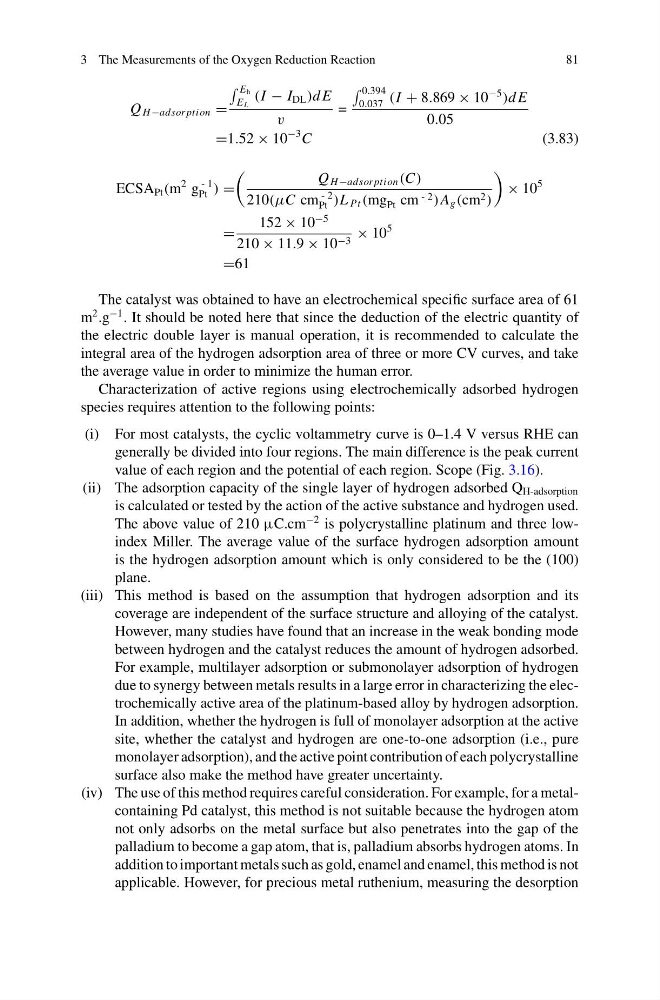
The catalyst was obtained to have an electrochemical specific surface area of 61
m
2 .g
−1 . It should be noted here that since the deduction of the electric quantity of
the electric double layer is manual operation, it is recommended to calculate the
integral area of the hydrogen adsorption area of three or more CV curves, and take
the average value in order to minimize the human error.
Characterization of active regions using electrochemically adsorbed hydrogen
species requires attention to the following points:
(i) For most catalysts, the cyclic voltammetry curve is 0–1.4 V versus RHE can
generally be divided into four regions. The main difference is the peak current
value of each region and the potential of each region. Scope (Fig. 3.16).
(ii) The adsorption capacity of the single layer of hydrogen adsorbed Q H-adsorption
is calculated or tested by the action of the active substance and hydrogen used.
The above value of 210 μC.cm
−2 is polycrystalline platinum and three lowindex Miller. The average value of the surface hydrogen adsorption amount
is the hydrogen adsorption amount which is only considered to be the (100)
plane.
(iii) This method is based on the assumption that hydrogen adsorption and its
coverage are independent of the surface structure and alloying of the catalyst.
However, many studies have found that an increase in the weak bonding mode
between hydrogen and the catalyst reduces the amount of hydrogen adsorbed.
For example, multilayer adsorption or submonolayer adsorption of hydrogen
due to synergy between metals results in a large error in characterizing the electrochemically active area of the platinum-based alloy by hydrogen adsorption.
In addition, whether the hydrogen is full of monolayer adsorption at the active
site, whether the catalyst and hydrogen are one-to-one adsorption (i.e., pure
monolayer adsorption), and the active point contribution of each polycrystalline
surface also make the method have greater uncertainty.
(iv) The use of this method requires careful consideration. For example, for a metalcontaining Pd catalyst, this method is not suitable because the hydrogen atom
not only adsorbs on the metal surface but also penetrates into the gap of the
palladium to become a gap atom, that is, palladium absorbs hydrogen atoms. In
addition to important metals such as gold, enamel and enamel, this method is not
applicable. However, for precious metal ruthenium, measuring the desorption
81
Q H −adsor ption =
E h
E L
(I − I DL )d E
v
=
0.394
0.037 (I + 8.869 × 10
−5
)d E
0.05
=1.52 × 10
−3 C
(3.83)
ECSA Pt (m
2 g
- 1
Pt ) =
Q H −adsor ption (C)
210(μC cm
- 2
Pt )L Pt (mg Pt cm - 2 )A g (cm 2 )
× 10
5
=
152 × 10
−5
210 × 11.9 × 10 −3 × 10
5
=61
The catalyst was obtained to have an electrochemical specific surface area of 61
m
2 .g
−1 . It should be noted here that since the deduction of the electric quantity of
the electric double layer is manual operation, it is recommended to calculate the
integral area of the hydrogen adsorption area of three or more CV curves, and take
the average value in order to minimize the human error.
Characterization of active regions using electrochemically adsorbed hydrogen
species requires attention to the following points:
(i) For most catalysts, the cyclic voltammetry curve is 0–1.4 V versus RHE can
generally be divided into four regions. The main difference is the peak current
value of each region and the potential of each region. Scope (Fig. 3.16).
(ii) The adsorption capacity of the single layer of hydrogen adsorbed Q H-adsorption
is calculated or tested by the action of the active substance and hydrogen used.
The above value of 210 μC.cm
−2 is polycrystalline platinum and three lowindex Miller. The average value of the surface hydrogen adsorption amount
is the hydrogen adsorption amount which is only considered to be the (100)
plane.
(iii) This method is based on the assumption that hydrogen adsorption and its
coverage are independent of the surface structure and alloying of the catalyst.
However, many studies have found that an increase in the weak bonding mode
between hydrogen and the catalyst reduces the amount of hydrogen adsorbed.
For example, multilayer adsorption or submonolayer adsorption of hydrogen
due to synergy between metals results in a large error in characterizing the electrochemically active area of the platinum-based alloy by hydrogen adsorption.
In addition, whether the hydrogen is full of monolayer adsorption at the active
site, whether the catalyst and hydrogen are one-to-one adsorption (i.e., pure
monolayer adsorption), and the active point contribution of each polycrystalline
surface also make the method have greater uncertainty.
(iv) The use of this method requires careful consideration. For example, for a metalcontaining Pd catalyst, this method is not suitable because the hydrogen atom
not only adsorbs on the metal surface but also penetrates into the gap of the
palladium to become a gap atom, that is, palladium absorbs hydrogen atoms. In
addition to important metals such as gold, enamel and enamel, this method is not
applicable. However, for precious metal ruthenium, measuring the desorption