

3 The Measurements of the Oxygen Reduction Reaction
43
density (mathematical simulation). Calculations and experiments have shown that
the reduction in film thickness is beneficial to simplify the correction of the kinetic
current).
Based on previous research results, in 2001, Paulus, Schmidt and Gasteiger
proposed the film rotation (ring) disk electrode method [TF–R(R)DE]. They prepared
a 20 wt % Pt/Vulcan XC 72 catalyst with Nafion as a catalyst slurry and applied it
to a polished glassy carbon electrode with a loading of 28 μg Pt cm
−2 . According to
the mass of Nafion and electrode area estimates, the Nafion film thickness is about
0.1–0.2 μm. Although the film thickness is submicron, it is enough to allow the
catalyst particles to adhere to the surface of the glassy carbon substrate. The optical
microscope shows the catalyst/Nafion layer. The total thickness is approximately
1 μm. The cyclic voltammogram of this electrode is similar to the polycrystalline
Pt electrode. In addition, if the error of the dispersion of the high-resolution lens
is calculated and the error of the active area is calculated by the electrochemical
method, the surface platinum concentration calculated by the hydrogen underpotential deposition method is n Pt,s = 4.2 × 10
–8 mol Pt cm
−2 , this is very close to n Pt,s =
3.7 × 10
–8 mol Pt cm
−2 calculated from the dispersion of platinum and the dispersion
of the grain size of the platinum particles, which means that the utilization rate of
the Pt/Vulcan catalyst is basically 100%. [10] In addition, the hydrogen desorption
and desorption of different platinum-loaded catalysts are linear with the platinum
loading, which also demonstrates the effectiveness of the method. The repeatability
of this method was also confirmed by comparing the amount of electricity in the
hydrogen desorption zone of the electrode with a platinum loading of 7 μg Pt cm
–2
and 14 μg Pt cm
−2 .
Further discussing the mass transfer effect of the film thickness, Lawson D. R et al.
added the influence of the film impedance to the Koutecký-Levich equation, fully
considering the influence of the mass transfer diffusion resistance on the experiment.
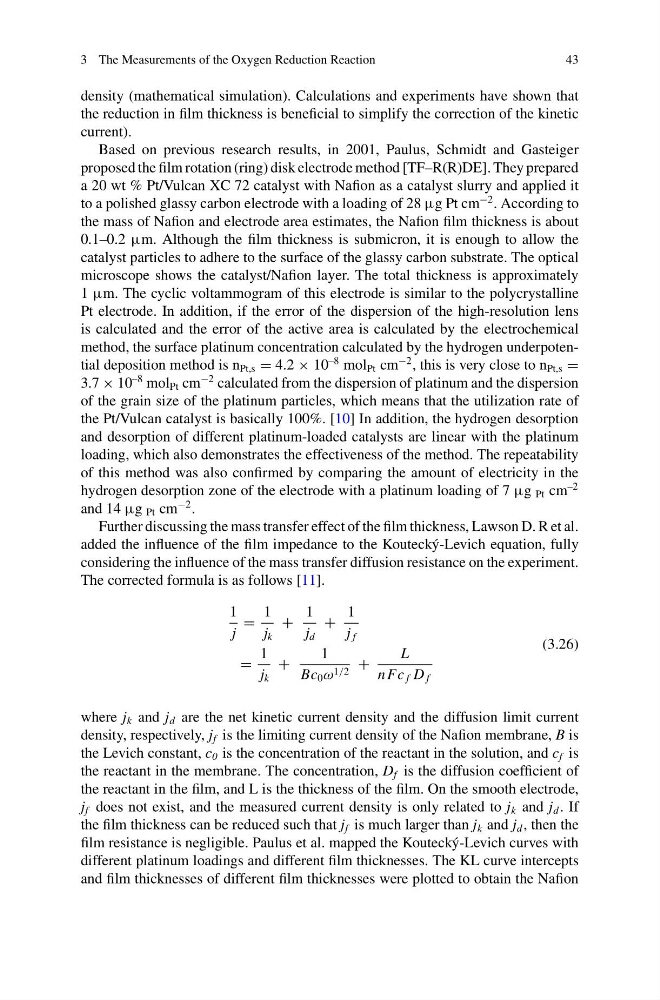
The corrected formula is as follows [11].
1
j
=
1
j k
+
1
j d
+
1
j f
=
1
j k
+
1
Bc 0 ω 1/2 +
L
n Fc f D f
(3.26)
where j k and j d are the net kinetic current density and the diffusion limit current
density, respectively, j f is the limiting current density of the Nafion membrane, B is
the Levich constant, c 0 is the concentration of the reactant in the solution, and c f is
the reactant in the membrane. The concentration, D f is the diffusion coefficient of
the reactant in the film, and L is the thickness of the film. On the smooth electrode,
j f does not exist, and the measured current density is only related to j k and j d . If
the film thickness can be reduced such that j f is much larger than j k and j d , then the
film resistance is negligible. Paulus et al. mapped the Koutecký-Levich curves with
different platinum loadings and different film thicknesses. The KL curve intercepts
and film thicknesses of different film thicknesses were plotted to obtain the Nafion
43
density (mathematical simulation). Calculations and experiments have shown that
the reduction in film thickness is beneficial to simplify the correction of the kinetic
current).
Based on previous research results, in 2001, Paulus, Schmidt and Gasteiger
proposed the film rotation (ring) disk electrode method [TF–R(R)DE]. They prepared
a 20 wt % Pt/Vulcan XC 72 catalyst with Nafion as a catalyst slurry and applied it
to a polished glassy carbon electrode with a loading of 28 μg Pt cm
−2 . According to
the mass of Nafion and electrode area estimates, the Nafion film thickness is about
0.1–0.2 μm. Although the film thickness is submicron, it is enough to allow the
catalyst particles to adhere to the surface of the glassy carbon substrate. The optical
microscope shows the catalyst/Nafion layer. The total thickness is approximately
1 μm. The cyclic voltammogram of this electrode is similar to the polycrystalline
Pt electrode. In addition, if the error of the dispersion of the high-resolution lens
is calculated and the error of the active area is calculated by the electrochemical
method, the surface platinum concentration calculated by the hydrogen underpotential deposition method is n Pt,s = 4.2 × 10
–8 mol Pt cm
−2 , this is very close to n Pt,s =
3.7 × 10
–8 mol Pt cm
−2 calculated from the dispersion of platinum and the dispersion
of the grain size of the platinum particles, which means that the utilization rate of
the Pt/Vulcan catalyst is basically 100%. [10] In addition, the hydrogen desorption
and desorption of different platinum-loaded catalysts are linear with the platinum
loading, which also demonstrates the effectiveness of the method. The repeatability
of this method was also confirmed by comparing the amount of electricity in the
hydrogen desorption zone of the electrode with a platinum loading of 7 μg Pt cm
–2
and 14 μg Pt cm
−2 .
Further discussing the mass transfer effect of the film thickness, Lawson D. R et al.
added the influence of the film impedance to the Koutecký-Levich equation, fully
considering the influence of the mass transfer diffusion resistance on the experiment.
The corrected formula is as follows [11].
1
j
=
1
j k
+
1
j d
+
1
j f
=
1
j k
+
1
Bc 0 ω 1/2 +
L
n Fc f D f
(3.26)
where j k and j d are the net kinetic current density and the diffusion limit current
density, respectively, j f is the limiting current density of the Nafion membrane, B is
the Levich constant, c 0 is the concentration of the reactant in the solution, and c f is
the reactant in the membrane. The concentration, D f is the diffusion coefficient of
the reactant in the film, and L is the thickness of the film. On the smooth electrode,
j f does not exist, and the measured current density is only related to j k and j d . If
the film thickness can be reduced such that j f is much larger than j k and j d , then the
film resistance is negligible. Paulus et al. mapped the Koutecký-Levich curves with
different platinum loadings and different film thicknesses. The KL curve intercepts
and film thicknesses of different film thicknesses were plotted to obtain the Nafion