

40
C. Juhong et al.
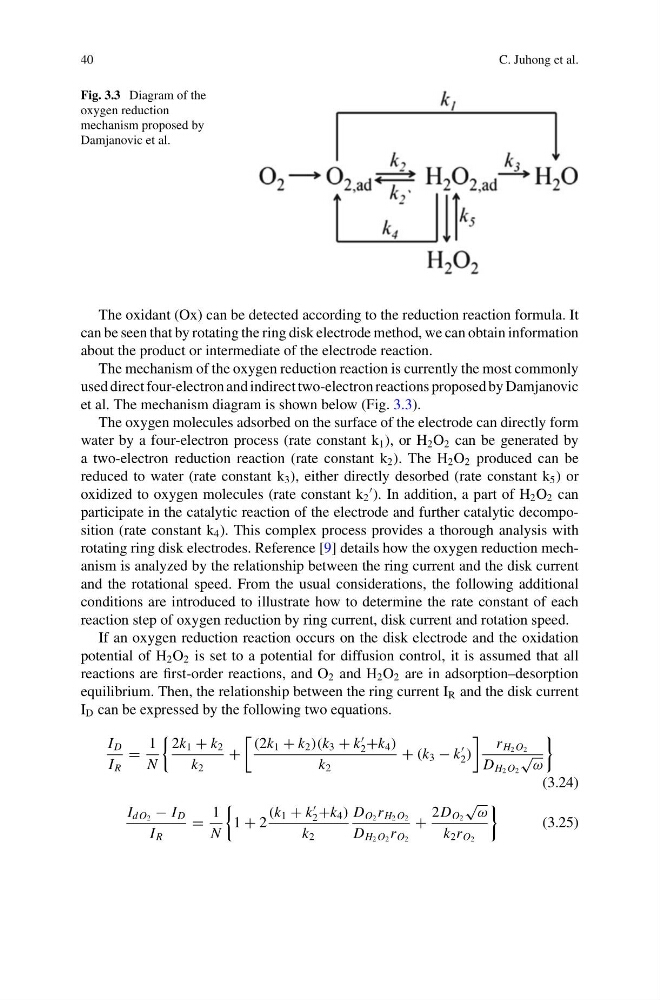
Fig. 3.3 Diagram of the
oxygen reduction
mechanism proposed by
Damjanovic et al.
The oxidant (Ox) can be detected according to the reduction reaction formula. It
can be seen that by rotating the ring disk electrode method, we can obtain information
about the product or intermediate of the electrode reaction.
The mechanism of the oxygen reduction reaction is currently the most commonly
used direct four-electron and indirect two-electron reactions proposed by Damjanovic
et al. The mechanism diagram is shown below (Fig. 3.3).
The oxygen molecules adsorbed on the surface of the electrode can directly form
water by a four-electron process (rate constant k 1 ), or H 2 O 2 can be generated by
a two-electron reduction reaction (rate constant k 2 ). The H 2 O 2 produced can be
reduced to water (rate constant k 3 ), either directly desorbed (rate constant k 5 ) or
oxidized to oxygen molecules (rate constant k 2
). In addition, a part of H 2 O 2 can
participate in the catalytic reaction of the electrode and further catalytic decomposition (rate constant k 4 ). This complex process provides a thorough analysis with
rotating ring disk electrodes. Reference [9] details how the oxygen reduction mechanism is analyzed by the relationship between the ring current and the disk current
and the rotational speed. From the usual considerations, the following additional
conditions are introduced to illustrate how to determine the rate constant of each
reaction step of oxygen reduction by ring current, disk current and rotation speed.
If an oxygen reduction reaction occurs on the disk electrode and the oxidation
potential of H 2 O 2 is set to a potential for diffusion control, it is assumed that all
reactions are first-order reactions, and O 2 and H 2 O 2 are in adsorption–desorption
equilibrium. Then, the relationship between the ring current I R and the disk current
I D can be expressed by the following two equations.
I D
I R
=
1
N
2k 1 + k 2
k 2
+
(2k 1 + k 2 )(k 3 + k
2 +k 4 )
k 2
+ (k 3 − k
2 )
r H 2 O 2
D H 2 O 2
√
ω
(3.24)
I d O 2 − I D
I R
=
1
N
1 + 2
(k 1 + k
2 +k 4 )
k 2
D O 2 r H 2 O 2
D H 2 O 2 r O 2
+
2D O 2
√ ω
k 2 r O 2
(3.25)
C. Juhong et al.
Fig. 3.3 Diagram of the
oxygen reduction
mechanism proposed by
Damjanovic et al.
The oxidant (Ox) can be detected according to the reduction reaction formula. It
can be seen that by rotating the ring disk electrode method, we can obtain information
about the product or intermediate of the electrode reaction.
The mechanism of the oxygen reduction reaction is currently the most commonly
used direct four-electron and indirect two-electron reactions proposed by Damjanovic
et al. The mechanism diagram is shown below (Fig. 3.3).
The oxygen molecules adsorbed on the surface of the electrode can directly form
water by a four-electron process (rate constant k 1 ), or H 2 O 2 can be generated by
a two-electron reduction reaction (rate constant k 2 ). The H 2 O 2 produced can be
reduced to water (rate constant k 3 ), either directly desorbed (rate constant k 5 ) or
oxidized to oxygen molecules (rate constant k 2
). In addition, a part of H 2 O 2 can
participate in the catalytic reaction of the electrode and further catalytic decomposition (rate constant k 4 ). This complex process provides a thorough analysis with
rotating ring disk electrodes. Reference [9] details how the oxygen reduction mechanism is analyzed by the relationship between the ring current and the disk current
and the rotational speed. From the usual considerations, the following additional
conditions are introduced to illustrate how to determine the rate constant of each
reaction step of oxygen reduction by ring current, disk current and rotation speed.
If an oxygen reduction reaction occurs on the disk electrode and the oxidation
potential of H 2 O 2 is set to a potential for diffusion control, it is assumed that all
reactions are first-order reactions, and O 2 and H 2 O 2 are in adsorption–desorption
equilibrium. Then, the relationship between the ring current I R and the disk current
I D can be expressed by the following two equations.
I D
I R
=
1
N
2k 1 + k 2
k 2
+
(2k 1 + k 2 )(k 3 + k
2 +k 4 )
k 2
+ (k 3 − k
2 )
r H 2 O 2
D H 2 O 2
√
ω
(3.24)
I d O 2 − I D
I R
=
1
N
1 + 2
(k 1 + k
2 +k 4 )
k 2
D O 2 r H 2 O 2
D H 2 O 2 r O 2
+
2D O 2
√ ω
k 2 r O 2
(3.25)