

38
C. Juhong et al.
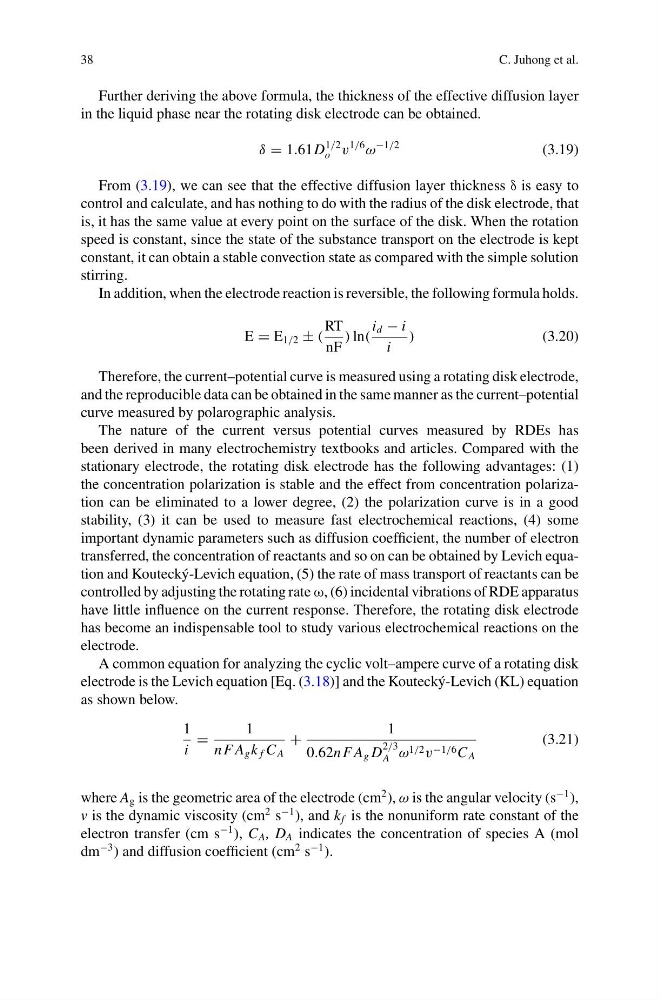
Further deriving the above formula, the thickness of the effective diffusion layer
in the liquid phase near the rotating disk electrode can be obtained.
δ = 1.61D
1/2
o v
1/6
ω
−1/2
(3.19)
From (3.19), we can see that the effective diffusion layer thickness δ is easy to
control and calculate, and has nothing to do with the radius of the disk electrode, that
is, it has the same value at every point on the surface of the disk. When the rotation
speed is constant, since the state of the substance transport on the electrode is kept
constant, it can obtain a stable convection state as compared with the simple solution
stirring.
In addition, when the electrode reaction is reversible, the following formula holds.
E = E 1/2 ± (
RT
nF
) ln(
i d − i
i
)
(3.20)
Therefore, the current–potential curve is measured using a rotating disk electrode,
and the reproducible data can be obtained in the same manner as the current–potential
curve measured by polarographic analysis.
The nature of the current versus potential curves measured by RDEs has
been derived in many electrochemistry textbooks and articles. Compared with the
stationary electrode, the rotating disk electrode has the following advantages: (1)
the concentration polarization is stable and the effect from concentration polarization can be eliminated to a lower degree, (2) the polarization curve is in a good
stability, (3) it can be used to measure fast electrochemical reactions, (4) some
important dynamic parameters such as diffusion coefficient, the number of electron
transferred, the concentration of reactants and so on can be obtained by Levich equation and Koutecký-Levich equation, (5) the rate of mass transport of reactants can be
controlled by adjusting the rotating rate ω, (6) incidental vibrations of RDE apparatus
have little influence on the current response. Therefore, the rotating disk electrode
has become an indispensable tool to study various electrochemical reactions on the
electrode.
A common equation for analyzing the cyclic volt–ampere curve of a rotating disk
electrode is the Levich equation [Eq. (3.18)] and the Koutecký-Levich (KL) equation
as shown below.
1
i
=
1
n F A g k f C A
+
1
0.62n F A g D
2/3
A ω 1/2 v −1/6 C A
(3.21)
where A g is the geometric area of the electrode (cm
2 ), ω is the angular velocity (s
−1 ),
v is the dynamic viscosity (cm
2 s
−1 ), and k f is the nonuniform rate constant of the
electron transfer (cm s
−1 ), C A , D A indicates the concentration of species A (mol
dm
−3 ) and diffusion coefficient (cm
2 s
−1 ).
C. Juhong et al.
Further deriving the above formula, the thickness of the effective diffusion layer
in the liquid phase near the rotating disk electrode can be obtained.
δ = 1.61D
1/2
o v
1/6
ω
−1/2
(3.19)
From (3.19), we can see that the effective diffusion layer thickness δ is easy to
control and calculate, and has nothing to do with the radius of the disk electrode, that
is, it has the same value at every point on the surface of the disk. When the rotation
speed is constant, since the state of the substance transport on the electrode is kept
constant, it can obtain a stable convection state as compared with the simple solution
stirring.
In addition, when the electrode reaction is reversible, the following formula holds.
E = E 1/2 ± (
RT
nF
) ln(
i d − i
i
)
(3.20)
Therefore, the current–potential curve is measured using a rotating disk electrode,
and the reproducible data can be obtained in the same manner as the current–potential
curve measured by polarographic analysis.
The nature of the current versus potential curves measured by RDEs has
been derived in many electrochemistry textbooks and articles. Compared with the
stationary electrode, the rotating disk electrode has the following advantages: (1)
the concentration polarization is stable and the effect from concentration polarization can be eliminated to a lower degree, (2) the polarization curve is in a good
stability, (3) it can be used to measure fast electrochemical reactions, (4) some
important dynamic parameters such as diffusion coefficient, the number of electron
transferred, the concentration of reactants and so on can be obtained by Levich equation and Koutecký-Levich equation, (5) the rate of mass transport of reactants can be
controlled by adjusting the rotating rate ω, (6) incidental vibrations of RDE apparatus
have little influence on the current response. Therefore, the rotating disk electrode
has become an indispensable tool to study various electrochemical reactions on the
electrode.
A common equation for analyzing the cyclic volt–ampere curve of a rotating disk
electrode is the Levich equation [Eq. (3.18)] and the Koutecký-Levich (KL) equation
as shown below.
1
i
=
1
n F A g k f C A
+
1
0.62n F A g D
2/3
A ω 1/2 v −1/6 C A
(3.21)
where A g is the geometric area of the electrode (cm
2 ), ω is the angular velocity (s
−1 ),
v is the dynamic viscosity (cm
2 s
−1 ), and k f is the nonuniform rate constant of the
electron transfer (cm s
−1 ), C A , D A indicates the concentration of species A (mol
dm
−3 ) and diffusion coefficient (cm
2 s
−1 ).