

26
Z. Zhao and P. K. Shen
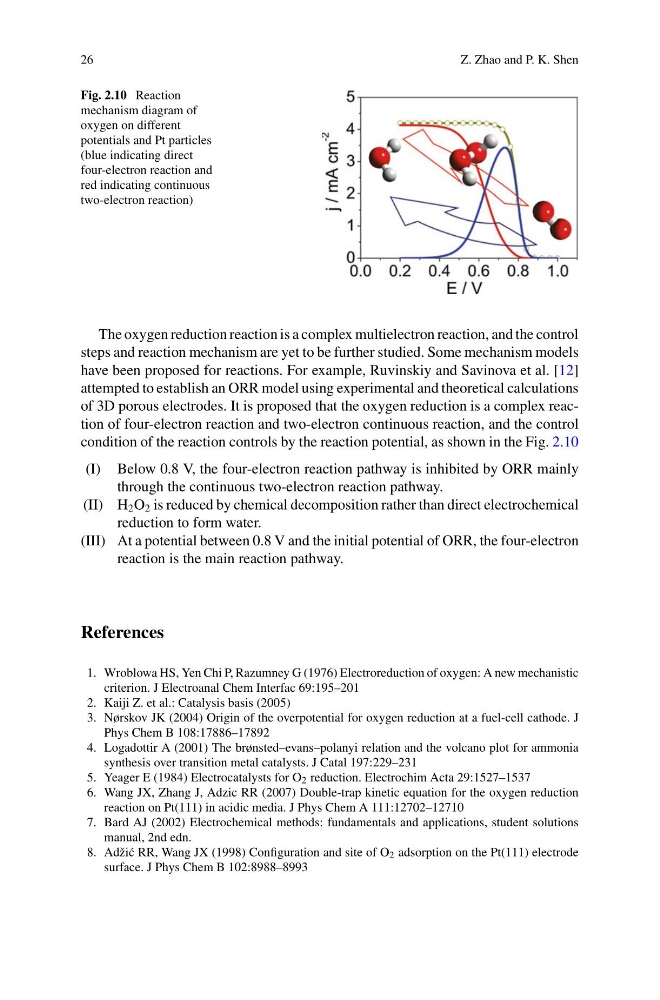
Fig. 2.10 Reaction
mechanism diagram of
oxygen on different
potentials and Pt particles
(blue indicating direct
four-electron reaction and
red indicating continuous
two-electron reaction)
The oxygen reduction reaction is a complex multielectron reaction, and the control
steps and reaction mechanism are yet to be further studied. Some mechanism models
have been proposed for reactions. For example, Ruvinskiy and Savinova et al. [12]
attempted to establish an ORR model using experimental and theoretical calculations
of 3D porous electrodes. It is proposed that the oxygen reduction is a complex reaction of four-electron reaction and two-electron continuous reaction, and the control
condition of the reaction controls by the reaction potential, as shown in the Fig. 2.10
(I) Below 0.8 V, the four-electron reaction pathway is inhibited by ORR mainly
through the continuous two-electron reaction pathway.
(II) H 2 O 2 is reduced by chemical decomposition rather than direct electrochemical
reduction to form water.
(III) At a potential between 0.8 V and the initial potential of ORR, the four-electron
reaction is the main reaction pathway.
References
1. Wroblowa HS, Yen Chi P, Razumney G (1976) Electroreduction of oxygen: A new mechanistic
criterion. J Electroanal Chem Interfac 69:195–201
2. Kaiji Z. et al.: Catalysis basis (2005)
3. Nørskov JK (2004) Origin of the overpotential for oxygen reduction at a fuel-cell cathode. J
Phys Chem B 108:17886–17892
4. Logadottir A (2001) The brønsted–evans–polanyi relation and the volcano plot for ammonia
synthesis over transition metal catalysts. J Catal 197:229–231
5. Yeager E (1984) Electrocatalysts for O 2 reduction. Electrochim Acta 29:1527–1537
6. Wang JX, Zhang J, Adzic RR (2007) Double-trap kinetic equation for the oxygen reduction
reaction on Pt(111) in acidic media. J Phys Chem A 111:12702–12710
7. Bard AJ (2002) Electrochemical methods: fundamentals and applications, student solutions
manual, 2nd edn.
8. Adži´ c RR, Wang JX (1998) Configuration and site of O 2 adsorption on the Pt(111) electrode
surface. J Phys Chem B 102:8988–8993
Z. Zhao and P. K. Shen
Fig. 2.10 Reaction
mechanism diagram of
oxygen on different
potentials and Pt particles
(blue indicating direct
four-electron reaction and
red indicating continuous
two-electron reaction)
The oxygen reduction reaction is a complex multielectron reaction, and the control
steps and reaction mechanism are yet to be further studied. Some mechanism models
have been proposed for reactions. For example, Ruvinskiy and Savinova et al. [12]
attempted to establish an ORR model using experimental and theoretical calculations
of 3D porous electrodes. It is proposed that the oxygen reduction is a complex reaction of four-electron reaction and two-electron continuous reaction, and the control
condition of the reaction controls by the reaction potential, as shown in the Fig. 2.10
(I) Below 0.8 V, the four-electron reaction pathway is inhibited by ORR mainly
through the continuous two-electron reaction pathway.
(II) H 2 O 2 is reduced by chemical decomposition rather than direct electrochemical
reduction to form water.
(III) At a potential between 0.8 V and the initial potential of ORR, the four-electron
reaction is the main reaction pathway.
References
1. Wroblowa HS, Yen Chi P, Razumney G (1976) Electroreduction of oxygen: A new mechanistic
criterion. J Electroanal Chem Interfac 69:195–201
2. Kaiji Z. et al.: Catalysis basis (2005)
3. Nørskov JK (2004) Origin of the overpotential for oxygen reduction at a fuel-cell cathode. J
Phys Chem B 108:17886–17892
4. Logadottir A (2001) The brønsted–evans–polanyi relation and the volcano plot for ammonia
synthesis over transition metal catalysts. J Catal 197:229–231
5. Yeager E (1984) Electrocatalysts for O 2 reduction. Electrochim Acta 29:1527–1537
6. Wang JX, Zhang J, Adzic RR (2007) Double-trap kinetic equation for the oxygen reduction
reaction on Pt(111) in acidic media. J Phys Chem A 111:12702–12710
7. Bard AJ (2002) Electrochemical methods: fundamentals and applications, student solutions
manual, 2nd edn.
8. Adži´ c RR, Wang JX (1998) Configuration and site of O 2 adsorption on the Pt(111) electrode
surface. J Phys Chem B 102:8988–8993