

2 Mechanism of Oxygen Reduction Reaction
21
studied by adding a certain voltage to the peripheral metal ring for oxidizing these
intermediate products.
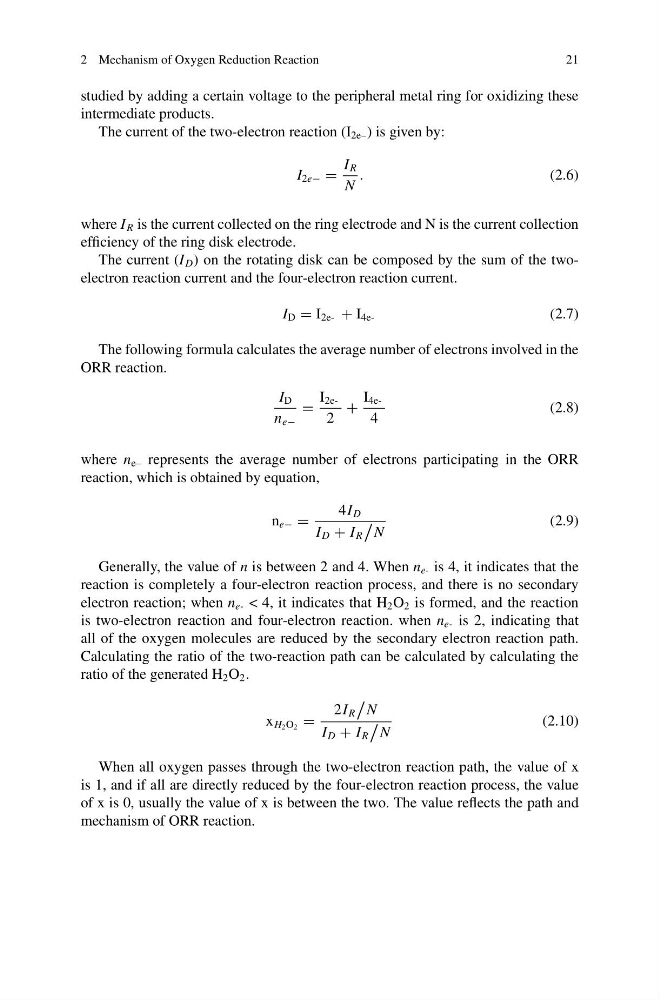
The current of the two-electron reaction (I 2e– ) is given by:
I 2e− =
I R
N
.
(2.6)
where I R is the current collected on the ring electrode and N is the current collection
efficiency of the ring disk electrode.
The current (I D ) on the rotating disk can be composed by the sum of the twoelectron reaction current and the four-electron reaction current.
I D = I 2e- + I 4e(2.7)
The following formula calculates the average number of electrons involved in the
ORR reaction.
I D
n e−
=
I 2e2
+
I 4e4
(2.8)
where n e– represents the average number of electrons participating in the ORR
reaction, which is obtained by equation,
n e− =
4I D
I D + I R
N
(2.9)
Generally, the value of n is between 2 and 4. When n e- is 4, it indicates that the
reaction is completely a four-electron reaction process, and there is no secondary
electron reaction; when n e- < 4, it indicates that H 2 O 2 is formed, and the reaction
is two-electron reaction and four-electron reaction. when n e- is 2, indicating that
all of the oxygen molecules are reduced by the secondary electron reaction path.
Calculating the ratio of the two-reaction path can be calculated by calculating the
ratio of the generated H 2 O 2 .
x H 2 O 2 =
2I R
N
I D + I R
N
(2.10)
When all oxygen passes through the two-electron reaction path, the value of x
is 1, and if all are directly reduced by the four-electron reaction process, the value
of x is 0, usually the value of x is between the two. The value reflects the path and
mechanism of ORR reaction.
21
studied by adding a certain voltage to the peripheral metal ring for oxidizing these
intermediate products.
The current of the two-electron reaction (I 2e– ) is given by:
I 2e− =
I R
N
.
(2.6)
where I R is the current collected on the ring electrode and N is the current collection
efficiency of the ring disk electrode.
The current (I D ) on the rotating disk can be composed by the sum of the twoelectron reaction current and the four-electron reaction current.
I D = I 2e- + I 4e(2.7)
The following formula calculates the average number of electrons involved in the
ORR reaction.
I D
n e−
=
I 2e2
+
I 4e4
(2.8)
where n e– represents the average number of electrons participating in the ORR
reaction, which is obtained by equation,
n e− =
4I D
I D + I R
N
(2.9)
Generally, the value of n is between 2 and 4. When n e- is 4, it indicates that the
reaction is completely a four-electron reaction process, and there is no secondary
electron reaction; when n e- < 4, it indicates that H 2 O 2 is formed, and the reaction
is two-electron reaction and four-electron reaction. when n e- is 2, indicating that
all of the oxygen molecules are reduced by the secondary electron reaction path.
Calculating the ratio of the two-reaction path can be calculated by calculating the
ratio of the generated H 2 O 2 .
x H 2 O 2 =
2I R
N
I D + I R
N
(2.10)
When all oxygen passes through the two-electron reaction path, the value of x
is 1, and if all are directly reduced by the four-electron reaction process, the value
of x is 0, usually the value of x is between the two. The value reflects the path and
mechanism of ORR reaction.