

2 Mechanism of Oxygen Reduction Reaction
19
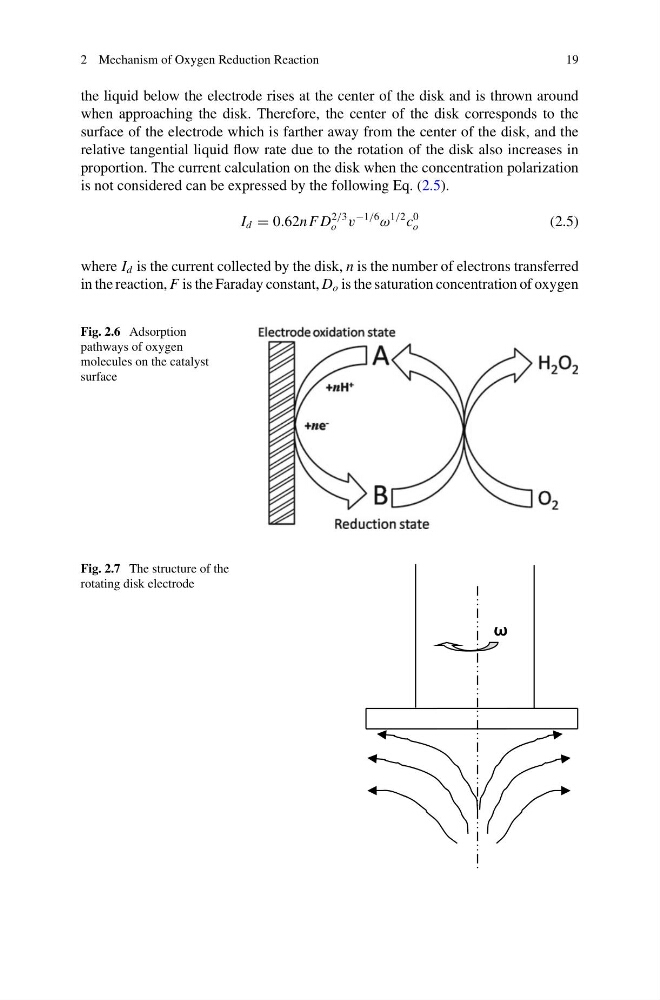
the liquid below the electrode rises at the center of the disk and is thrown around
when approaching the disk. Therefore, the center of the disk corresponds to the
surface of the electrode which is farther away from the center of the disk, and the
relative tangential liquid flow rate due to the rotation of the disk also increases in
proportion. The current calculation on the disk when the concentration polarization
is not considered can be expressed by the following Eq. (2.5).
I d = 0.62n F D
2/3
o v
−1/6
ω
1/2 c
0
o
(2.5)
where I d is the current collected by the disk, n is the number of electrons transferred
in the reaction, F is the Faraday constant, D o is the saturation concentration of oxygen
Fig. 2.6 Adsorption
pathways of oxygen
molecules on the catalyst
surface
Fig. 2.7 The structure of the
rotating disk electrode
ω
19
the liquid below the electrode rises at the center of the disk and is thrown around
when approaching the disk. Therefore, the center of the disk corresponds to the
surface of the electrode which is farther away from the center of the disk, and the
relative tangential liquid flow rate due to the rotation of the disk also increases in
proportion. The current calculation on the disk when the concentration polarization
is not considered can be expressed by the following Eq. (2.5).
I d = 0.62n F D
2/3
o v
−1/6
ω
1/2 c
0
o
(2.5)
where I d is the current collected by the disk, n is the number of electrons transferred
in the reaction, F is the Faraday constant, D o is the saturation concentration of oxygen
Fig. 2.6 Adsorption
pathways of oxygen
molecules on the catalyst
surface
Fig. 2.7 The structure of the
rotating disk electrode
ω