

246
J. Zhu et al.
6.4.1 Carbon Material Electrocatalyst
Strictly speaking, a carbon material electrocatalyst is not an electrocatalyst in the
traditional sense, but is used as an electrode material, a support of an electrocatalyst
or a conductive additive of a battery. Because the carbon material can provide a very
suitable porosity, the discharge products of the battery can be deposited in pores of
various sizes, thereby affecting the discharge performance of the battery. The pores
in the mesopore size range have the greatest impact on battery performance, because
in this interval, oxygen and electrolyte can fully enter, thereby forming an effective
reaction zone, and the insoluble electrolyte products formed by discharge can also be
deposited into the mesopores, of which the filling rate is higher than that of the large
pores, and more products can be accommodated than the small pores. In addition
to the pore properties, the characteristics of the carbon material itself also affect the
performance of the battery. For example, carbon powder doped with nitrogen is more
catalytically active than undoped, thereby improving discharge performance.
One-dimensional nanocarbon materials, such as carbon nanotubes and carbon
nanofibers, are also used for lithium-air battery electrodes. For example, carbon
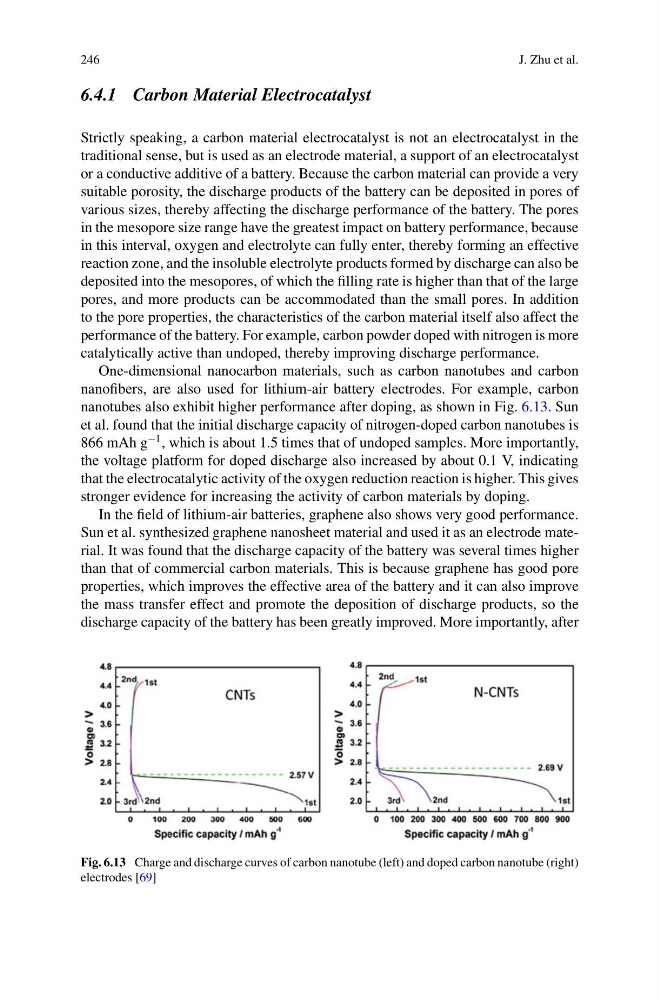
nanotubes also exhibit higher performance after doping, as shown in Fig. 6.13. Sun
et al. found that the initial discharge capacity of nitrogen-doped carbon nanotubes is
866 mAh g
−1 , which is about 1.5 times that of undoped samples. More importantly,
the voltage platform for doped discharge also increased by about 0.1 V, indicating
that the electrocatalytic activity of the oxygen reduction reaction is higher. This gives
stronger evidence for increasing the activity of carbon materials by doping.
In the field of lithium-air batteries, graphene also shows very good performance.
Sun et al. synthesized graphene nanosheet material and used it as an electrode material. It was found that the discharge capacity of the battery was several times higher
than that of commercial carbon materials. This is because graphene has good pore
properties, which improves the effective area of the battery and it can also improve
the mass transfer effect and promote the deposition of discharge products, so the
discharge capacity of the battery has been greatly improved. More importantly, after
Fig. 6.13 Charge and discharge curves of carbon nanotube (left) and doped carbon nanotube (right)
electrodes [69]
J. Zhu et al.
6.4.1 Carbon Material Electrocatalyst
Strictly speaking, a carbon material electrocatalyst is not an electrocatalyst in the
traditional sense, but is used as an electrode material, a support of an electrocatalyst
or a conductive additive of a battery. Because the carbon material can provide a very
suitable porosity, the discharge products of the battery can be deposited in pores of
various sizes, thereby affecting the discharge performance of the battery. The pores
in the mesopore size range have the greatest impact on battery performance, because
in this interval, oxygen and electrolyte can fully enter, thereby forming an effective
reaction zone, and the insoluble electrolyte products formed by discharge can also be
deposited into the mesopores, of which the filling rate is higher than that of the large
pores, and more products can be accommodated than the small pores. In addition
to the pore properties, the characteristics of the carbon material itself also affect the
performance of the battery. For example, carbon powder doped with nitrogen is more
catalytically active than undoped, thereby improving discharge performance.
One-dimensional nanocarbon materials, such as carbon nanotubes and carbon
nanofibers, are also used for lithium-air battery electrodes. For example, carbon
nanotubes also exhibit higher performance after doping, as shown in Fig. 6.13. Sun
et al. found that the initial discharge capacity of nitrogen-doped carbon nanotubes is
866 mAh g
−1 , which is about 1.5 times that of undoped samples. More importantly,
the voltage platform for doped discharge also increased by about 0.1 V, indicating
that the electrocatalytic activity of the oxygen reduction reaction is higher. This gives
stronger evidence for increasing the activity of carbon materials by doping.
In the field of lithium-air batteries, graphene also shows very good performance.
Sun et al. synthesized graphene nanosheet material and used it as an electrode material. It was found that the discharge capacity of the battery was several times higher
than that of commercial carbon materials. This is because graphene has good pore
properties, which improves the effective area of the battery and it can also improve
the mass transfer effect and promote the deposition of discharge products, so the
discharge capacity of the battery has been greatly improved. More importantly, after
Fig. 6.13 Charge and discharge curves of carbon nanotube (left) and doped carbon nanotube (right)
electrodes [69]