

6 Application of Oxygen Reduction Catalysts
243
6.3.2 Electrocatalytic Process for Oxygen Reduction
of Secondary Lithium-Air Batteries
The oxygen reduction electrocatalysis process of secondary lithium-air batteries is
more complicated, not only related to the electrocatalyst used but also to the electrolyte, especially the cations in the electrolyte have a great influence on the oxygen
reduction process. In electrolytes containing tetraethylammonium (TEA
+ ) or tetrabutylammonium (TBA
+ ), oxygen (O 2 ) can be quickly reduced to superoxide ions
(O
−
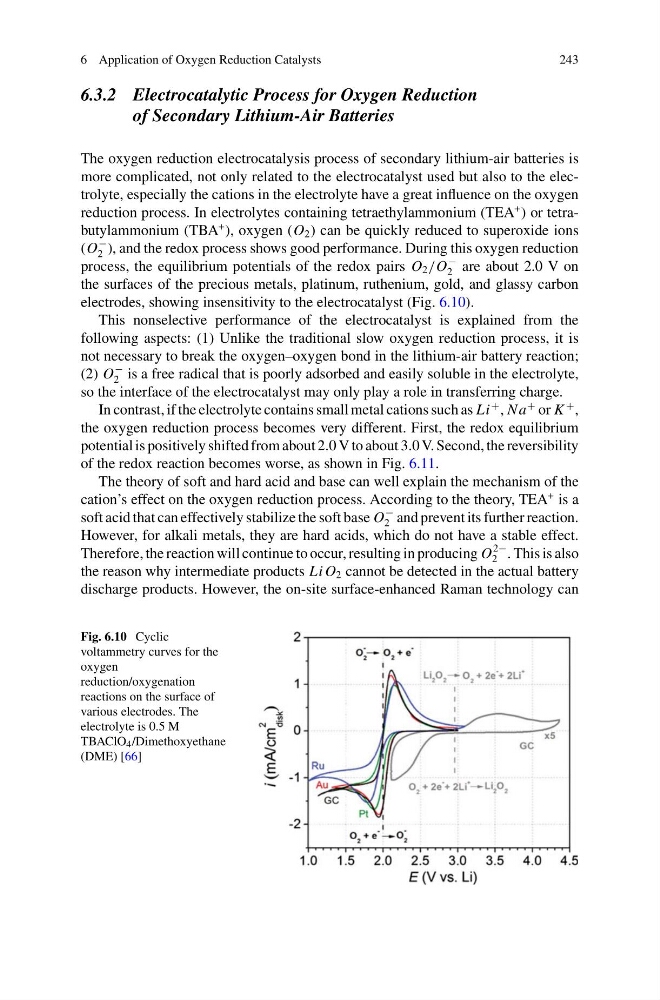
2 ), and the redox process shows good performance. During this oxygen reduction
process, the equilibrium potentials of the redox pairs O 2 /O
−
2 are about 2.0 V on
the surfaces of the precious metals, platinum, ruthenium, gold, and glassy carbon
electrodes, showing insensitivity to the electrocatalyst (Fig. 6.10).
This nonselective performance of the electrocatalyst is explained from the
following aspects: (1) Unlike the traditional slow oxygen reduction process, it is
not necessary to break the oxygen–oxygen bond in the lithium-air battery reaction;
(2) O
−
2 is a free radical that is poorly adsorbed and easily soluble in the electrolyte,
so the interface of the electrocatalyst may only play a role in transferring charge.
In contrast, if the electrolyte contains small metal cations such as Li
+ , N a
+ or K
+ ,
the oxygen reduction process becomes very different. First, the redox equilibrium
potential is positively shifted from about 2.0 V to about 3.0 V. Second, the reversibility
of the redox reaction becomes worse, as shown in Fig. 6.11.
The theory of soft and hard acid and base can well explain the mechanism of the
cation’s effect on the oxygen reduction process. According to the theory, TEA
+ is a
soft acid that can effectively stabilize the soft base O
−
2 and prevent its further reaction.
However, for alkali metals, they are hard acids, which do not have a stable effect.
Therefore, the reaction will continue to occur, resulting in producing O
2−
2 . This is also
the reason why intermediate products Li O 2 cannot be detected in the actual battery
discharge products. However, the on-site surface-enhanced Raman technology can
Fig. 6.10 Cyclic
voltammetry curves for the
oxygen
reduction/oxygenation
reactions on the surface of
various electrodes. The
electrolyte is 0.5 M
TBAClO 4 /Dimethoxyethane
(DME) [66]
243
6.3.2 Electrocatalytic Process for Oxygen Reduction
of Secondary Lithium-Air Batteries
The oxygen reduction electrocatalysis process of secondary lithium-air batteries is
more complicated, not only related to the electrocatalyst used but also to the electrolyte, especially the cations in the electrolyte have a great influence on the oxygen
reduction process. In electrolytes containing tetraethylammonium (TEA
+ ) or tetrabutylammonium (TBA
+ ), oxygen (O 2 ) can be quickly reduced to superoxide ions
(O
−
2 ), and the redox process shows good performance. During this oxygen reduction
process, the equilibrium potentials of the redox pairs O 2 /O
−
2 are about 2.0 V on
the surfaces of the precious metals, platinum, ruthenium, gold, and glassy carbon
electrodes, showing insensitivity to the electrocatalyst (Fig. 6.10).
This nonselective performance of the electrocatalyst is explained from the
following aspects: (1) Unlike the traditional slow oxygen reduction process, it is
not necessary to break the oxygen–oxygen bond in the lithium-air battery reaction;
(2) O
−
2 is a free radical that is poorly adsorbed and easily soluble in the electrolyte,
so the interface of the electrocatalyst may only play a role in transferring charge.
In contrast, if the electrolyte contains small metal cations such as Li
+ , N a
+ or K
+ ,
the oxygen reduction process becomes very different. First, the redox equilibrium
potential is positively shifted from about 2.0 V to about 3.0 V. Second, the reversibility
of the redox reaction becomes worse, as shown in Fig. 6.11.
The theory of soft and hard acid and base can well explain the mechanism of the
cation’s effect on the oxygen reduction process. According to the theory, TEA
+ is a
soft acid that can effectively stabilize the soft base O
−
2 and prevent its further reaction.
However, for alkali metals, they are hard acids, which do not have a stable effect.
Therefore, the reaction will continue to occur, resulting in producing O
2−
2 . This is also
the reason why intermediate products Li O 2 cannot be detected in the actual battery
discharge products. However, the on-site surface-enhanced Raman technology can
Fig. 6.10 Cyclic
voltammetry curves for the
oxygen
reduction/oxygenation
reactions on the surface of
various electrodes. The
electrolyte is 0.5 M
TBAClO 4 /Dimethoxyethane
(DME) [66]