

232
J. Zhu et al.
systems for portable power supplies, backup power supplies and underwater propulsion devices using alloyed aluminum anodes and effective air electrodes. At present,
the research hotspots in various countries mainly focus on aluminum-air batteries
for high-power electric vehicles or automobiles. In February 2014, at the advanced
automotive battery conference held in Atlanta, USA, Alcoa and Israel’s Phinergy
Company signed a joint development agreement on the further development of Phinergy aluminum-air batteries. The purpose of this joint development is to promote the
commercialization process of aluminum-air batteries as soon as possible. Earlier,
Israel’s Phinergy Company announced that it has developed an aluminum-air battery
for electric vehicles. The battery consists of 50 aluminum plates and has an endurance
of 1600 km. During this period, only water needs to be injected. The quality of the
aluminum-air battery is only 70% of that of a standard battery, and rapid mechanical
charging can be realized by replacing an aluminum plate. The battery uses aluminum
alloy with high energy utilization rate as the negative electrode, Ag as the air catalyst,
the electrolyte used can dissolve aluminum oxide on the surface layer of the aluminum
negative electrode, the discharge product of the battery is Al(OH) 3 , and the Al(OH) 3
can be processed and recycled by an aluminum factory to realize sustainable utilization. In July 2019, at the Shanghai International Aluminum Industry Exhibition,
Chinalco Group introduced three aluminum-air battery products, namely, aluminum
fuel emergency power supply, portable aluminum fuel emergency power supply and
hydrothermal integrated aluminum fuel emergency support equipment. Aluminum
fuel emergency power supply is mainly used as backup power for 5G communication
base stations and other communication systems. Portable aluminum fuel emergency
power supply, which mainly provides power for camping and rescue applications;
water, electricity and heat integrated aluminum fuel emergency support equipment
supplies power, water and heat to scenes such as field training, disaster-stricken
resettlement sites or urban shelters.
(1) Working principle of aluminum-air battery [49]
Unlike lithium-air batteries, which use nonaqueous electrolytes, aluminum-air
batteries generally use aqueous solutions, mainly neutral and alkaline. In neutral
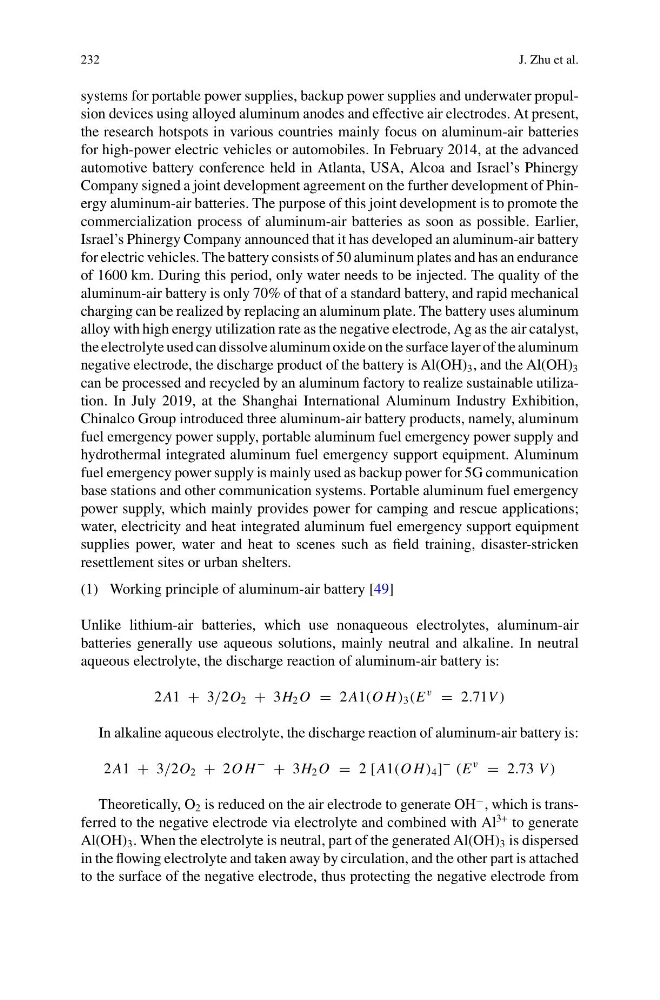
aqueous electrolyte, the discharge reaction of aluminum-air battery is:
2 A1 + 3/2O 2 + 3H 2 O = 2 A1(O H) 3 (E
v
= 2.71V )
In alkaline aqueous electrolyte, the discharge reaction of aluminum-air battery is:
2 A1 + 3/2O 2 + 2O H
−
+ 3H 2 O = 2 [A1(O H) 4 ]
−
(E
v
= 2.73 V )
Theoretically, O 2 is reduced on the air electrode to generate OH
− , which is transferred to the negative electrode via electrolyte and combined with Al
3+ to generate
Al(OH) 3 . When the electrolyte is neutral, part of the generated Al(OH) 3 is dispersed
in the flowing electrolyte and taken away by circulation, and the other part is attached
to the surface of the negative electrode, thus protecting the negative electrode from
J. Zhu et al.
systems for portable power supplies, backup power supplies and underwater propulsion devices using alloyed aluminum anodes and effective air electrodes. At present,
the research hotspots in various countries mainly focus on aluminum-air batteries
for high-power electric vehicles or automobiles. In February 2014, at the advanced
automotive battery conference held in Atlanta, USA, Alcoa and Israel’s Phinergy
Company signed a joint development agreement on the further development of Phinergy aluminum-air batteries. The purpose of this joint development is to promote the
commercialization process of aluminum-air batteries as soon as possible. Earlier,
Israel’s Phinergy Company announced that it has developed an aluminum-air battery
for electric vehicles. The battery consists of 50 aluminum plates and has an endurance
of 1600 km. During this period, only water needs to be injected. The quality of the
aluminum-air battery is only 70% of that of a standard battery, and rapid mechanical
charging can be realized by replacing an aluminum plate. The battery uses aluminum
alloy with high energy utilization rate as the negative electrode, Ag as the air catalyst,
the electrolyte used can dissolve aluminum oxide on the surface layer of the aluminum
negative electrode, the discharge product of the battery is Al(OH) 3 , and the Al(OH) 3
can be processed and recycled by an aluminum factory to realize sustainable utilization. In July 2019, at the Shanghai International Aluminum Industry Exhibition,
Chinalco Group introduced three aluminum-air battery products, namely, aluminum
fuel emergency power supply, portable aluminum fuel emergency power supply and
hydrothermal integrated aluminum fuel emergency support equipment. Aluminum
fuel emergency power supply is mainly used as backup power for 5G communication
base stations and other communication systems. Portable aluminum fuel emergency
power supply, which mainly provides power for camping and rescue applications;
water, electricity and heat integrated aluminum fuel emergency support equipment
supplies power, water and heat to scenes such as field training, disaster-stricken
resettlement sites or urban shelters.
(1) Working principle of aluminum-air battery [49]
Unlike lithium-air batteries, which use nonaqueous electrolytes, aluminum-air
batteries generally use aqueous solutions, mainly neutral and alkaline. In neutral
aqueous electrolyte, the discharge reaction of aluminum-air battery is:
2 A1 + 3/2O 2 + 3H 2 O = 2 A1(O H) 3 (E
v
= 2.71V )
In alkaline aqueous electrolyte, the discharge reaction of aluminum-air battery is:
2 A1 + 3/2O 2 + 2O H
−
+ 3H 2 O = 2 [A1(O H) 4 ]
−
(E
v
= 2.73 V )
Theoretically, O 2 is reduced on the air electrode to generate OH
− , which is transferred to the negative electrode via electrolyte and combined with Al
3+ to generate
Al(OH) 3 . When the electrolyte is neutral, part of the generated Al(OH) 3 is dispersed
in the flowing electrolyte and taken away by circulation, and the other part is attached
to the surface of the negative electrode, thus protecting the negative electrode from