

6 Application of Oxygen Reduction Catalysts
229
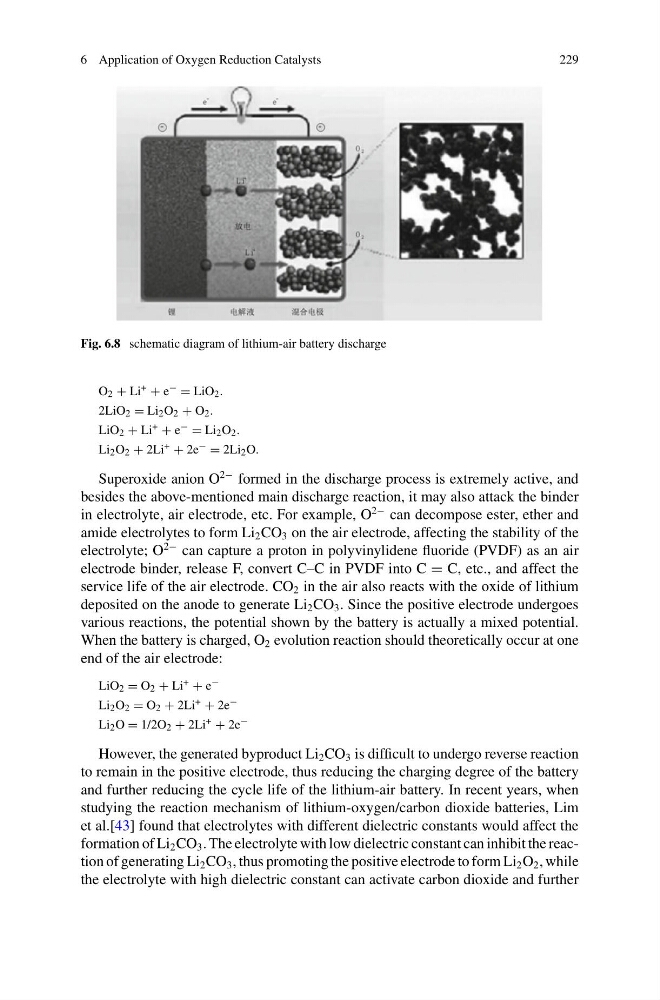
Fig. 6.8 schematic diagram of lithium-air battery discharge
O 2 + Li + + e − = LiO 2 .
2LiO 2 = Li 2 O 2 + O 2 .
LiO 2 + Li + + e − = Li 2 O 2 .
Li 2 O 2 + 2Li + + 2e − = 2Li 2 O.
Superoxide anion O
2− formed in the discharge process is extremely active, and
besides the above-mentioned main discharge reaction, it may also attack the binder
in electrolyte, air electrode, etc. For example, O
2− can decompose ester, ether and
amide electrolytes to form Li 2 CO 3 on the air electrode, affecting the stability of the
electrolyte; O
2− can capture a proton in polyvinylidene fluoride (PVDF) as an air
electrode binder, release F, convert C–C in PVDF into C = C, etc., and affect the
service life of the air electrode. CO 2 in the air also reacts with the oxide of lithium
deposited on the anode to generate Li 2 CO 3 . Since the positive electrode undergoes
various reactions, the potential shown by the battery is actually a mixed potential.
When the battery is charged, O 2 evolution reaction should theoretically occur at one
end of the air electrode:
LiO 2 = O 2 + Li + + e −
Li 2 O 2 = O 2 + 2Li + + 2e −
Li 2 O = 1/2O 2 + 2Li + + 2e −
However, the generated byproduct Li 2 CO 3 is difficult to undergo reverse reaction
to remain in the positive electrode, thus reducing the charging degree of the battery
and further reducing the cycle life of the lithium-air battery. In recent years, when
studying the reaction mechanism of lithium-oxygen/carbon dioxide batteries, Lim
et al.[43] found that electrolytes with different dielectric constants would affect the
formation of Li 2 CO 3 . The electrolyte with low dielectric constant can inhibit the reaction of generating Li 2 CO 3 , thus promoting the positive electrode to form Li 2 O 2 , while
the electrolyte with high dielectric constant can activate carbon dioxide and further
229
Fig. 6.8 schematic diagram of lithium-air battery discharge
O 2 + Li + + e − = LiO 2 .
2LiO 2 = Li 2 O 2 + O 2 .
LiO 2 + Li + + e − = Li 2 O 2 .
Li 2 O 2 + 2Li + + 2e − = 2Li 2 O.
Superoxide anion O
2− formed in the discharge process is extremely active, and
besides the above-mentioned main discharge reaction, it may also attack the binder
in electrolyte, air electrode, etc. For example, O
2− can decompose ester, ether and
amide electrolytes to form Li 2 CO 3 on the air electrode, affecting the stability of the
electrolyte; O
2− can capture a proton in polyvinylidene fluoride (PVDF) as an air
electrode binder, release F, convert C–C in PVDF into C = C, etc., and affect the
service life of the air electrode. CO 2 in the air also reacts with the oxide of lithium
deposited on the anode to generate Li 2 CO 3 . Since the positive electrode undergoes
various reactions, the potential shown by the battery is actually a mixed potential.
When the battery is charged, O 2 evolution reaction should theoretically occur at one
end of the air electrode:
LiO 2 = O 2 + Li + + e −
Li 2 O 2 = O 2 + 2Li + + 2e −
Li 2 O = 1/2O 2 + 2Li + + 2e −
However, the generated byproduct Li 2 CO 3 is difficult to undergo reverse reaction
to remain in the positive electrode, thus reducing the charging degree of the battery
and further reducing the cycle life of the lithium-air battery. In recent years, when
studying the reaction mechanism of lithium-oxygen/carbon dioxide batteries, Lim
et al.[43] found that electrolytes with different dielectric constants would affect the
formation of Li 2 CO 3 . The electrolyte with low dielectric constant can inhibit the reaction of generating Li 2 CO 3 , thus promoting the positive electrode to form Li 2 O 2 , while
the electrolyte with high dielectric constant can activate carbon dioxide and further