

4 Catalyst Materials for Oxygen Reduction Reaction
149
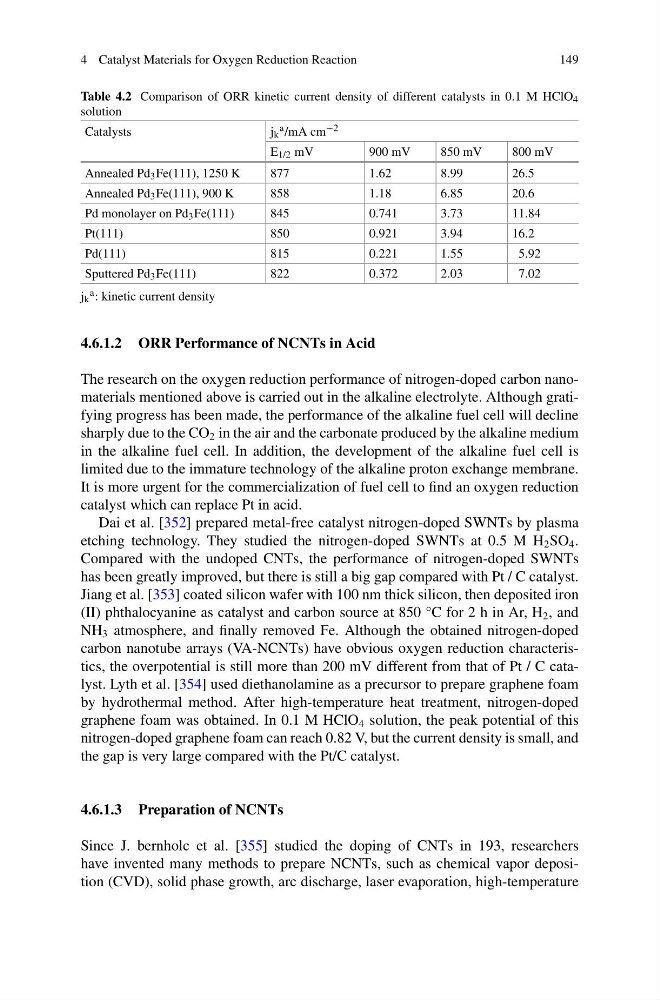
Table 4.2 Comparison of ORR kinetic current density of different catalysts in 0.1 M HClO 4
solution
Catalysts
j k
a /mA cm −2
E 1/2 mV
900 mV
850 mV
800 mV
Annealed Pd 3 Fe(111), 1250 K
877
1.62
8.99
26.5
Annealed Pd 3 Fe(111), 900 K
858
1.18
6.85
20.6
Pd monolayer on Pd 3 Fe(111)
845
0.741
3.73
11.84
Pt(111)
850
0.921
3.94
16.2
Pd(111)
815
0.221
1.55
5.92
Sputtered Pd 3 Fe(111)
822
0.372
2.03
7.02
j k
a : kinetic current density
4.6.1.2 ORR Performance of NCNTs in Acid
The research on the oxygen reduction performance of nitrogen-doped carbon nanomaterials mentioned above is carried out in the alkaline electrolyte. Although gratifying progress has been made, the performance of the alkaline fuel cell will decline
sharply due to the CO 2 in the air and the carbonate produced by the alkaline medium
in the alkaline fuel cell. In addition, the development of the alkaline fuel cell is
limited due to the immature technology of the alkaline proton exchange membrane.
It is more urgent for the commercialization of fuel cell to find an oxygen reduction
catalyst which can replace Pt in acid.
Dai et al. [352] prepared metal-free catalyst nitrogen-doped SWNTs by plasma
etching technology. They studied the nitrogen-doped SWNTs at 0.5 M H 2 SO 4 .
Compared with the undoped CNTs, the performance of nitrogen-doped SWNTs
has been greatly improved, but there is still a big gap compared with Pt / C catalyst.
Jiang et al. [353] coated silicon wafer with 100 nm thick silicon, then deposited iron
(II) phthalocyanine as catalyst and carbon source at 850 °C for 2 h in Ar, H 2 , and
NH 3 atmosphere, and finally removed Fe. Although the obtained nitrogen-doped
carbon nanotube arrays (VA-NCNTs) have obvious oxygen reduction characteristics, the overpotential is still more than 200 mV different from that of Pt / C catalyst. Lyth et al. [354] used diethanolamine as a precursor to prepare graphene foam
by hydrothermal method. After high-temperature heat treatment, nitrogen-doped
graphene foam was obtained. In 0.1 M HClO 4 solution, the peak potential of this
nitrogen-doped graphene foam can reach 0.82 V, but the current density is small, and
the gap is very large compared with the Pt/C catalyst.
4.6.1.3 Preparation of NCNTs
Since J. bernholc et al. [355] studied the doping of CNTs in 193, researchers
have invented many methods to prepare NCNTs, such as chemical vapor deposition (CVD), solid phase growth, arc discharge, laser evaporation, high-temperature
149
Table 4.2 Comparison of ORR kinetic current density of different catalysts in 0.1 M HClO 4
solution
Catalysts
j k
a /mA cm −2
E 1/2 mV
900 mV
850 mV
800 mV
Annealed Pd 3 Fe(111), 1250 K
877
1.62
8.99
26.5
Annealed Pd 3 Fe(111), 900 K
858
1.18
6.85
20.6
Pd monolayer on Pd 3 Fe(111)
845
0.741
3.73
11.84
Pt(111)
850
0.921
3.94
16.2
Pd(111)
815
0.221
1.55
5.92
Sputtered Pd 3 Fe(111)
822
0.372
2.03
7.02
j k
a : kinetic current density
4.6.1.2 ORR Performance of NCNTs in Acid
The research on the oxygen reduction performance of nitrogen-doped carbon nanomaterials mentioned above is carried out in the alkaline electrolyte. Although gratifying progress has been made, the performance of the alkaline fuel cell will decline
sharply due to the CO 2 in the air and the carbonate produced by the alkaline medium
in the alkaline fuel cell. In addition, the development of the alkaline fuel cell is
limited due to the immature technology of the alkaline proton exchange membrane.
It is more urgent for the commercialization of fuel cell to find an oxygen reduction
catalyst which can replace Pt in acid.
Dai et al. [352] prepared metal-free catalyst nitrogen-doped SWNTs by plasma
etching technology. They studied the nitrogen-doped SWNTs at 0.5 M H 2 SO 4 .
Compared with the undoped CNTs, the performance of nitrogen-doped SWNTs
has been greatly improved, but there is still a big gap compared with Pt / C catalyst.
Jiang et al. [353] coated silicon wafer with 100 nm thick silicon, then deposited iron
(II) phthalocyanine as catalyst and carbon source at 850 °C for 2 h in Ar, H 2 , and
NH 3 atmosphere, and finally removed Fe. Although the obtained nitrogen-doped
carbon nanotube arrays (VA-NCNTs) have obvious oxygen reduction characteristics, the overpotential is still more than 200 mV different from that of Pt / C catalyst. Lyth et al. [354] used diethanolamine as a precursor to prepare graphene foam
by hydrothermal method. After high-temperature heat treatment, nitrogen-doped
graphene foam was obtained. In 0.1 M HClO 4 solution, the peak potential of this
nitrogen-doped graphene foam can reach 0.82 V, but the current density is small, and
the gap is very large compared with the Pt/C catalyst.
4.6.1.3 Preparation of NCNTs
Since J. bernholc et al. [355] studied the doping of CNTs in 193, researchers
have invented many methods to prepare NCNTs, such as chemical vapor deposition (CVD), solid phase growth, arc discharge, laser evaporation, high-temperature