

140
Y. Li et al.
0.88 V (vs. RHE), which was greatly improved compared to Co 3 O 4 . When graphene
becomes nitrogen-doped graphene, its ORR activity can be further improved, and
its on-set potential can reach more than 0.9 V (vs. RHE). The materials were loaded
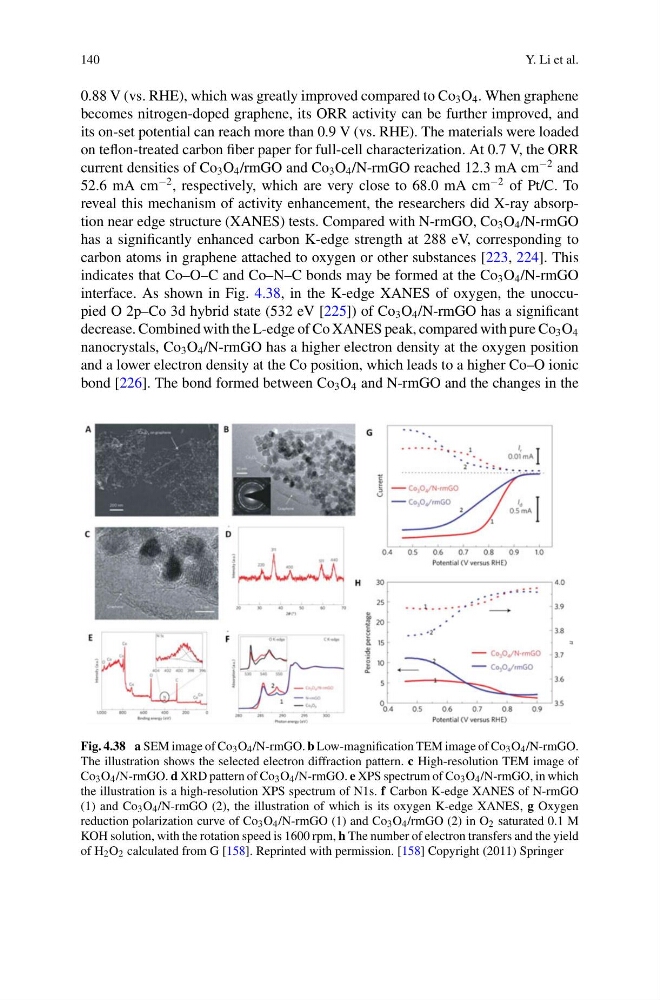
on teflon-treated carbon fiber paper for full-cell characterization. At 0.7 V, the ORR
current densities of Co 3 O 4 /rmGO and Co 3 O 4 /N-rmGO reached 12.3 mA cm
−2 and
52.6 mA cm
−2 , respectively, which are very close to 68.0 mA cm
−2 of Pt/C. To
reveal this mechanism of activity enhancement, the researchers did X-ray absorption near edge structure (XANES) tests. Compared with N-rmGO, Co 3 O 4 /N-rmGO
has a significantly enhanced carbon K-edge strength at 288 eV, corresponding to
carbon atoms in graphene attached to oxygen or other substances [223, 224]. This
indicates that Co–O–C and Co–N–C bonds may be formed at the Co 3 O 4 /N-rmGO
interface. As shown in Fig. 4.38, in the K-edge XANES of oxygen, the unoccupied O 2p–Co 3d hybrid state (532 eV [225]) of Co 3 O 4 /N-rmGO has a significant
decrease. Combined with the L-edge of Co XANES peak, compared with pure Co 3 O 4
nanocrystals, Co 3 O 4 /N-rmGO has a higher electron density at the oxygen position
and a lower electron density at the Co position, which leads to a higher Co–O ionic
bond [226]. The bond formed between Co 3 O 4 and N-rmGO and the changes in the
Fig. 4.38 a SEM image of Co 3 O 4 /N-rmGO. b Low-magnification TEM image of Co 3 O 4 /N-rmGO.
The illustration shows the selected electron diffraction pattern. c High-resolution TEM image of
Co 3 O 4 /N-rmGO. d XRD pattern of Co 3 O 4 /N-rmGO. e XPS spectrum of Co 3 O 4 /N-rmGO, in which
the illustration is a high-resolution XPS spectrum of N1s. f Carbon K-edge XANES of N-rmGO
(1) and Co 3 O 4 /N-rmGO (2), the illustration of which is its oxygen K-edge XANES, g Oxygen
reduction polarization curve of Co 3 O 4 /N-rmGO (1) and Co 3 O 4 /rmGO (2) in O 2 saturated 0.1 M
KOH solution, with the rotation speed is 1600 rpm, h The number of electron transfers and the yield
of H 2 O 2 calculated from G [158]. Reprinted with permission. [158] Copyright (2011) Springer
Y. Li et al.
0.88 V (vs. RHE), which was greatly improved compared to Co 3 O 4 . When graphene
becomes nitrogen-doped graphene, its ORR activity can be further improved, and
its on-set potential can reach more than 0.9 V (vs. RHE). The materials were loaded
on teflon-treated carbon fiber paper for full-cell characterization. At 0.7 V, the ORR
current densities of Co 3 O 4 /rmGO and Co 3 O 4 /N-rmGO reached 12.3 mA cm
−2 and
52.6 mA cm
−2 , respectively, which are very close to 68.0 mA cm
−2 of Pt/C. To
reveal this mechanism of activity enhancement, the researchers did X-ray absorption near edge structure (XANES) tests. Compared with N-rmGO, Co 3 O 4 /N-rmGO
has a significantly enhanced carbon K-edge strength at 288 eV, corresponding to
carbon atoms in graphene attached to oxygen or other substances [223, 224]. This
indicates that Co–O–C and Co–N–C bonds may be formed at the Co 3 O 4 /N-rmGO
interface. As shown in Fig. 4.38, in the K-edge XANES of oxygen, the unoccupied O 2p–Co 3d hybrid state (532 eV [225]) of Co 3 O 4 /N-rmGO has a significant
decrease. Combined with the L-edge of Co XANES peak, compared with pure Co 3 O 4
nanocrystals, Co 3 O 4 /N-rmGO has a higher electron density at the oxygen position
and a lower electron density at the Co position, which leads to a higher Co–O ionic
bond [226]. The bond formed between Co 3 O 4 and N-rmGO and the changes in the
Fig. 4.38 a SEM image of Co 3 O 4 /N-rmGO. b Low-magnification TEM image of Co 3 O 4 /N-rmGO.
The illustration shows the selected electron diffraction pattern. c High-resolution TEM image of
Co 3 O 4 /N-rmGO. d XRD pattern of Co 3 O 4 /N-rmGO. e XPS spectrum of Co 3 O 4 /N-rmGO, in which
the illustration is a high-resolution XPS spectrum of N1s. f Carbon K-edge XANES of N-rmGO
(1) and Co 3 O 4 /N-rmGO (2), the illustration of which is its oxygen K-edge XANES, g Oxygen
reduction polarization curve of Co 3 O 4 /N-rmGO (1) and Co 3 O 4 /rmGO (2) in O 2 saturated 0.1 M
KOH solution, with the rotation speed is 1600 rpm, h The number of electron transfers and the yield
of H 2 O 2 calculated from G [158]. Reprinted with permission. [158] Copyright (2011) Springer