

4 Catalyst Materials for Oxygen Reduction Reaction
137
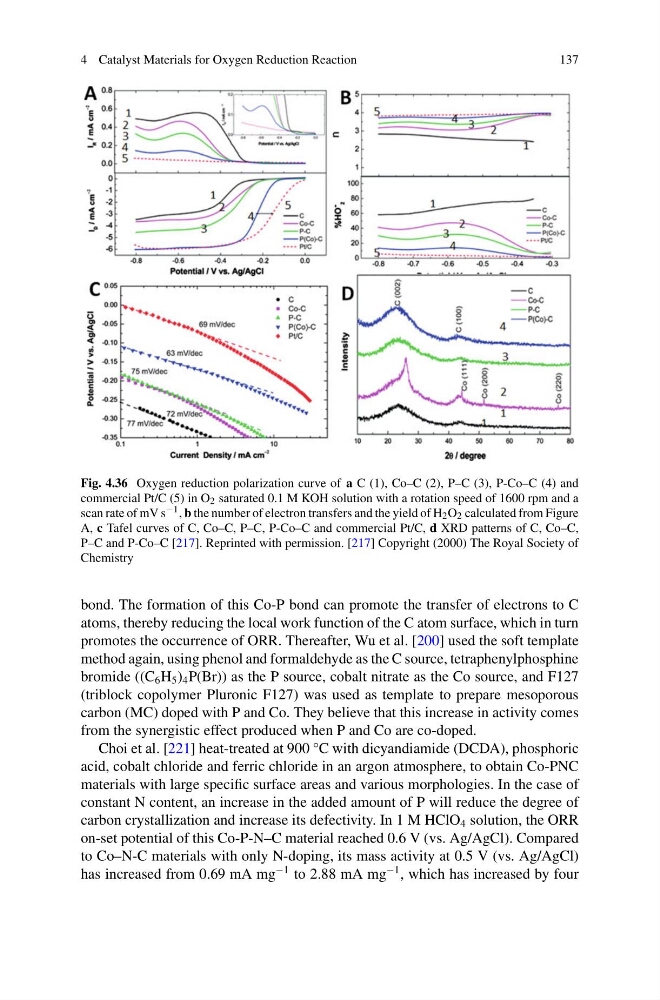
Fig. 4.36 Oxygen reduction polarization curve of a C (1), Co–C (2), P–C (3), P-Co–C (4) and
commercial Pt/C (5) in O 2 saturated 0.1 M KOH solution with a rotation speed of 1600 rpm and a
scan rate of mV s −1 , b the number of electron transfers and the yield of H 2 O 2 calculated from Figure
A, c Tafel curves of C, Co–C, P–C, P-Co–C and commercial Pt/C, d XRD patterns of C, Co–C,
P–C and P-Co–C [217]. Reprinted with permission. [217] Copyright (2000) The Royal Society of
Chemistry
bond. The formation of this Co-P bond can promote the transfer of electrons to C
atoms, thereby reducing the local work function of the C atom surface, which in turn
promotes the occurrence of ORR. Thereafter, Wu et al. [200] used the soft template
method again, using phenol and formaldehyde as the C source, tetraphenylphosphine
bromide ((C 6 H 5 ) 4 P(Br)) as the P source, cobalt nitrate as the Co source, and F127
(triblock copolymer Pluronic F127) was used as template to prepare mesoporous
carbon (MC) doped with P and Co. They believe that this increase in activity comes
from the synergistic effect produced when P and Co are co-doped.
Choi et al. [221] heat-treated at 900 °C with dicyandiamide (DCDA), phosphoric
acid, cobalt chloride and ferric chloride in an argon atmosphere, to obtain Co-PNC
materials with large specific surface areas and various morphologies. In the case of
constant N content, an increase in the added amount of P will reduce the degree of
carbon crystallization and increase its defectivity. In 1 M HClO 4 solution, the ORR
on-set potential of this Co-P-N–C material reached 0.6 V (vs. Ag/AgCl). Compared
to Co–N-C materials with only N-doping, its mass activity at 0.5 V (vs. Ag/AgCl)
has increased from 0.69 mA mg
−1 to 2.88 mA mg
−1 , which has increased by four
137
Fig. 4.36 Oxygen reduction polarization curve of a C (1), Co–C (2), P–C (3), P-Co–C (4) and
commercial Pt/C (5) in O 2 saturated 0.1 M KOH solution with a rotation speed of 1600 rpm and a
scan rate of mV s −1 , b the number of electron transfers and the yield of H 2 O 2 calculated from Figure
A, c Tafel curves of C, Co–C, P–C, P-Co–C and commercial Pt/C, d XRD patterns of C, Co–C,
P–C and P-Co–C [217]. Reprinted with permission. [217] Copyright (2000) The Royal Society of
Chemistry
bond. The formation of this Co-P bond can promote the transfer of electrons to C
atoms, thereby reducing the local work function of the C atom surface, which in turn
promotes the occurrence of ORR. Thereafter, Wu et al. [200] used the soft template
method again, using phenol and formaldehyde as the C source, tetraphenylphosphine
bromide ((C 6 H 5 ) 4 P(Br)) as the P source, cobalt nitrate as the Co source, and F127
(triblock copolymer Pluronic F127) was used as template to prepare mesoporous
carbon (MC) doped with P and Co. They believe that this increase in activity comes
from the synergistic effect produced when P and Co are co-doped.
Choi et al. [221] heat-treated at 900 °C with dicyandiamide (DCDA), phosphoric
acid, cobalt chloride and ferric chloride in an argon atmosphere, to obtain Co-PNC
materials with large specific surface areas and various morphologies. In the case of
constant N content, an increase in the added amount of P will reduce the degree of
carbon crystallization and increase its defectivity. In 1 M HClO 4 solution, the ORR
on-set potential of this Co-P-N–C material reached 0.6 V (vs. Ag/AgCl). Compared
to Co–N-C materials with only N-doping, its mass activity at 0.5 V (vs. Ag/AgCl)
has increased from 0.69 mA mg
−1 to 2.88 mA mg
−1 , which has increased by four