

118
Y. Li et al.
that of commercial Pt/C catalyst. This article can be said to be the continuation of
Stamenkovic et al. proposal of single crystal Pt 3 Ni(111) with super high activity in
2007 [159].
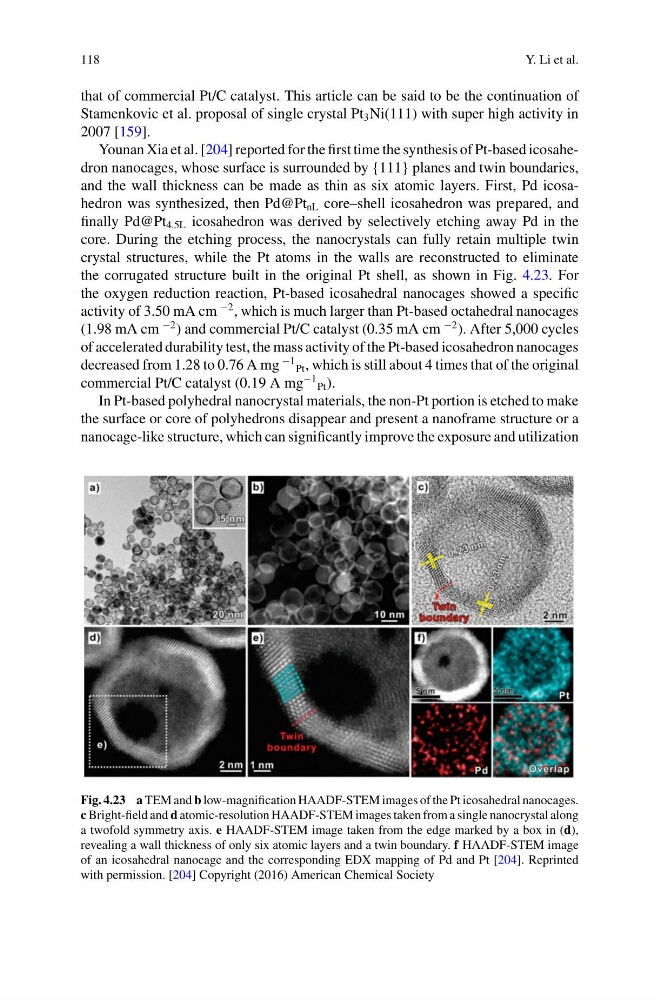
Younan Xia et al. [204] reported for the first time the synthesis of Pt-based icosahedron nanocages, whose surface is surrounded by {111} planes and twin boundaries,
and the wall thickness can be made as thin as six atomic layers. First, Pd icosahedron was synthesized, then Pd@Pt nL core–shell icosahedron was prepared, and
finally Pd@Pt 4.5L icosahedron was derived by selectively etching away Pd in the
core. During the etching process, the nanocrystals can fully retain multiple twin
crystal structures, while the Pt atoms in the walls are reconstructed to eliminate
the corrugated structure built in the original Pt shell, as shown in Fig. 4.23. For
the oxygen reduction reaction, Pt-based icosahedral nanocages showed a specific
activity of 3.50 mA cm
−2 , which is much larger than Pt-based octahedral nanocages
(1.98 mA cm
−2 ) and commercial Pt/C catalyst (0.35 mA cm
−2 ). After 5,000 cycles
of accelerated durability test, the mass activity of the Pt-based icosahedron nanocages
decreased from 1.28 to 0.76 A mg
−1
Pt , which is still about 4 times that of the original
commercial Pt/C catalyst (0.19 A mg
−1
Pt ).
In Pt-based polyhedral nanocrystal materials, the non-Pt portion is etched to make
the surface or core of polyhedrons disappear and present a nanoframe structure or a
nanocage-like structure, which can significantly improve the exposure and utilization
Fig. 4.23 a TEM and b low-magnification HAADF-STEM images of the Pt icosahedral nanocages.
c Bright-field and d atomic-resolution HAADF-STEM images taken from a single nanocrystal along
a twofold symmetry axis. e HAADF-STEM image taken from the edge marked by a box in (d),
revealing a wall thickness of only six atomic layers and a twin boundary. f HAADF-STEM image
of an icosahedral nanocage and the corresponding EDX mapping of Pd and Pt [204]. Reprinted
with permission. [204] Copyright (2016) American Chemical Society
Y. Li et al.
that of commercial Pt/C catalyst. This article can be said to be the continuation of
Stamenkovic et al. proposal of single crystal Pt 3 Ni(111) with super high activity in
2007 [159].
Younan Xia et al. [204] reported for the first time the synthesis of Pt-based icosahedron nanocages, whose surface is surrounded by {111} planes and twin boundaries,
and the wall thickness can be made as thin as six atomic layers. First, Pd icosahedron was synthesized, then Pd@Pt nL core–shell icosahedron was prepared, and
finally Pd@Pt 4.5L icosahedron was derived by selectively etching away Pd in the
core. During the etching process, the nanocrystals can fully retain multiple twin
crystal structures, while the Pt atoms in the walls are reconstructed to eliminate
the corrugated structure built in the original Pt shell, as shown in Fig. 4.23. For
the oxygen reduction reaction, Pt-based icosahedral nanocages showed a specific
activity of 3.50 mA cm
−2 , which is much larger than Pt-based octahedral nanocages
(1.98 mA cm
−2 ) and commercial Pt/C catalyst (0.35 mA cm
−2 ). After 5,000 cycles
of accelerated durability test, the mass activity of the Pt-based icosahedron nanocages
decreased from 1.28 to 0.76 A mg
−1
Pt , which is still about 4 times that of the original
commercial Pt/C catalyst (0.19 A mg
−1
Pt ).
In Pt-based polyhedral nanocrystal materials, the non-Pt portion is etched to make
the surface or core of polyhedrons disappear and present a nanoframe structure or a
nanocage-like structure, which can significantly improve the exposure and utilization
Fig. 4.23 a TEM and b low-magnification HAADF-STEM images of the Pt icosahedral nanocages.
c Bright-field and d atomic-resolution HAADF-STEM images taken from a single nanocrystal along
a twofold symmetry axis. e HAADF-STEM image taken from the edge marked by a box in (d),
revealing a wall thickness of only six atomic layers and a twin boundary. f HAADF-STEM image
of an icosahedral nanocage and the corresponding EDX mapping of Pd and Pt [204]. Reprinted
with permission. [204] Copyright (2016) American Chemical Society