

1 Introduction
3
Carnot cycle, and the actual working conversion efficiency can reach 40 ~ 60%. Theoretically, as long as oxidant and fuel are continuously supplied, fuel cells can continuously work to generate electric energy. The fuel of fuel cell is mainly hydrogen-rich
gas, and the emission of carbon dioxide is about 40% lower than that of heat engine
power generation; if the fuel is pure hydrogen, its electrochemical reaction product
is only water, which fundamentally reduces the emission of air pollutants such as
carbon monoxide, nitride and sulfide. Therefore, fuel cell has become the fourthgeneration power generation device after hydropower, thermal power and nuclear
power, and is listed as the top ten science and technology in the world in the future.
In 1839, when William Grove studied the water electrolysis reaction, he found that
the reverse reaction of the water electrolysis reaction can also occur under certain
conditions, and then put forward the first fuel cell model. In 1889, Mond et al.,
using hydrogen as fuel, oxygen as oxidant and lead as electrode reaction catalyst,
successfully prepared a battery device with similar structure to the fuel cell widely
used in modern times, and named it “fuel cell.” In 1960s, fuel cell was used as an
auxiliary power supply on the Apollo spacecraft of NASA. Subsequently, the research
of fuel cells entered a rapid development stage, and various power generation devices
of fuel cells came out one after another, such as phosphoric acid fuel cells, molten
carbonate cells and solid oxide fuel cells. The research focus of fuel cells shifted
from aerospace to ground power generation devices.
At present, more than 92% of fuel cell devices are proton exchange membrane fuel
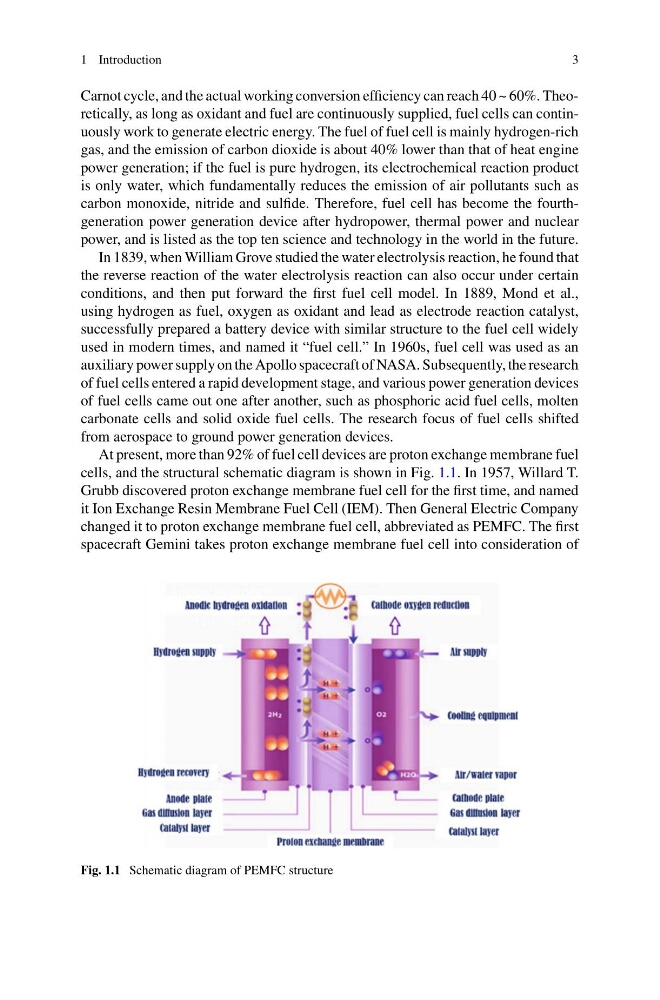
cells, and the structural schematic diagram is shown in Fig. 1.1. In 1957, Willard T.
Grubb discovered proton exchange membrane fuel cell for the first time, and named
it Ion Exchange Resin Membrane Fuel Cell (IEM). Then General Electric Company
changed it to proton exchange membrane fuel cell, abbreviated as PEMFC. The first
spacecraft Gemini takes proton exchange membrane fuel cell into consideration of
Fig. 1.1 Schematic diagram of PEMFC structure
3
Carnot cycle, and the actual working conversion efficiency can reach 40 ~ 60%. Theoretically, as long as oxidant and fuel are continuously supplied, fuel cells can continuously work to generate electric energy. The fuel of fuel cell is mainly hydrogen-rich
gas, and the emission of carbon dioxide is about 40% lower than that of heat engine
power generation; if the fuel is pure hydrogen, its electrochemical reaction product
is only water, which fundamentally reduces the emission of air pollutants such as
carbon monoxide, nitride and sulfide. Therefore, fuel cell has become the fourthgeneration power generation device after hydropower, thermal power and nuclear
power, and is listed as the top ten science and technology in the world in the future.
In 1839, when William Grove studied the water electrolysis reaction, he found that
the reverse reaction of the water electrolysis reaction can also occur under certain
conditions, and then put forward the first fuel cell model. In 1889, Mond et al.,
using hydrogen as fuel, oxygen as oxidant and lead as electrode reaction catalyst,
successfully prepared a battery device with similar structure to the fuel cell widely
used in modern times, and named it “fuel cell.” In 1960s, fuel cell was used as an
auxiliary power supply on the Apollo spacecraft of NASA. Subsequently, the research
of fuel cells entered a rapid development stage, and various power generation devices
of fuel cells came out one after another, such as phosphoric acid fuel cells, molten
carbonate cells and solid oxide fuel cells. The research focus of fuel cells shifted
from aerospace to ground power generation devices.
At present, more than 92% of fuel cell devices are proton exchange membrane fuel
cells, and the structural schematic diagram is shown in Fig. 1.1. In 1957, Willard T.
Grubb discovered proton exchange membrane fuel cell for the first time, and named
it Ion Exchange Resin Membrane Fuel Cell (IEM). Then General Electric Company
changed it to proton exchange membrane fuel cell, abbreviated as PEMFC. The first
spacecraft Gemini takes proton exchange membrane fuel cell into consideration of
Fig. 1.1 Schematic diagram of PEMFC structure