

4 Catalyst Materials for Oxygen Reduction Reaction
101
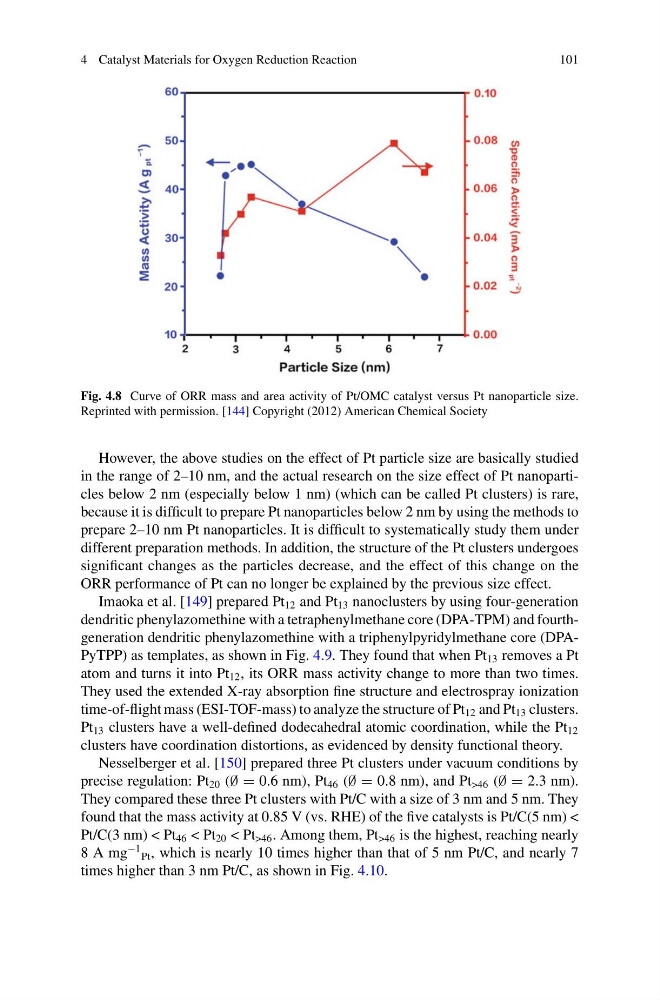
Fig. 4.8 Curve of ORR mass and area activity of Pt/OMC catalyst versus Pt nanoparticle size.
Reprinted with permission. [144] Copyright (2012) American Chemical Society
However, the above studies on the effect of Pt particle size are basically studied
in the range of 2–10 nm, and the actual research on the size effect of Pt nanoparticles below 2 nm (especially below 1 nm) (which can be called Pt clusters) is rare,
because it is difficult to prepare Pt nanoparticles below 2 nm by using the methods to
prepare 2–10 nm Pt nanoparticles. It is difficult to systematically study them under
different preparation methods. In addition, the structure of the Pt clusters undergoes
significant changes as the particles decrease, and the effect of this change on the
ORR performance of Pt can no longer be explained by the previous size effect.
Imaoka et al. [149] prepared Pt 12 and Pt 13 nanoclusters by using four-generation
dendritic phenylazomethine with a tetraphenylmethane core (DPA-TPM) and fourthgeneration dendritic phenylazomethine with a triphenylpyridylmethane core (DPAPyTPP) as templates, as shown in Fig. 4.9. They found that when Pt 13 removes a Pt
atom and turns it into Pt 12 , its ORR mass activity change to more than two times.
They used the extended X-ray absorption fine structure and electrospray ionization
time-of-flight mass (ESI-TOF-mass) to analyze the structure of Pt 12 and Pt 13 clusters.
Pt 13 clusters have a well-defined dodecahedral atomic coordination, while the Pt 12
clusters have coordination distortions, as evidenced by density functional theory.
Nesselberger et al. [150] prepared three Pt clusters under vacuum conditions by
precise regulation: Pt 20 (∅ = 0.6 nm), Pt 46 (∅ = 0.8 nm), and Pt >46 (∅ = 2.3 nm).
They compared these three Pt clusters with Pt/C with a size of 3 nm and 5 nm. They
found that the mass activity at 0.85 V (vs. RHE) of the five catalysts is Pt/C(5 nm) <
Pt/C(3 nm) < Pt 46 < Pt 20 < Pt >46 . Among them, Pt >46 is the highest, reaching nearly
8 A mg
−1
Pt , which is nearly 10 times higher than that of 5 nm Pt/C, and nearly 7
times higher than 3 nm Pt/C, as shown in Fig. 4.10.
101
Fig. 4.8 Curve of ORR mass and area activity of Pt/OMC catalyst versus Pt nanoparticle size.
Reprinted with permission. [144] Copyright (2012) American Chemical Society
However, the above studies on the effect of Pt particle size are basically studied
in the range of 2–10 nm, and the actual research on the size effect of Pt nanoparticles below 2 nm (especially below 1 nm) (which can be called Pt clusters) is rare,
because it is difficult to prepare Pt nanoparticles below 2 nm by using the methods to
prepare 2–10 nm Pt nanoparticles. It is difficult to systematically study them under
different preparation methods. In addition, the structure of the Pt clusters undergoes
significant changes as the particles decrease, and the effect of this change on the
ORR performance of Pt can no longer be explained by the previous size effect.
Imaoka et al. [149] prepared Pt 12 and Pt 13 nanoclusters by using four-generation
dendritic phenylazomethine with a tetraphenylmethane core (DPA-TPM) and fourthgeneration dendritic phenylazomethine with a triphenylpyridylmethane core (DPAPyTPP) as templates, as shown in Fig. 4.9. They found that when Pt 13 removes a Pt
atom and turns it into Pt 12 , its ORR mass activity change to more than two times.
They used the extended X-ray absorption fine structure and electrospray ionization
time-of-flight mass (ESI-TOF-mass) to analyze the structure of Pt 12 and Pt 13 clusters.
Pt 13 clusters have a well-defined dodecahedral atomic coordination, while the Pt 12
clusters have coordination distortions, as evidenced by density functional theory.
Nesselberger et al. [150] prepared three Pt clusters under vacuum conditions by
precise regulation: Pt 20 (∅ = 0.6 nm), Pt 46 (∅ = 0.8 nm), and Pt >46 (∅ = 2.3 nm).
They compared these three Pt clusters with Pt/C with a size of 3 nm and 5 nm. They
found that the mass activity at 0.85 V (vs. RHE) of the five catalysts is Pt/C(5 nm) <
Pt/C(3 nm) < Pt 46 < Pt 20 < Pt >46 . Among them, Pt >46 is the highest, reaching nearly
8 A mg
−1
Pt , which is nearly 10 times higher than that of 5 nm Pt/C, and nearly 7
times higher than 3 nm Pt/C, as shown in Fig. 4.10.