

76
M. Seto et al.
to zero by lowering the temperature to zero, phonon annihilation is difficult to observe
at low temperature as expected. In contrast, phonon creation is possible even at zero
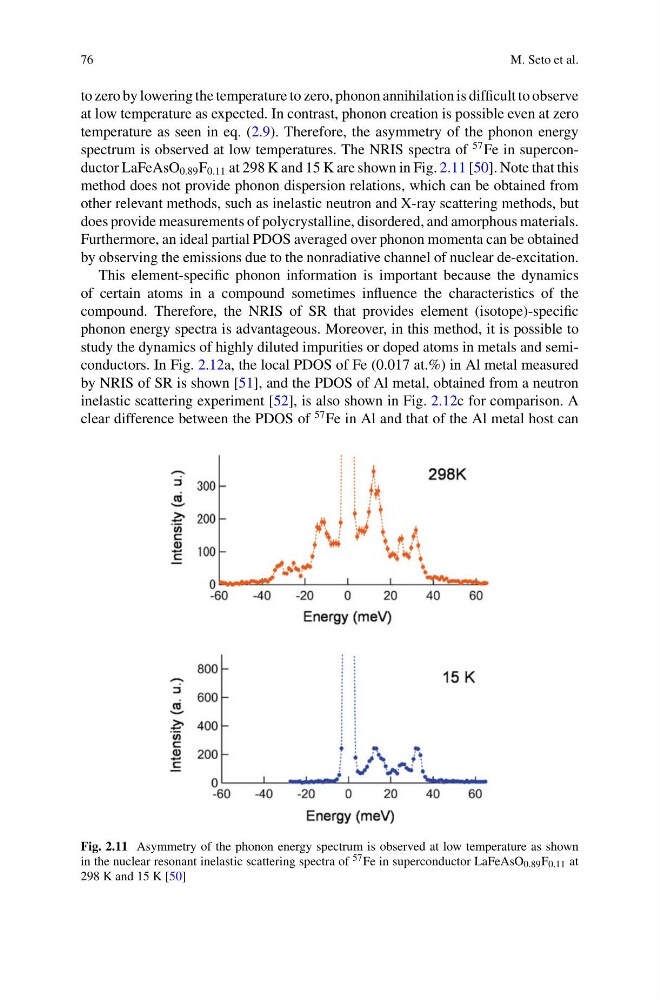
temperature as seen in eq. (2.9). Therefore, the asymmetry of the phonon energy
spectrum is observed at low temperatures. The NRIS spectra of
57 Fe in superconductor LaFeAsO 0.89 F 0.11 at 298 K and 15 K are shown in Fig. 2.11 [50]. Note that this
method does not provide phonon dispersion relations, which can be obtained from
other relevant methods, such as inelastic neutron and X-ray scattering methods, but
does provide measurements of polycrystalline, disordered, and amorphous materials.
Furthermore, an ideal partial PDOS averaged over phonon momenta can be obtained
by observing the emissions due to the nonradiative channel of nuclear de-excitation.
This element-specific phonon information is important because the dynamics
of certain atoms in a compound sometimes influence the characteristics of the
compound. Therefore, the NRIS of SR that provides element (isotope)-specific
phonon energy spectra is advantageous. Moreover, in this method, it is possible to
study the dynamics of highly diluted impurities or doped atoms in metals and semiconductors. In Fig. 2.12a, the local PDOS of Fe (0.017 at.%) in Al metal measured
by NRIS of SR is shown [51], and the PDOS of Al metal, obtained from a neutron
inelastic scattering experiment [52], is also shown in Fig. 2.12c for comparison. A
clear difference between the PDOS of
57 Fe in Al and that of the Al metal host can
Fig. 2.11 Asymmetry of the phonon energy spectrum is observed at low temperature as shown
in the nuclear resonant inelastic scattering spectra of 57 Fe in superconductor LaFeAsO 0.89 F 0.11 at
298 K and 15 K [50]
M. Seto et al.
to zero by lowering the temperature to zero, phonon annihilation is difficult to observe
at low temperature as expected. In contrast, phonon creation is possible even at zero
temperature as seen in eq. (2.9). Therefore, the asymmetry of the phonon energy
spectrum is observed at low temperatures. The NRIS spectra of
57 Fe in superconductor LaFeAsO 0.89 F 0.11 at 298 K and 15 K are shown in Fig. 2.11 [50]. Note that this
method does not provide phonon dispersion relations, which can be obtained from
other relevant methods, such as inelastic neutron and X-ray scattering methods, but
does provide measurements of polycrystalline, disordered, and amorphous materials.
Furthermore, an ideal partial PDOS averaged over phonon momenta can be obtained
by observing the emissions due to the nonradiative channel of nuclear de-excitation.
This element-specific phonon information is important because the dynamics
of certain atoms in a compound sometimes influence the characteristics of the
compound. Therefore, the NRIS of SR that provides element (isotope)-specific
phonon energy spectra is advantageous. Moreover, in this method, it is possible to
study the dynamics of highly diluted impurities or doped atoms in metals and semiconductors. In Fig. 2.12a, the local PDOS of Fe (0.017 at.%) in Al metal measured
by NRIS of SR is shown [51], and the PDOS of Al metal, obtained from a neutron
inelastic scattering experiment [52], is also shown in Fig. 2.12c for comparison. A
clear difference between the PDOS of
57 Fe in Al and that of the Al metal host can
Fig. 2.11 Asymmetry of the phonon energy spectrum is observed at low temperature as shown
in the nuclear resonant inelastic scattering spectra of 57 Fe in superconductor LaFeAsO 0.89 F 0.11 at
298 K and 15 K [50]