

2 Synchrotron-Radiation-Based Energy-Domain Mössbauer …
69
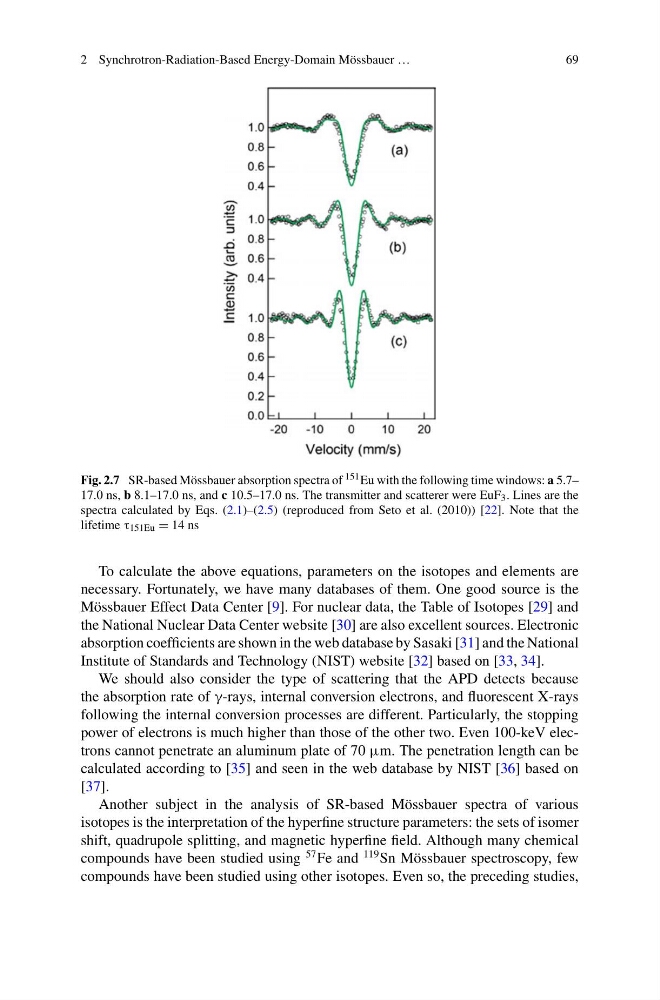
Fig. 2.7 SR-based Mössbauer absorption spectra of 151 Eu with the following time windows: a 5.7–
17.0 ns, b 8.1–17.0 ns, and c 10.5–17.0 ns. The transmitter and scatterer were EuF 3 . Lines are the
spectra calculated by Eqs. (2.1)–(2.5) (reproduced from Seto et al. (2010)) [22]. Note that the
lifetime τ 151Eu = 14 ns
To calculate the above equations, parameters on the isotopes and elements are
necessary. Fortunately, we have many databases of them. One good source is the
Mössbauer Effect Data Center [9]. For nuclear data, the Table of Isotopes [29] and
the National Nuclear Data Center website [30] are also excellent sources. Electronic
absorption coefficients are shown in the web database by Sasaki [31] and the National
Institute of Standards and Technology (NIST) website [32] based on [33, 34].
We should also consider the type of scattering that the APD detects because
the absorption rate of γ-rays, internal conversion electrons, and fluorescent X-rays
following the internal conversion processes are different. Particularly, the stopping
power of electrons is much higher than those of the other two. Even 100-keV electrons cannot penetrate an aluminum plate of 70 μm. The penetration length can be
calculated according to [35] and seen in the web database by NIST [36] based on
[37].
Another subject in the analysis of SR-based Mössbauer spectra of various
isotopes is the interpretation of the hyperfine structure parameters: the sets of isomer
shift, quadrupole splitting, and magnetic hyperfine field. Although many chemical
compounds have been studied using
57 Fe and
119 Sn Mössbauer spectroscopy, few
compounds have been studied using other isotopes. Even so, the preceding studies,
69
Fig. 2.7 SR-based Mössbauer absorption spectra of 151 Eu with the following time windows: a 5.7–
17.0 ns, b 8.1–17.0 ns, and c 10.5–17.0 ns. The transmitter and scatterer were EuF 3 . Lines are the
spectra calculated by Eqs. (2.1)–(2.5) (reproduced from Seto et al. (2010)) [22]. Note that the
lifetime τ 151Eu = 14 ns
To calculate the above equations, parameters on the isotopes and elements are
necessary. Fortunately, we have many databases of them. One good source is the
Mössbauer Effect Data Center [9]. For nuclear data, the Table of Isotopes [29] and
the National Nuclear Data Center website [30] are also excellent sources. Electronic
absorption coefficients are shown in the web database by Sasaki [31] and the National
Institute of Standards and Technology (NIST) website [32] based on [33, 34].
We should also consider the type of scattering that the APD detects because
the absorption rate of γ-rays, internal conversion electrons, and fluorescent X-rays
following the internal conversion processes are different. Particularly, the stopping
power of electrons is much higher than those of the other two. Even 100-keV electrons cannot penetrate an aluminum plate of 70 μm. The penetration length can be
calculated according to [35] and seen in the web database by NIST [36] based on
[37].
Another subject in the analysis of SR-based Mössbauer spectra of various
isotopes is the interpretation of the hyperfine structure parameters: the sets of isomer
shift, quadrupole splitting, and magnetic hyperfine field. Although many chemical
compounds have been studied using
57 Fe and
119 Sn Mössbauer spectroscopy, few
compounds have been studied using other isotopes. Even so, the preceding studies,