

1 Historical Developments and Future Perspectives …
43
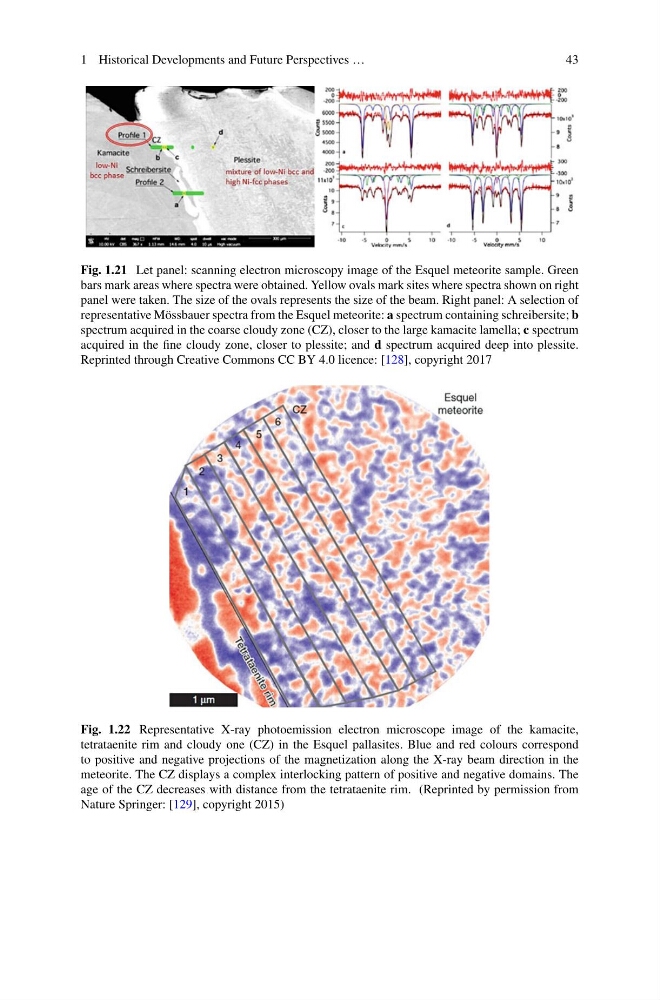
Fig. 1.21 Let panel: scanning electron microscopy image of the Esquel meteorite sample. Green
bars mark areas where spectra were obtained. Yellow ovals mark sites where spectra shown on right
panel were taken. The size of the ovals represents the size of the beam. Right panel: A selection of
representative Mössbauer spectra from the Esquel meteorite: a spectrum containing schreibersite; b
spectrum acquired in the coarse cloudy zone (CZ), closer to the large kamacite lamella; c spectrum
acquired in the fine cloudy zone, closer to plessite; and d spectrum acquired deep into plessite.
Reprinted through Creative Commons CC BY 4.0 licence: [128], copyright 2017
Fig. 1.22 Representative X-ray photoemission electron microscope image of the kamacite,
tetrataenite rim and cloudy one (CZ) in the Esquel pallasites. Blue and red colours correspond
to positive and negative projections of the magnetization along the X-ray beam direction in the
meteorite. The CZ displays a complex interlocking pattern of positive and negative domains. The
age of the CZ decreases with distance from the tetrataenite rim. (Reprinted by permission from
Nature Springer: [129], copyright 2015)
43
Fig. 1.21 Let panel: scanning electron microscopy image of the Esquel meteorite sample. Green
bars mark areas where spectra were obtained. Yellow ovals mark sites where spectra shown on right
panel were taken. The size of the ovals represents the size of the beam. Right panel: A selection of
representative Mössbauer spectra from the Esquel meteorite: a spectrum containing schreibersite; b
spectrum acquired in the coarse cloudy zone (CZ), closer to the large kamacite lamella; c spectrum
acquired in the fine cloudy zone, closer to plessite; and d spectrum acquired deep into plessite.
Reprinted through Creative Commons CC BY 4.0 licence: [128], copyright 2017
Fig. 1.22 Representative X-ray photoemission electron microscope image of the kamacite,
tetrataenite rim and cloudy one (CZ) in the Esquel pallasites. Blue and red colours correspond
to positive and negative projections of the magnetization along the X-ray beam direction in the
meteorite. The CZ displays a complex interlocking pattern of positive and negative domains. The
age of the CZ decreases with distance from the tetrataenite rim. (Reprinted by permission from
Nature Springer: [129], copyright 2015)