

478
Y. Yoshida
transducer + PPAC
d
(a)
(b)
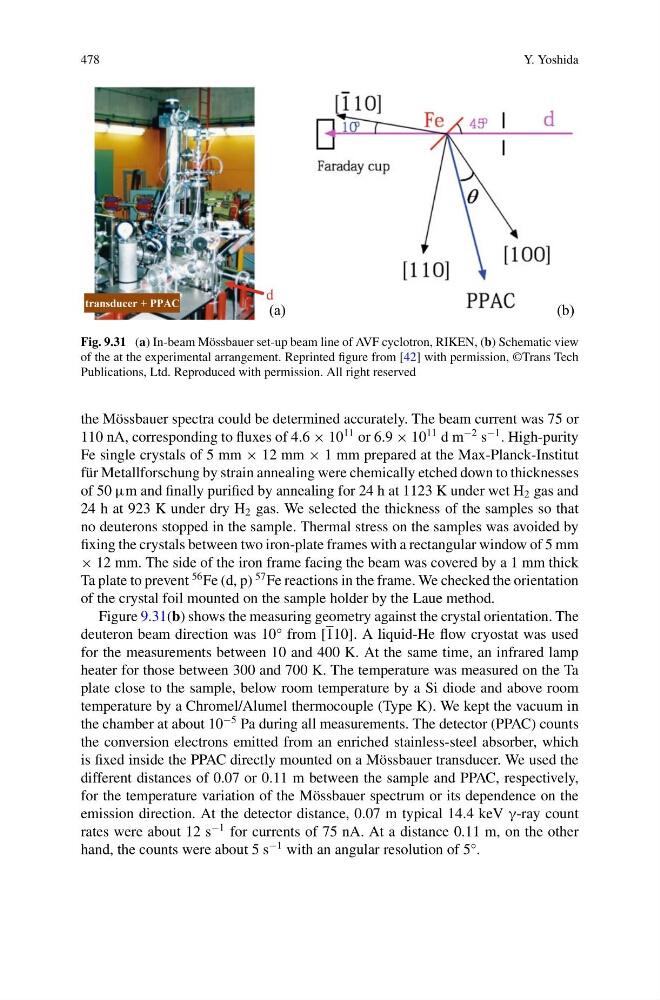
Fig. 9.31 (a) In-beam Mössbauer set-up beam line of AVF cyclotron, RIKEN, (b) Schematic view
of the at the experimental arrangement. Reprinted figure from [42] with permission, ©Trans Tech
Publications, Ltd. Reproduced with permission. All right reserved
the Mössbauer spectra could be determined accurately. The beam current was 75 or
110 nA, corresponding to fluxes of 4.6 × 10
11 or 6.9 × 10
11 d m
−2 s
−1 . High-purity
Fe single crystals of 5 mm × 12 mm × 1 mm prepared at the Max-Planck-Institut
für Metallforschung by strain annealing were chemically etched down to thicknesses
of 50 μm and finally purified by annealing for 24 h at 1123 K under wet H 2 gas and
24 h at 923 K under dry H 2 gas. We selected the thickness of the samples so that
no deuterons stopped in the sample. Thermal stress on the samples was avoided by
fixing the crystals between two iron-plate frames with a rectangular window of 5 mm
× 12 mm. The side of the iron frame facing the beam was covered by a 1 mm thick
Ta plate to prevent
56 Fe (d, p)
57 Fe reactions in the frame. We checked the orientation
of the crystal foil mounted on the sample holder by the Laue method.
Figure 9.31(b) shows the measuring geometry against the crystal orientation. The
deuteron beam direction was 10° from [110]. A liquid-He flow cryostat was used
for the measurements between 10 and 400 K. At the same time, an infrared lamp
heater for those between 300 and 700 K. The temperature was measured on the Ta
plate close to the sample, below room temperature by a Si diode and above room
temperature by a Chromel/Alumel thermocouple (Type K). We kept the vacuum in
the chamber at about 10
−5 Pa during all measurements. The detector (PPAC) counts
the conversion electrons emitted from an enriched stainless-steel absorber, which
is fixed inside the PPAC directly mounted on a Mössbauer transducer. We used the
different distances of 0.07 or 0.11 m between the sample and PPAC, respectively,
for the temperature variation of the Mössbauer spectrum or its dependence on the
emission direction. At the detector distance, 0.07 m typical 14.4 keV γ-ray count
rates were about 12 s
−1 for currents of 75 nA. At a distance 0.11 m, on the other
hand, the counts were about 5 s
−1 with an angular resolution of 5°.
Y. Yoshida
transducer + PPAC
d
(a)
(b)
Fig. 9.31 (a) In-beam Mössbauer set-up beam line of AVF cyclotron, RIKEN, (b) Schematic view
of the at the experimental arrangement. Reprinted figure from [42] with permission, ©Trans Tech
Publications, Ltd. Reproduced with permission. All right reserved
the Mössbauer spectra could be determined accurately. The beam current was 75 or
110 nA, corresponding to fluxes of 4.6 × 10
11 or 6.9 × 10
11 d m
−2 s
−1 . High-purity
Fe single crystals of 5 mm × 12 mm × 1 mm prepared at the Max-Planck-Institut
für Metallforschung by strain annealing were chemically etched down to thicknesses
of 50 μm and finally purified by annealing for 24 h at 1123 K under wet H 2 gas and
24 h at 923 K under dry H 2 gas. We selected the thickness of the samples so that
no deuterons stopped in the sample. Thermal stress on the samples was avoided by
fixing the crystals between two iron-plate frames with a rectangular window of 5 mm
× 12 mm. The side of the iron frame facing the beam was covered by a 1 mm thick
Ta plate to prevent
56 Fe (d, p)
57 Fe reactions in the frame. We checked the orientation
of the crystal foil mounted on the sample holder by the Laue method.
Figure 9.31(b) shows the measuring geometry against the crystal orientation. The
deuteron beam direction was 10° from [110]. A liquid-He flow cryostat was used
for the measurements between 10 and 400 K. At the same time, an infrared lamp
heater for those between 300 and 700 K. The temperature was measured on the Ta
plate close to the sample, below room temperature by a Si diode and above room
temperature by a Chromel/Alumel thermocouple (Type K). We kept the vacuum in
the chamber at about 10
−5 Pa during all measurements. The detector (PPAC) counts
the conversion electrons emitted from an enriched stainless-steel absorber, which
is fixed inside the PPAC directly mounted on a Mössbauer transducer. We used the
different distances of 0.07 or 0.11 m between the sample and PPAC, respectively,
for the temperature variation of the Mössbauer spectrum or its dependence on the
emission direction. At the detector distance, 0.07 m typical 14.4 keV γ-ray count
rates were about 12 s
−1 for currents of 75 nA. At a distance 0.11 m, on the other
hand, the counts were about 5 s
−1 with an angular resolution of 5°.