

9 Mössbauer Spectroscopic Studies on Atomic Diffusion in Materials
449
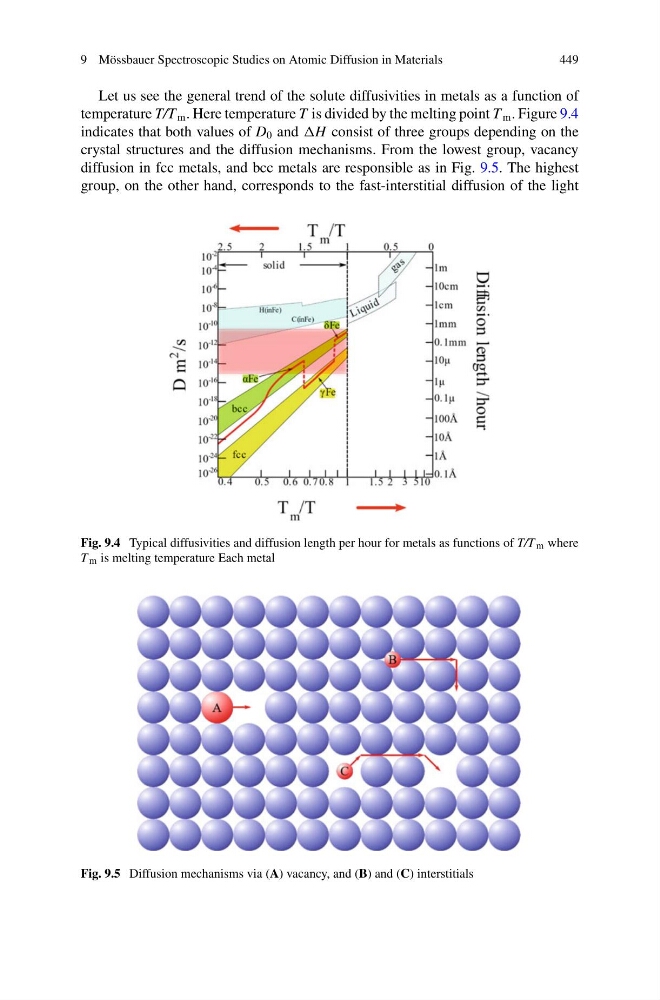
Let us see the general trend of the solute diffusivities in metals as a function of
temperature T/T m . Here temperature T is divided by the melting point T m . Figure 9.4
indicates that both values of D 0 and H consist of three groups depending on the
crystal structures and the diffusion mechanisms. From the lowest group, vacancy
diffusion in fcc metals, and bcc metals are responsible as in Fig. 9.5. The highest
group, on the other hand, corresponds to the fast-interstitial diffusion of the light
Fig. 9.4 Typical diffusivities and diffusion length per hour for metals as functions of T/T m where
T m is melting temperature Each metal
Fig. 9.5 Diffusion mechanisms via (A) vacancy, and (B) and (C) interstitials
449
Let us see the general trend of the solute diffusivities in metals as a function of
temperature T/T m . Here temperature T is divided by the melting point T m . Figure 9.4
indicates that both values of D 0 and H consist of three groups depending on the
crystal structures and the diffusion mechanisms. From the lowest group, vacancy
diffusion in fcc metals, and bcc metals are responsible as in Fig. 9.5. The highest
group, on the other hand, corresponds to the fast-interstitial diffusion of the light
Fig. 9.4 Typical diffusivities and diffusion length per hour for metals as functions of T/T m where
T m is melting temperature Each metal
Fig. 9.5 Diffusion mechanisms via (A) vacancy, and (B) and (C) interstitials