

8 Mössbauer Spectroscopy in External Magnetic Fields
431
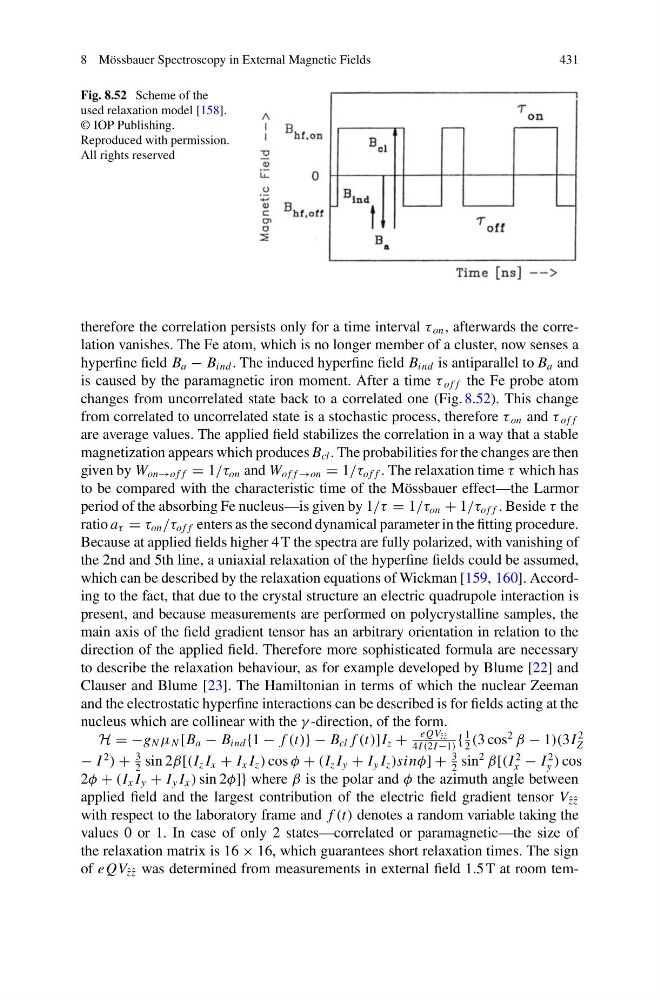
Fig. 8.52 Scheme of the
used relaxation model [158].
© IOP Publishing.
Reproduced with permission.
All rights reserved
therefore the correlation persists only for a time interval τ on , afterwards the correlation vanishes. The Fe atom, which is no longer member of a cluster, now senses a
hyperfine field B a − B ind . The induced hyperfine field B ind is antiparallel to B a and
is caused by the paramagnetic iron moment. After a time τ of f the Fe probe atom
changes from uncorrelated state back to a correlated one (Fig. 8.52). This change
from correlated to uncorrelated state is a stochastic process, therefore τ on and τ of f
are average values. The applied field stabilizes the correlation in a way that a stable
magnetization appears which produces B cl . The probabilities for the changes are then
given by W on→of f = 1/τ on and W of f →on = 1/τ of f . The relaxation time τ which has
to be compared with the characteristic time of the Mössbauer effect—the Larmor
period of the absorbing Fe nucleus—is given by 1/τ = 1/τ on + 1/τ of f . Beside τ the
ratio a τ = τ on /τ of f enters as the second dynamical parameter in the fitting procedure.
Because at applied fields higher 4 T the spectra are fully polarized, with vanishing of
the 2nd and 5th line, a uniaxial relaxation of the hyperfine fields could be assumed,
which can be described by the relaxation equations of Wickman [159, 160]. According to the fact, that due to the crystal structure an electric quadrupole interaction is
present, and because measurements are performed on polycrystalline samples, the
main axis of the field gradient tensor has an arbitrary orientation in relation to the
direction of the applied field. Therefore more sophisticated formula are necessary
to describe the relaxation behaviour, as for example developed by Blume [22] and
Clauser and Blume [23]. The Hamiltonian in terms of which the nuclear Zeeman
and the electrostatic hyperfine interactions can be described is for fields acting at the
nucleus which are collinear with the γ -direction, of the form.
H = −g N μ N [B a − B ind {1 − f (t)} − B cl f (t)]I z +
eQV ˆ
z ˆ
z
4I (2I −1)
{
1
2
(3 cos
2
β − 1)(3I
2
Z
− I
2
) +
3
2
sin 2β[(I z I x + I x I z ) cos φ + (I z I y + I y I z )sinφ] +
3
2
sin
2
β[(I
2
x − I
2
y ) cos
2φ + (I x I y + I y I x ) sin 2φ]} where β is the polar and φ the azimuth angle between
applied field and the largest contribution of the electric field gradient tensor V ˆ
z ˆ
z
with respect to the laboratory frame and f (t) denotes a random variable taking the
values 0 or 1. In case of only 2 states—correlated or paramagnetic—the size of
the relaxation matrix is 16 × 16, which guarantees short relaxation times. The sign
of eQV ˆ
z ˆ
z was determined from measurements in external field 1.5 T at room tem-
431
Fig. 8.52 Scheme of the
used relaxation model [158].
© IOP Publishing.
Reproduced with permission.
All rights reserved
therefore the correlation persists only for a time interval τ on , afterwards the correlation vanishes. The Fe atom, which is no longer member of a cluster, now senses a
hyperfine field B a − B ind . The induced hyperfine field B ind is antiparallel to B a and
is caused by the paramagnetic iron moment. After a time τ of f the Fe probe atom
changes from uncorrelated state back to a correlated one (Fig. 8.52). This change
from correlated to uncorrelated state is a stochastic process, therefore τ on and τ of f
are average values. The applied field stabilizes the correlation in a way that a stable
magnetization appears which produces B cl . The probabilities for the changes are then
given by W on→of f = 1/τ on and W of f →on = 1/τ of f . The relaxation time τ which has
to be compared with the characteristic time of the Mössbauer effect—the Larmor
period of the absorbing Fe nucleus—is given by 1/τ = 1/τ on + 1/τ of f . Beside τ the
ratio a τ = τ on /τ of f enters as the second dynamical parameter in the fitting procedure.
Because at applied fields higher 4 T the spectra are fully polarized, with vanishing of
the 2nd and 5th line, a uniaxial relaxation of the hyperfine fields could be assumed,
which can be described by the relaxation equations of Wickman [159, 160]. According to the fact, that due to the crystal structure an electric quadrupole interaction is
present, and because measurements are performed on polycrystalline samples, the
main axis of the field gradient tensor has an arbitrary orientation in relation to the
direction of the applied field. Therefore more sophisticated formula are necessary
to describe the relaxation behaviour, as for example developed by Blume [22] and
Clauser and Blume [23]. The Hamiltonian in terms of which the nuclear Zeeman
and the electrostatic hyperfine interactions can be described is for fields acting at the
nucleus which are collinear with the γ -direction, of the form.
H = −g N μ N [B a − B ind {1 − f (t)} − B cl f (t)]I z +
eQV ˆ
z ˆ
z
4I (2I −1)
{
1
2
(3 cos
2
β − 1)(3I
2
Z
− I
2
) +
3
2
sin 2β[(I z I x + I x I z ) cos φ + (I z I y + I y I z )sinφ] +
3
2
sin
2
β[(I
2
x − I
2
y ) cos
2φ + (I x I y + I y I x ) sin 2φ]} where β is the polar and φ the azimuth angle between
applied field and the largest contribution of the electric field gradient tensor V ˆ
z ˆ
z
with respect to the laboratory frame and f (t) denotes a random variable taking the
values 0 or 1. In case of only 2 states—correlated or paramagnetic—the size of
the relaxation matrix is 16 × 16, which guarantees short relaxation times. The sign
of eQV ˆ
z ˆ
z was determined from measurements in external field 1.5 T at room tem-