

1 Historical Developments and Future Perspectives …
27
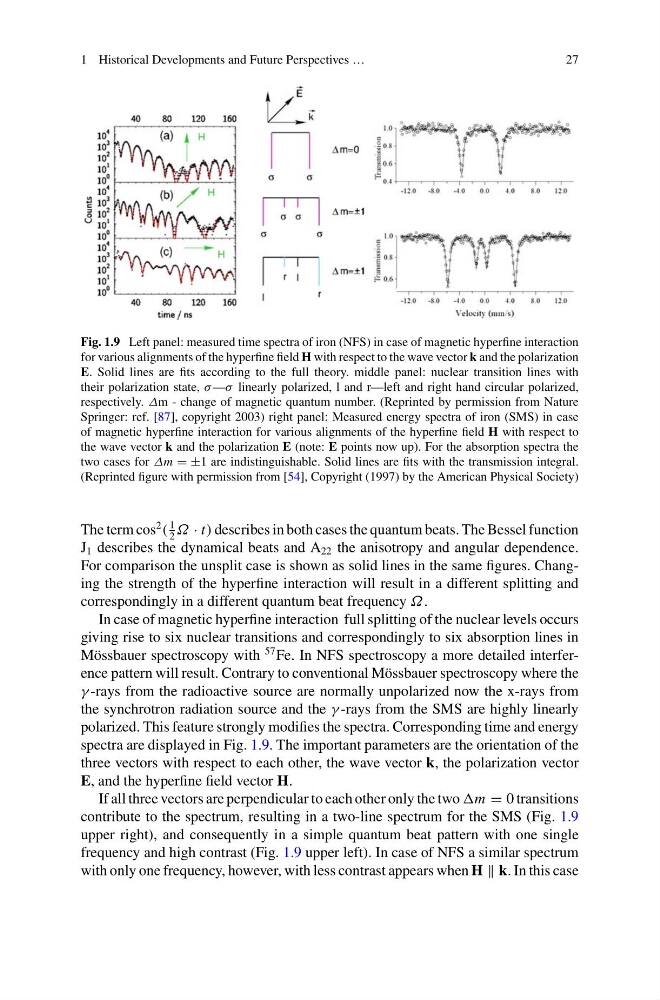
Fig. 1.9 Left panel: measured time spectra of iron (NFS) in case of magnetic hyperfine interaction
for various alignments of the hyperfine field H with respect to the wave vector k and the polarization
E. Solid lines are fits according to the full theory. middle panel: nuclear transition lines with
their polarization state, σ —σ linearly polarized, l and r—left and right hand circular polarized,
respectively. Δm - change of magnetic quantum number. (Reprinted by permission from Nature
Springer: ref. [87], copyright 2003) right panel: Measured energy spectra of iron (SMS) in case
of magnetic hyperfine interaction for various alignments of the hyperfine field H with respect to
the wave vector k and the polarization E (note: E points now up). For the absorption spectra the
two cases for Δm = ±1 are indistinguishable. Solid lines are fits with the transmission integral.
(Reprinted figure with permission from [54], Copyright (1997) by the American Physical Society)
The term cos
2
(
1
2
Ω · t) describes in both cases the quantum beats. The Bessel function
J 1 describes the dynamical beats and A 22 the anisotropy and angular dependence.
For comparison the unsplit case is shown as solid lines in the same figures. Changing the strength of the hyperfine interaction will result in a different splitting and
correspondingly in a different quantum beat frequency Ω.
In case of magnetic hyperfine interaction full splitting of the nuclear levels occurs
giving rise to six nuclear transitions and correspondingly to six absorption lines in
Mössbauer spectroscopy with
57 Fe. In NFS spectroscopy a more detailed interference pattern will result. Contrary to conventional Mössbauer spectroscopy where the
γ -rays from the radioactive source are normally unpolarized now the x-rays from
the synchrotron radiation source and the γ -rays from the SMS are highly linearly
polarized. This feature strongly modifies the spectra. Corresponding time and energy
spectra are displayed in Fig. 1.9. The important parameters are the orientation of the
three vectors with respect to each other, the wave vector k, the polarization vector
E, and the hyperfine field vector H.
If all three vectors are perpendicular to each other only the two m = 0 transitions
contribute to the spectrum, resulting in a two-line spectrum for the SMS (Fig. 1.9
upper right), and consequently in a simple quantum beat pattern with one single
frequency and high contrast (Fig. 1.9 upper left). In case of NFS a similar spectrum
with only one frequency, however, with less contrast appears when H k. In this case
27
Fig. 1.9 Left panel: measured time spectra of iron (NFS) in case of magnetic hyperfine interaction
for various alignments of the hyperfine field H with respect to the wave vector k and the polarization
E. Solid lines are fits according to the full theory. middle panel: nuclear transition lines with
their polarization state, σ —σ linearly polarized, l and r—left and right hand circular polarized,
respectively. Δm - change of magnetic quantum number. (Reprinted by permission from Nature
Springer: ref. [87], copyright 2003) right panel: Measured energy spectra of iron (SMS) in case
of magnetic hyperfine interaction for various alignments of the hyperfine field H with respect to
the wave vector k and the polarization E (note: E points now up). For the absorption spectra the
two cases for Δm = ±1 are indistinguishable. Solid lines are fits with the transmission integral.
(Reprinted figure with permission from [54], Copyright (1997) by the American Physical Society)
The term cos
2
(
1
2
Ω · t) describes in both cases the quantum beats. The Bessel function
J 1 describes the dynamical beats and A 22 the anisotropy and angular dependence.
For comparison the unsplit case is shown as solid lines in the same figures. Changing the strength of the hyperfine interaction will result in a different splitting and
correspondingly in a different quantum beat frequency Ω.
In case of magnetic hyperfine interaction full splitting of the nuclear levels occurs
giving rise to six nuclear transitions and correspondingly to six absorption lines in
Mössbauer spectroscopy with
57 Fe. In NFS spectroscopy a more detailed interference pattern will result. Contrary to conventional Mössbauer spectroscopy where the
γ -rays from the radioactive source are normally unpolarized now the x-rays from
the synchrotron radiation source and the γ -rays from the SMS are highly linearly
polarized. This feature strongly modifies the spectra. Corresponding time and energy
spectra are displayed in Fig. 1.9. The important parameters are the orientation of the
three vectors with respect to each other, the wave vector k, the polarization vector
E, and the hyperfine field vector H.
If all three vectors are perpendicular to each other only the two m = 0 transitions
contribute to the spectrum, resulting in a two-line spectrum for the SMS (Fig. 1.9
upper right), and consequently in a simple quantum beat pattern with one single
frequency and high contrast (Fig. 1.9 upper left). In case of NFS a similar spectrum
with only one frequency, however, with less contrast appears when H k. In this case