

386
M. Reissner
8.3 Simple Magnetic Structures
In case of a diamagnet all electronic shells are completely filled. Thus they do not
carry a magnetic moment, therefore they do not react on an applied field B a . In that
case the measured hyperfine field B h f at the nucleus is identical to B a .
In case of an isotropic paramagnet the situation is the following: without external
field the spectrum is a single line, or in case of a small electric quadrupole interaction
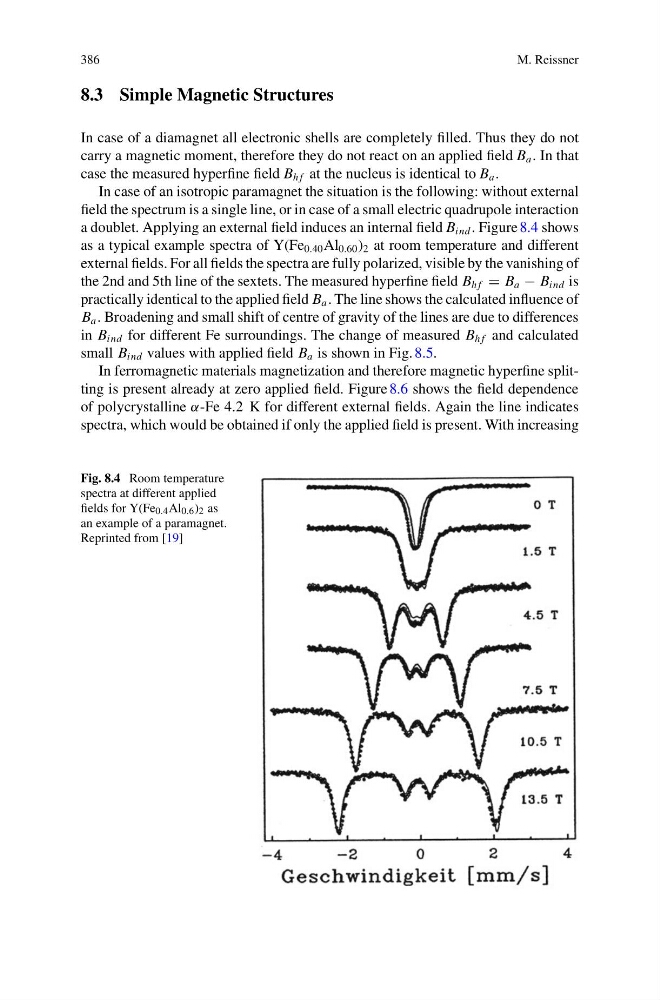
a doublet. Applying an external field induces an internal field B ind . Figure 8.4 shows
as a typical example spectra of Y(Fe 0.40 Al 0.60 ) 2 at room temperature and different
external fields. For all fields the spectra are fully polarized, visible by the vanishing of
the 2nd and 5th line of the sextets. The measured hyperfine field B h f = B a − B ind is
practically identical to the applied field B a . The line shows the calculated influence of
B a . Broadening and small shift of centre of gravity of the lines are due to differences
in B ind for different Fe surroundings. The change of measured B h f and calculated
small B ind values with applied field B a is shown in Fig. 8.5.
In ferromagnetic materials magnetization and therefore magnetic hyperfine splitting is present already at zero applied field. Figure 8.6 shows the field dependence
of polycrystalline α-Fe 4.2 K for different external fields. Again the line indicates
spectra, which would be obtained if only the applied field is present. With increasing
Fig. 8.4 Room temperature
spectra at different applied
fields for Y(Fe 0.4 Al 0.6 ) 2 as
an example of a paramagnet.
Reprinted from [19]
M. Reissner
8.3 Simple Magnetic Structures
In case of a diamagnet all electronic shells are completely filled. Thus they do not
carry a magnetic moment, therefore they do not react on an applied field B a . In that
case the measured hyperfine field B h f at the nucleus is identical to B a .
In case of an isotropic paramagnet the situation is the following: without external
field the spectrum is a single line, or in case of a small electric quadrupole interaction
a doublet. Applying an external field induces an internal field B ind . Figure 8.4 shows
as a typical example spectra of Y(Fe 0.40 Al 0.60 ) 2 at room temperature and different
external fields. For all fields the spectra are fully polarized, visible by the vanishing of
the 2nd and 5th line of the sextets. The measured hyperfine field B h f = B a − B ind is
practically identical to the applied field B a . The line shows the calculated influence of
B a . Broadening and small shift of centre of gravity of the lines are due to differences
in B ind for different Fe surroundings. The change of measured B h f and calculated
small B ind values with applied field B a is shown in Fig. 8.5.
In ferromagnetic materials magnetization and therefore magnetic hyperfine splitting is present already at zero applied field. Figure 8.6 shows the field dependence
of polycrystalline α-Fe 4.2 K for different external fields. Again the line indicates
spectra, which would be obtained if only the applied field is present. With increasing
Fig. 8.4 Room temperature
spectra at different applied
fields for Y(Fe 0.4 Al 0.6 ) 2 as
an example of a paramagnet.
Reprinted from [19]