

374
P.-E. Lippens
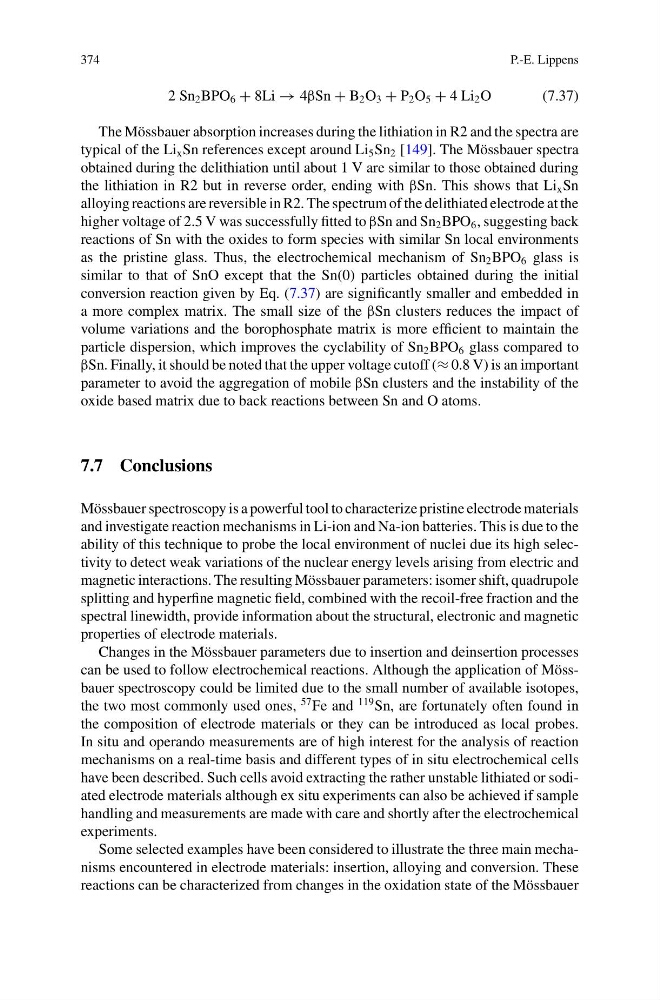
2 Sn 2 BPO 6 + 8Li → 4βSn + B 2 O 3 + P 2 O 5 + 4 Li 2 O
(7.37)
The Mössbauer absorption increases during the lithiation in R2 and the spectra are
typical of the Li x Sn references except around Li 5 Sn 2 [149]. The Mössbauer spectra
obtained during the delithiation until about 1 V are similar to those obtained during
the lithiation in R2 but in reverse order, ending with βSn. This shows that Li x Sn
alloying reactions are reversible in R2. The spectrum of the delithiated electrode at the
higher voltage of 2.5 V was successfully fitted to βSn and Sn 2 BPO 6 , suggesting back
reactions of Sn with the oxides to form species with similar Sn local environments
as the pristine glass. Thus, the electrochemical mechanism of Sn 2 BPO 6 glass is
similar to that of SnO except that the Sn(0) particles obtained during the initial
conversion reaction given by Eq. (7.37) are significantly smaller and embedded in
a more complex matrix. The small size of the βSn clusters reduces the impact of
volume variations and the borophosphate matrix is more efficient to maintain the
particle dispersion, which improves the cyclability of Sn 2 BPO 6 glass compared to
βSn. Finally, it should be noted that the upper voltage cutoff (≈ 0.8 V) is an important
parameter to avoid the aggregation of mobile βSn clusters and the instability of the
oxide based matrix due to back reactions between Sn and O atoms.
7.7 Conclusions
Mössbauer spectroscopy is a powerful tool to characterize pristine electrode materials
and investigate reaction mechanisms in Li-ion and Na-ion batteries. This is due to the
ability of this technique to probe the local environment of nuclei due its high selectivity to detect weak variations of the nuclear energy levels arising from electric and
magnetic interactions. The resulting Mössbauer parameters: isomer shift, quadrupole
splitting and hyperfine magnetic field, combined with the recoil-free fraction and the
spectral linewidth, provide information about the structural, electronic and magnetic
properties of electrode materials.
Changes in the Mössbauer parameters due to insertion and deinsertion processes
can be used to follow electrochemical reactions. Although the application of Mössbauer spectroscopy could be limited due to the small number of available isotopes,
the two most commonly used ones,
57 Fe and
119 Sn, are fortunately often found in
the composition of electrode materials or they can be introduced as local probes.
In situ and operando measurements are of high interest for the analysis of reaction
mechanisms on a real-time basis and different types of in situ electrochemical cells
have been described. Such cells avoid extracting the rather unstable lithiated or sodiated electrode materials although ex situ experiments can also be achieved if sample
handling and measurements are made with care and shortly after the electrochemical
experiments.
Some selected examples have been considered to illustrate the three main mechanisms encountered in electrode materials: insertion, alloying and conversion. These
reactions can be characterized from changes in the oxidation state of the Mössbauer
P.-E. Lippens
2 Sn 2 BPO 6 + 8Li → 4βSn + B 2 O 3 + P 2 O 5 + 4 Li 2 O
(7.37)
The Mössbauer absorption increases during the lithiation in R2 and the spectra are
typical of the Li x Sn references except around Li 5 Sn 2 [149]. The Mössbauer spectra
obtained during the delithiation until about 1 V are similar to those obtained during
the lithiation in R2 but in reverse order, ending with βSn. This shows that Li x Sn
alloying reactions are reversible in R2. The spectrum of the delithiated electrode at the
higher voltage of 2.5 V was successfully fitted to βSn and Sn 2 BPO 6 , suggesting back
reactions of Sn with the oxides to form species with similar Sn local environments
as the pristine glass. Thus, the electrochemical mechanism of Sn 2 BPO 6 glass is
similar to that of SnO except that the Sn(0) particles obtained during the initial
conversion reaction given by Eq. (7.37) are significantly smaller and embedded in
a more complex matrix. The small size of the βSn clusters reduces the impact of
volume variations and the borophosphate matrix is more efficient to maintain the
particle dispersion, which improves the cyclability of Sn 2 BPO 6 glass compared to
βSn. Finally, it should be noted that the upper voltage cutoff (≈ 0.8 V) is an important
parameter to avoid the aggregation of mobile βSn clusters and the instability of the
oxide based matrix due to back reactions between Sn and O atoms.
7.7 Conclusions
Mössbauer spectroscopy is a powerful tool to characterize pristine electrode materials
and investigate reaction mechanisms in Li-ion and Na-ion batteries. This is due to the
ability of this technique to probe the local environment of nuclei due its high selectivity to detect weak variations of the nuclear energy levels arising from electric and
magnetic interactions. The resulting Mössbauer parameters: isomer shift, quadrupole
splitting and hyperfine magnetic field, combined with the recoil-free fraction and the
spectral linewidth, provide information about the structural, electronic and magnetic
properties of electrode materials.
Changes in the Mössbauer parameters due to insertion and deinsertion processes
can be used to follow electrochemical reactions. Although the application of Mössbauer spectroscopy could be limited due to the small number of available isotopes,
the two most commonly used ones,
57 Fe and
119 Sn, are fortunately often found in
the composition of electrode materials or they can be introduced as local probes.
In situ and operando measurements are of high interest for the analysis of reaction
mechanisms on a real-time basis and different types of in situ electrochemical cells
have been described. Such cells avoid extracting the rather unstable lithiated or sodiated electrode materials although ex situ experiments can also be achieved if sample
handling and measurements are made with care and shortly after the electrochemical
experiments.
Some selected examples have been considered to illustrate the three main mechanisms encountered in electrode materials: insertion, alloying and conversion. These
reactions can be characterized from changes in the oxidation state of the Mössbauer