

7 Application of Mössbauer Spectroscopy to Li-Ion and Na-Ion …
369
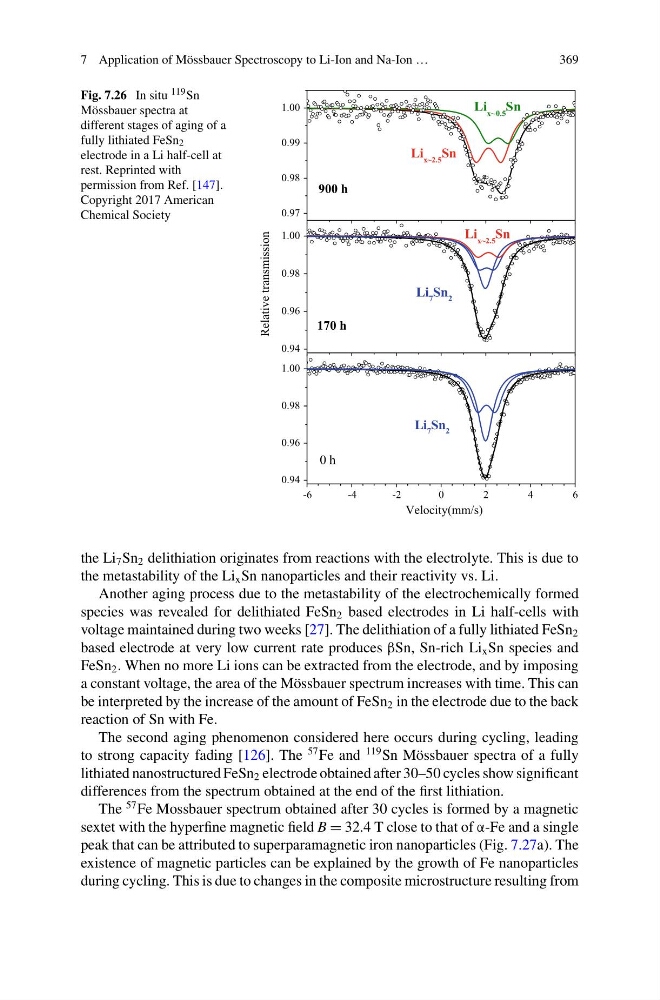
Fig. 7.26 In situ 119 Sn
Mössbauer spectra at
different stages of aging of a
fully lithiated FeSn 2
electrode in a Li half-cell at
rest. Reprinted with
permission from Ref. [147].
Copyright 2017 American
Chemical Society
-6
-4
-2
0
2
4
6
0.94
0.96
0.98
1.00
0.94
0.96
0.98
1.00
0.97
0.98
0.99
1.00
0 h
Li 7 Sn 2
170 h
Li x~2.5 Sn
Li 7 Sn 2
Relative transmission
Li x~0.5 Sn
Li x~2.5 Sn
900 h
Velocity(mm/s)
the Li 7 Sn 2 delithiation originates from reactions with the electrolyte. This is due to
the metastability of the Li x Sn nanoparticles and their reactivity vs. Li.
Another aging process due to the metastability of the electrochemically formed
species was revealed for delithiated FeSn 2 based electrodes in Li half-cells with
voltage maintained during two weeks [27]. The delithiation of a fully lithiated FeSn 2
based electrode at very low current rate produces βSn, Sn-rich Li x Sn species and
FeSn 2 . When no more Li ions can be extracted from the electrode, and by imposing
a constant voltage, the area of the Mössbauer spectrum increases with time. This can
be interpreted by the increase of the amount of FeSn 2 in the electrode due to the back
reaction of Sn with Fe.
The second aging phenomenon considered here occurs during cycling, leading
to strong capacity fading [126]. The
57 Fe and
119 Sn Mössbauer spectra of a fully
lithiated nanostructured FeSn 2 electrode obtained after 30–50 cycles show significant
differences from the spectrum obtained at the end of the first lithiation.
The
57 Fe Mossbauer spectrum obtained after 30 cycles is formed by a magnetic
sextet with the hyperfine magnetic field B = 32.4 T close to that of α-Fe and a single
peak that can be attributed to superparamagnetic iron nanoparticles (Fig. 7.27a). The
existence of magnetic particles can be explained by the growth of Fe nanoparticles
during cycling. This is due to changes in the composite microstructure resulting from
369
Fig. 7.26 In situ 119 Sn
Mössbauer spectra at
different stages of aging of a
fully lithiated FeSn 2
electrode in a Li half-cell at
rest. Reprinted with
permission from Ref. [147].
Copyright 2017 American
Chemical Society
-6
-4
-2
0
2
4
6
0.94
0.96
0.98
1.00
0.94
0.96
0.98
1.00
0.97
0.98
0.99
1.00
0 h
Li 7 Sn 2
170 h
Li x~2.5 Sn
Li 7 Sn 2
Relative transmission
Li x~0.5 Sn
Li x~2.5 Sn
900 h
Velocity(mm/s)
the Li 7 Sn 2 delithiation originates from reactions with the electrolyte. This is due to
the metastability of the Li x Sn nanoparticles and their reactivity vs. Li.
Another aging process due to the metastability of the electrochemically formed
species was revealed for delithiated FeSn 2 based electrodes in Li half-cells with
voltage maintained during two weeks [27]. The delithiation of a fully lithiated FeSn 2
based electrode at very low current rate produces βSn, Sn-rich Li x Sn species and
FeSn 2 . When no more Li ions can be extracted from the electrode, and by imposing
a constant voltage, the area of the Mössbauer spectrum increases with time. This can
be interpreted by the increase of the amount of FeSn 2 in the electrode due to the back
reaction of Sn with Fe.
The second aging phenomenon considered here occurs during cycling, leading
to strong capacity fading [126]. The
57 Fe and
119 Sn Mössbauer spectra of a fully
lithiated nanostructured FeSn 2 electrode obtained after 30–50 cycles show significant
differences from the spectrum obtained at the end of the first lithiation.
The
57 Fe Mossbauer spectrum obtained after 30 cycles is formed by a magnetic
sextet with the hyperfine magnetic field B = 32.4 T close to that of α-Fe and a single
peak that can be attributed to superparamagnetic iron nanoparticles (Fig. 7.27a). The
existence of magnetic particles can be explained by the growth of Fe nanoparticles
during cycling. This is due to changes in the composite microstructure resulting from