

360
P.-E. Lippens
-3 -2 -1 0 1
2
3
6.5Li
0.0Li
-2
0
2
4
6
7.0Li
0.0Li
FeSn2
Fe
FeSn2
Li7Sn2
(a)
(b)
4
α
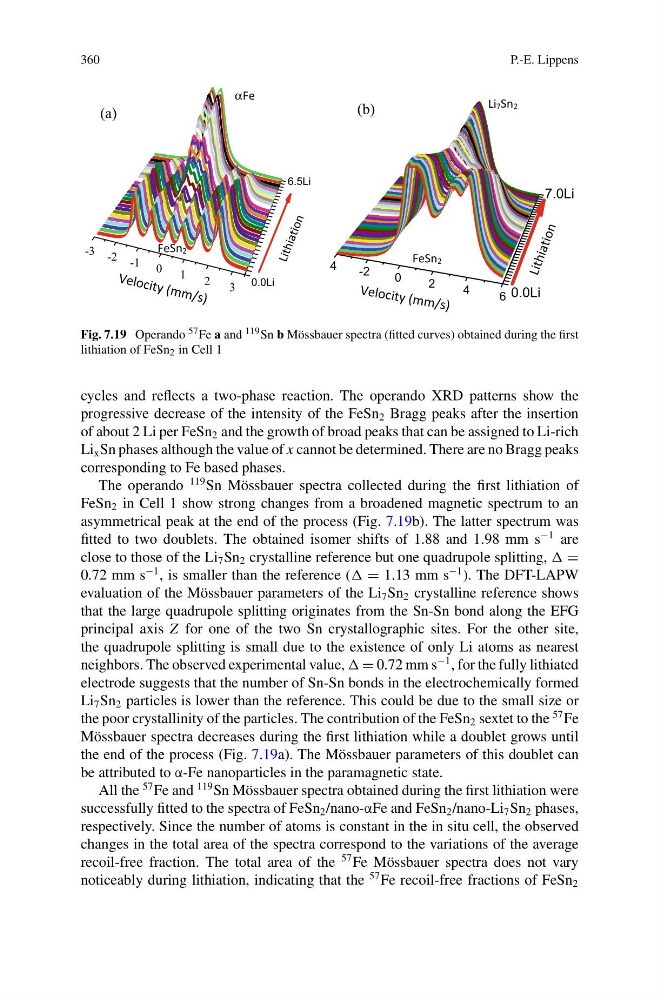
Fig. 7.19 Operando 57 Fe a and 119 Sn b Mössbauer spectra (fitted curves) obtained during the first
lithiation of FeSn 2 in Cell 1
cycles and reflects a two-phase reaction. The operando XRD patterns show the
progressive decrease of the intensity of the FeSn 2 Bragg peaks after the insertion
of about 2 Li per FeSn 2 and the growth of broad peaks that can be assigned to Li-rich
Li x Sn phases although the value of x cannot be determined. There are no Bragg peaks
corresponding to Fe based phases.
The operando
119 Sn Mössbauer spectra collected during the first lithiation of
FeSn 2 in Cell 1 show strong changes from a broadened magnetic spectrum to an
asymmetrical peak at the end of the process (Fig. 7.19b). The latter spectrum was
fitted to two doublets. The obtained isomer shifts of 1.88 and 1.98 mm s
−1 are
close to those of the Li 7 Sn 2 crystalline reference but one quadrupole splitting, =
0.72 mm s
−1 , is smaller than the reference ( = 1.13 mm s
−1 ). The DFT-LAPW
evaluation of the Mössbauer parameters of the Li 7 Sn 2 crystalline reference shows
that the large quadrupole splitting originates from the Sn-Sn bond along the EFG
principal axis Z for one of the two Sn crystallographic sites. For the other site,
the quadrupole splitting is small due to the existence of only Li atoms as nearest
neighbors. The observed experimental value, = 0.72 mm s
−1 , for the fully lithiated
electrode suggests that the number of Sn-Sn bonds in the electrochemically formed
Li 7 Sn 2 particles is lower than the reference. This could be due to the small size or
the poor crystallinity of the particles. The contribution of the FeSn 2 sextet to the
57 Fe
Mössbauer spectra decreases during the first lithiation while a doublet grows until
the end of the process (Fig. 7.19a). The Mössbauer parameters of this doublet can
be attributed to α-Fe nanoparticles in the paramagnetic state.
All the
57 Fe and
119 Sn Mössbauer spectra obtained during the first lithiation were
successfully fitted to the spectra of FeSn 2 /nano-αFe and FeSn 2 /nano-Li 7 Sn 2 phases,
respectively. Since the number of atoms is constant in the in situ cell, the observed
changes in the total area of the spectra correspond to the variations of the average
recoil-free fraction. The total area of the
57 Fe Mössbauer spectra does not vary
noticeably during lithiation, indicating that the
57 Fe recoil-free fractions of FeSn 2
P.-E. Lippens
-3 -2 -1 0 1
2
3
6.5Li
0.0Li
-2
0
2
4
6
7.0Li
0.0Li
FeSn2
Fe
FeSn2
Li7Sn2
(a)
(b)
4
α
Fig. 7.19 Operando 57 Fe a and 119 Sn b Mössbauer spectra (fitted curves) obtained during the first
lithiation of FeSn 2 in Cell 1
cycles and reflects a two-phase reaction. The operando XRD patterns show the
progressive decrease of the intensity of the FeSn 2 Bragg peaks after the insertion
of about 2 Li per FeSn 2 and the growth of broad peaks that can be assigned to Li-rich
Li x Sn phases although the value of x cannot be determined. There are no Bragg peaks
corresponding to Fe based phases.
The operando
119 Sn Mössbauer spectra collected during the first lithiation of
FeSn 2 in Cell 1 show strong changes from a broadened magnetic spectrum to an
asymmetrical peak at the end of the process (Fig. 7.19b). The latter spectrum was
fitted to two doublets. The obtained isomer shifts of 1.88 and 1.98 mm s
−1 are
close to those of the Li 7 Sn 2 crystalline reference but one quadrupole splitting, =
0.72 mm s
−1 , is smaller than the reference ( = 1.13 mm s
−1 ). The DFT-LAPW
evaluation of the Mössbauer parameters of the Li 7 Sn 2 crystalline reference shows
that the large quadrupole splitting originates from the Sn-Sn bond along the EFG
principal axis Z for one of the two Sn crystallographic sites. For the other site,
the quadrupole splitting is small due to the existence of only Li atoms as nearest
neighbors. The observed experimental value, = 0.72 mm s
−1 , for the fully lithiated
electrode suggests that the number of Sn-Sn bonds in the electrochemically formed
Li 7 Sn 2 particles is lower than the reference. This could be due to the small size or
the poor crystallinity of the particles. The contribution of the FeSn 2 sextet to the
57 Fe
Mössbauer spectra decreases during the first lithiation while a doublet grows until
the end of the process (Fig. 7.19a). The Mössbauer parameters of this doublet can
be attributed to α-Fe nanoparticles in the paramagnetic state.
All the
57 Fe and
119 Sn Mössbauer spectra obtained during the first lithiation were
successfully fitted to the spectra of FeSn 2 /nano-αFe and FeSn 2 /nano-Li 7 Sn 2 phases,
respectively. Since the number of atoms is constant in the in situ cell, the observed
changes in the total area of the spectra correspond to the variations of the average
recoil-free fraction. The total area of the
57 Fe Mössbauer spectra does not vary
noticeably during lithiation, indicating that the
57 Fe recoil-free fractions of FeSn 2