

350
P.-E. Lippens
The theoretical voltage profile of βSn was determined by DFT calculations [24,
90] by considering the different crystalline phases of the Li-Sn phase diagram [91]
and the following reactions
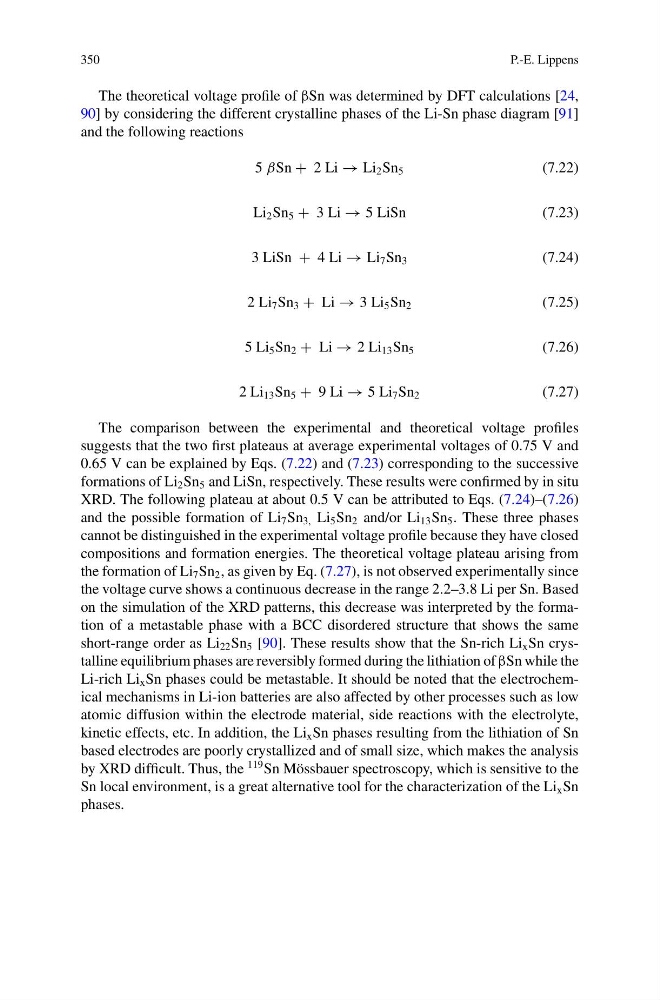
5 βSn + 2 Li → Li 2 Sn 5
(7.22)
Li 2 Sn 5 + 3 Li → 5 LiSn
(7.23)
3 LiSn + 4 Li → Li 7 Sn 3
(7.24)
2 Li 7 Sn 3 + Li → 3 Li 5 Sn 2
(7.25)
5 Li 5 Sn 2 + Li → 2 Li 13 Sn 5
(7.26)
2 Li 13 Sn 5 + 9 Li → 5 Li 7 Sn 2
(7.27)
The comparison between the experimental and theoretical voltage profiles
suggests that the two first plateaus at average experimental voltages of 0.75 V and
0.65 V can be explained by Eqs. (7.22) and (7.23) corresponding to the successive
formations of Li 2 Sn 5 and LiSn, respectively. These results were confirmed by in situ
XRD. The following plateau at about 0.5 V can be attributed to Eqs. (7.24)–(7.26)
and the possible formation of Li 7 Sn 3, Li 5 Sn 2 and/or Li 13 Sn 5 . These three phases
cannot be distinguished in the experimental voltage profile because they have closed
compositions and formation energies. The theoretical voltage plateau arising from
the formation of Li 7 Sn 2 , as given by Eq. (7.27), is not observed experimentally since
the voltage curve shows a continuous decrease in the range 2.2–3.8 Li per Sn. Based
on the simulation of the XRD patterns, this decrease was interpreted by the formation of a metastable phase with a BCC disordered structure that shows the same
short-range order as Li 22 Sn 5 [90]. These results show that the Sn-rich Li x Sn crystalline equilibrium phases are reversibly formed during the lithiation of βSn while the
Li-rich Li x Sn phases could be metastable. It should be noted that the electrochemical mechanisms in Li-ion batteries are also affected by other processes such as low
atomic diffusion within the electrode material, side reactions with the electrolyte,
kinetic effects, etc. In addition, the Li x Sn phases resulting from the lithiation of Sn
based electrodes are poorly crystallized and of small size, which makes the analysis
by XRD difficult. Thus, the
119 Sn Mössbauer spectroscopy, which is sensitive to the
Sn local environment, is a great alternative tool for the characterization of the Li x Sn
phases.
P.-E. Lippens
The theoretical voltage profile of βSn was determined by DFT calculations [24,
90] by considering the different crystalline phases of the Li-Sn phase diagram [91]
and the following reactions
5 βSn + 2 Li → Li 2 Sn 5
(7.22)
Li 2 Sn 5 + 3 Li → 5 LiSn
(7.23)
3 LiSn + 4 Li → Li 7 Sn 3
(7.24)
2 Li 7 Sn 3 + Li → 3 Li 5 Sn 2
(7.25)
5 Li 5 Sn 2 + Li → 2 Li 13 Sn 5
(7.26)
2 Li 13 Sn 5 + 9 Li → 5 Li 7 Sn 2
(7.27)
The comparison between the experimental and theoretical voltage profiles
suggests that the two first plateaus at average experimental voltages of 0.75 V and
0.65 V can be explained by Eqs. (7.22) and (7.23) corresponding to the successive
formations of Li 2 Sn 5 and LiSn, respectively. These results were confirmed by in situ
XRD. The following plateau at about 0.5 V can be attributed to Eqs. (7.24)–(7.26)
and the possible formation of Li 7 Sn 3, Li 5 Sn 2 and/or Li 13 Sn 5 . These three phases
cannot be distinguished in the experimental voltage profile because they have closed
compositions and formation energies. The theoretical voltage plateau arising from
the formation of Li 7 Sn 2 , as given by Eq. (7.27), is not observed experimentally since
the voltage curve shows a continuous decrease in the range 2.2–3.8 Li per Sn. Based
on the simulation of the XRD patterns, this decrease was interpreted by the formation of a metastable phase with a BCC disordered structure that shows the same
short-range order as Li 22 Sn 5 [90]. These results show that the Sn-rich Li x Sn crystalline equilibrium phases are reversibly formed during the lithiation of βSn while the
Li-rich Li x Sn phases could be metastable. It should be noted that the electrochemical mechanisms in Li-ion batteries are also affected by other processes such as low
atomic diffusion within the electrode material, side reactions with the electrolyte,
kinetic effects, etc. In addition, the Li x Sn phases resulting from the lithiation of Sn
based electrodes are poorly crystallized and of small size, which makes the analysis
by XRD difficult. Thus, the
119 Sn Mössbauer spectroscopy, which is sensitive to the
Sn local environment, is a great alternative tool for the characterization of the Li x Sn
phases.