

338
P.-E. Lippens
– Isomer shift: the single Lorentzian line is shifted by a value that gives the isomer
shift relative to the source (or a reference material).
– Quadrupole splitting: the single Lorentzian line is split into a doublet and the line
separation gives the quadrupole splitting.
– Magnetic interaction: the single Lorentzian line is split into six lines, the hyperfine
magnetic field can be determined from line separation.
The intensity of the spectral lines depends on the nuclear transition probabilities, which gives for example, 3:2:1:1:2:3 intensity ratio for the magnetic sextet of
powdered samples. This also depends on the directional dependence of the recoil-free
fraction arising from vibrational anisotropy, leading to an asymmetric doublet for
the quadrupole effect (Goldanskii-Karyagin effect) [63]. The sample thickness and
its texture can also affect the line shape. Finally, it is important to note that combined
quadrupole and magnetic interactions or magnetic relaxations may lead to complex
spectra.
SnO 2 and SnO have been regarded as negative electrode materials for Li-ion
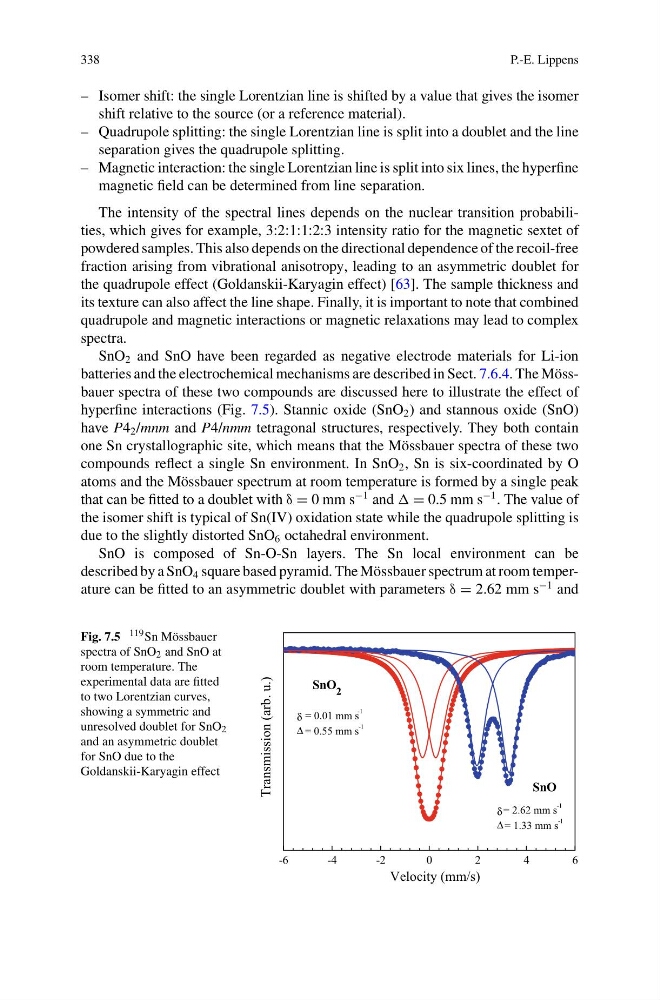
batteries and the electrochemical mechanisms are described in Sect. 7.6.4. The Mössbauer spectra of these two compounds are discussed here to illustrate the effect of
hyperfine interactions (Fig. 7.5). Stannic oxide (SnO 2 ) and stannous oxide (SnO)
have P4 2 /mnm and P4/nmm tetragonal structures, respectively. They both contain
one Sn crystallographic site, which means that the Mössbauer spectra of these two
compounds reflect a single Sn environment. In SnO 2 , Sn is six-coordinated by O
atoms and the Mössbauer spectrum at room temperature is formed by a single peak
that can be fitted to a doublet with δ = 0 mm s
−1 and = 0.5 mm s
−1 . The value of
the isomer shift is typical of Sn(IV) oxidation state while the quadrupole splitting is
due to the slightly distorted SnO 6 octahedral environment.
SnO is composed of Sn-O-Sn layers. The Sn local environment can be
described by a SnO 4 square based pyramid. The Mössbauer spectrum at room temperature can be fitted to an asymmetric doublet with parameters δ = 2.62 mm s
−1 and
Fig. 7.5 119 Sn Mössbauer
spectra of SnO 2 and SnO at
room temperature. The
experimental data are fitted
to two Lorentzian curves,
showing a symmetric and
unresolved doublet for SnO 2
and an asymmetric doublet
for SnO due to the
Goldanskii-Karyagin effect
-6
-4
-2
0
2
4
6
= 2.62 mm s
-1
= 1.33 mm s
-1
SnO 2
Transmission (arb. u.)
Velocity (mm/s)
SnO
= 0.01 mm s
-1
= 0.55 mm s
-1
δ
Δ
δ
Δ
P.-E. Lippens
– Isomer shift: the single Lorentzian line is shifted by a value that gives the isomer
shift relative to the source (or a reference material).
– Quadrupole splitting: the single Lorentzian line is split into a doublet and the line
separation gives the quadrupole splitting.
– Magnetic interaction: the single Lorentzian line is split into six lines, the hyperfine
magnetic field can be determined from line separation.
The intensity of the spectral lines depends on the nuclear transition probabilities, which gives for example, 3:2:1:1:2:3 intensity ratio for the magnetic sextet of
powdered samples. This also depends on the directional dependence of the recoil-free
fraction arising from vibrational anisotropy, leading to an asymmetric doublet for
the quadrupole effect (Goldanskii-Karyagin effect) [63]. The sample thickness and
its texture can also affect the line shape. Finally, it is important to note that combined
quadrupole and magnetic interactions or magnetic relaxations may lead to complex
spectra.
SnO 2 and SnO have been regarded as negative electrode materials for Li-ion
batteries and the electrochemical mechanisms are described in Sect. 7.6.4. The Mössbauer spectra of these two compounds are discussed here to illustrate the effect of
hyperfine interactions (Fig. 7.5). Stannic oxide (SnO 2 ) and stannous oxide (SnO)
have P4 2 /mnm and P4/nmm tetragonal structures, respectively. They both contain
one Sn crystallographic site, which means that the Mössbauer spectra of these two
compounds reflect a single Sn environment. In SnO 2 , Sn is six-coordinated by O
atoms and the Mössbauer spectrum at room temperature is formed by a single peak
that can be fitted to a doublet with δ = 0 mm s
−1 and = 0.5 mm s
−1 . The value of
the isomer shift is typical of Sn(IV) oxidation state while the quadrupole splitting is
due to the slightly distorted SnO 6 octahedral environment.
SnO is composed of Sn-O-Sn layers. The Sn local environment can be
described by a SnO 4 square based pyramid. The Mössbauer spectrum at room temperature can be fitted to an asymmetric doublet with parameters δ = 2.62 mm s
−1 and
Fig. 7.5 119 Sn Mössbauer
spectra of SnO 2 and SnO at
room temperature. The
experimental data are fitted
to two Lorentzian curves,
showing a symmetric and
unresolved doublet for SnO 2
and an asymmetric doublet
for SnO due to the
Goldanskii-Karyagin effect
-6
-4
-2
0
2
4
6
= 2.62 mm s
-1
= 1.33 mm s
-1
SnO 2
Transmission (arb. u.)
Velocity (mm/s)
SnO
= 0.01 mm s
-1
= 0.55 mm s
-1
δ
Δ
δ
Δ