

1 Historical Developments and Future Perspectives …
19
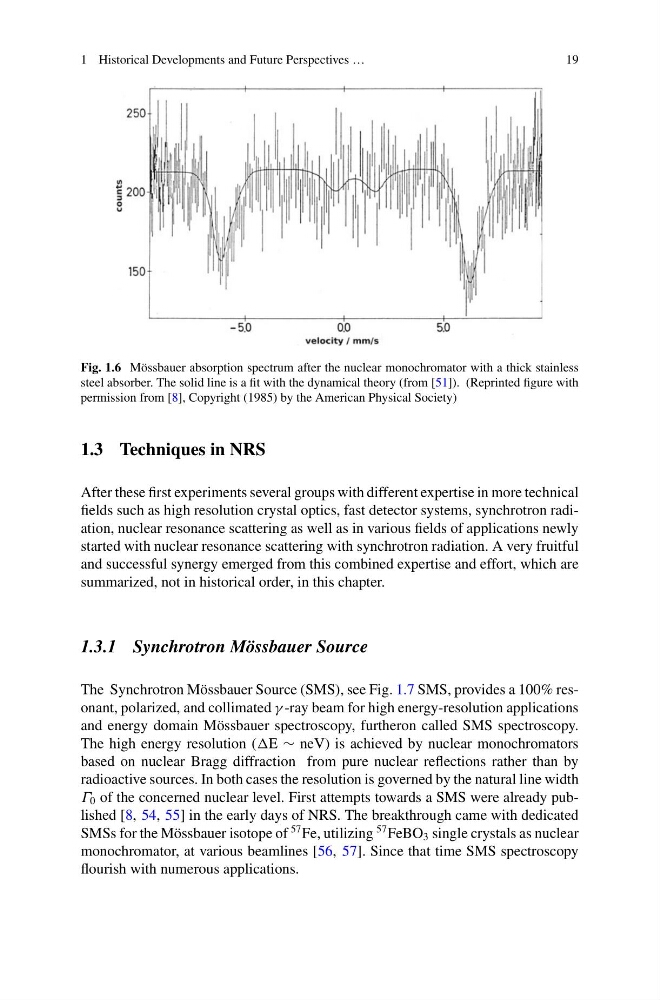
Fig. 1.6 Mössbauer absorption spectrum after the nuclear monochromator with a thick stainless
steel absorber. The solid line is a fit with the dynamical theory (from [51]). (Reprinted figure with
permission from [8], Copyright (1985) by the American Physical Society)
1.3 Techniques in NRS
After these first experiments several groups with different expertise in more technical
fields such as high resolution crystal optics, fast detector systems, synchrotron radiation, nuclear resonance scattering as well as in various fields of applications newly
started with nuclear resonance scattering with synchrotron radiation. A very fruitful
and successful synergy emerged from this combined expertise and effort, which are
summarized, not in historical order, in this chapter.
1.3.1 Synchrotron Mössbauer Source
The Synchrotron Mössbauer Source (SMS), see Fig. 1.7 SMS, provides a 100% resonant, polarized, and collimated γ -ray beam for high energy-resolution applications
and energy domain Mössbauer spectroscopy, furtheron called SMS spectroscopy.
The high energy resolution (E ∼ neV) is achieved by nuclear monochromators
based on nuclear Bragg diffraction from pure nuclear reflections rather than by
radioactive sources. In both cases the resolution is governed by the natural line width
Γ 0 of the concerned nuclear level. First attempts towards a SMS were already published [8, 54, 55] in the early days of NRS. The breakthrough came with dedicated
SMSs for the Mössbauer isotope of
57 Fe, utilizing
57 FeBO 3 single crystals as nuclear
monochromator, at various beamlines [56, 57]. Since that time SMS spectroscopy
flourish with numerous applications.
19
Fig. 1.6 Mössbauer absorption spectrum after the nuclear monochromator with a thick stainless
steel absorber. The solid line is a fit with the dynamical theory (from [51]). (Reprinted figure with
permission from [8], Copyright (1985) by the American Physical Society)
1.3 Techniques in NRS
After these first experiments several groups with different expertise in more technical
fields such as high resolution crystal optics, fast detector systems, synchrotron radiation, nuclear resonance scattering as well as in various fields of applications newly
started with nuclear resonance scattering with synchrotron radiation. A very fruitful
and successful synergy emerged from this combined expertise and effort, which are
summarized, not in historical order, in this chapter.
1.3.1 Synchrotron Mössbauer Source
The Synchrotron Mössbauer Source (SMS), see Fig. 1.7 SMS, provides a 100% resonant, polarized, and collimated γ -ray beam for high energy-resolution applications
and energy domain Mössbauer spectroscopy, furtheron called SMS spectroscopy.
The high energy resolution (E ∼ neV) is achieved by nuclear monochromators
based on nuclear Bragg diffraction from pure nuclear reflections rather than by
radioactive sources. In both cases the resolution is governed by the natural line width
Γ 0 of the concerned nuclear level. First attempts towards a SMS were already published [8, 54, 55] in the early days of NRS. The breakthrough came with dedicated
SMSs for the Mössbauer isotope of
57 Fe, utilizing
57 FeBO 3 single crystals as nuclear
monochromator, at various beamlines [56, 57]. Since that time SMS spectroscopy
flourish with numerous applications.