

336
P.-E. Lippens
f = ex p
−
3E R
2K B θ D
(7.17)
and for T θ D
f = ex p
−
6E R T
K B θ
2
D
(7.18)
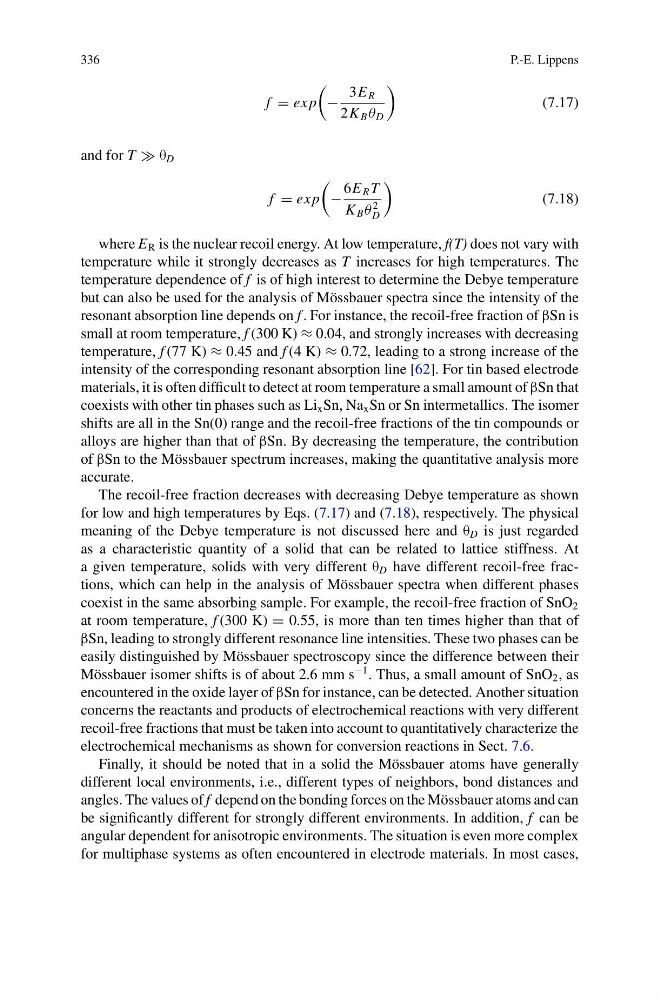
where E R is the nuclear recoil energy. At low temperature, f(T) does not vary with
temperature while it strongly decreases as T increases for high temperatures. The
temperature dependence of f is of high interest to determine the Debye temperature
but can also be used for the analysis of Mössbauer spectra since the intensity of the
resonant absorption line depends on f . For instance, the recoil-free fraction of βSn is
small at room temperature, f (300 K) ≈ 0.04, and strongly increases with decreasing
temperature, f (77 K) ≈ 0.45 and f (4 K) ≈ 0.72, leading to a strong increase of the
intensity of the corresponding resonant absorption line [62]. For tin based electrode
materials, it is often difficult to detect at room temperature a small amount of βSn that
coexists with other tin phases such as Li x Sn, Na x Sn or Sn intermetallics. The isomer
shifts are all in the Sn(0) range and the recoil-free fractions of the tin compounds or
alloys are higher than that of βSn. By decreasing the temperature, the contribution
of βSn to the Mössbauer spectrum increases, making the quantitative analysis more
accurate.
The recoil-free fraction decreases with decreasing Debye temperature as shown
for low and high temperatures by Eqs. (7.17) and (7.18), respectively. The physical
meaning of the Debye temperature is not discussed here and θ D is just regarded
as a characteristic quantity of a solid that can be related to lattice stiffness. At
a given temperature, solids with very different θ D have different recoil-free fractions, which can help in the analysis of Mössbauer spectra when different phases
coexist in the same absorbing sample. For example, the recoil-free fraction of SnO 2
at room temperature, f (300 K) = 0.55, is more than ten times higher than that of
βSn, leading to strongly different resonance line intensities. These two phases can be
easily distinguished by Mössbauer spectroscopy since the difference between their
Mössbauer isomer shifts is of about 2.6 mm s
−1 . Thus, a small amount of SnO 2 , as
encountered in the oxide layer of βSn for instance, can be detected. Another situation
concerns the reactants and products of electrochemical reactions with very different
recoil-free fractions that must be taken into account to quantitatively characterize the
electrochemical mechanisms as shown for conversion reactions in Sect. 7.6.
Finally, it should be noted that in a solid the Mössbauer atoms have generally
different local environments, i.e., different types of neighbors, bond distances and
angles. The values of f depend on the bonding forces on the Mössbauer atoms and can
be significantly different for strongly different environments. In addition, f can be
angular dependent for anisotropic environments. The situation is even more complex
for multiphase systems as often encountered in electrode materials. In most cases,
P.-E. Lippens
f = ex p
−
3E R
2K B θ D
(7.17)
and for T θ D
f = ex p
−
6E R T
K B θ
2
D
(7.18)
where E R is the nuclear recoil energy. At low temperature, f(T) does not vary with
temperature while it strongly decreases as T increases for high temperatures. The
temperature dependence of f is of high interest to determine the Debye temperature
but can also be used for the analysis of Mössbauer spectra since the intensity of the
resonant absorption line depends on f . For instance, the recoil-free fraction of βSn is
small at room temperature, f (300 K) ≈ 0.04, and strongly increases with decreasing
temperature, f (77 K) ≈ 0.45 and f (4 K) ≈ 0.72, leading to a strong increase of the
intensity of the corresponding resonant absorption line [62]. For tin based electrode
materials, it is often difficult to detect at room temperature a small amount of βSn that
coexists with other tin phases such as Li x Sn, Na x Sn or Sn intermetallics. The isomer
shifts are all in the Sn(0) range and the recoil-free fractions of the tin compounds or
alloys are higher than that of βSn. By decreasing the temperature, the contribution
of βSn to the Mössbauer spectrum increases, making the quantitative analysis more
accurate.
The recoil-free fraction decreases with decreasing Debye temperature as shown
for low and high temperatures by Eqs. (7.17) and (7.18), respectively. The physical
meaning of the Debye temperature is not discussed here and θ D is just regarded
as a characteristic quantity of a solid that can be related to lattice stiffness. At
a given temperature, solids with very different θ D have different recoil-free fractions, which can help in the analysis of Mössbauer spectra when different phases
coexist in the same absorbing sample. For example, the recoil-free fraction of SnO 2
at room temperature, f (300 K) = 0.55, is more than ten times higher than that of
βSn, leading to strongly different resonance line intensities. These two phases can be
easily distinguished by Mössbauer spectroscopy since the difference between their
Mössbauer isomer shifts is of about 2.6 mm s
−1 . Thus, a small amount of SnO 2 , as
encountered in the oxide layer of βSn for instance, can be detected. Another situation
concerns the reactants and products of electrochemical reactions with very different
recoil-free fractions that must be taken into account to quantitatively characterize the
electrochemical mechanisms as shown for conversion reactions in Sect. 7.6.
Finally, it should be noted that in a solid the Mössbauer atoms have generally
different local environments, i.e., different types of neighbors, bond distances and
angles. The values of f depend on the bonding forces on the Mössbauer atoms and can
be significantly different for strongly different environments. In addition, f can be
angular dependent for anisotropic environments. The situation is even more complex
for multiphase systems as often encountered in electrode materials. In most cases,