

7 Application of Mössbauer Spectroscopy to Li-Ion and Na-Ion …
333
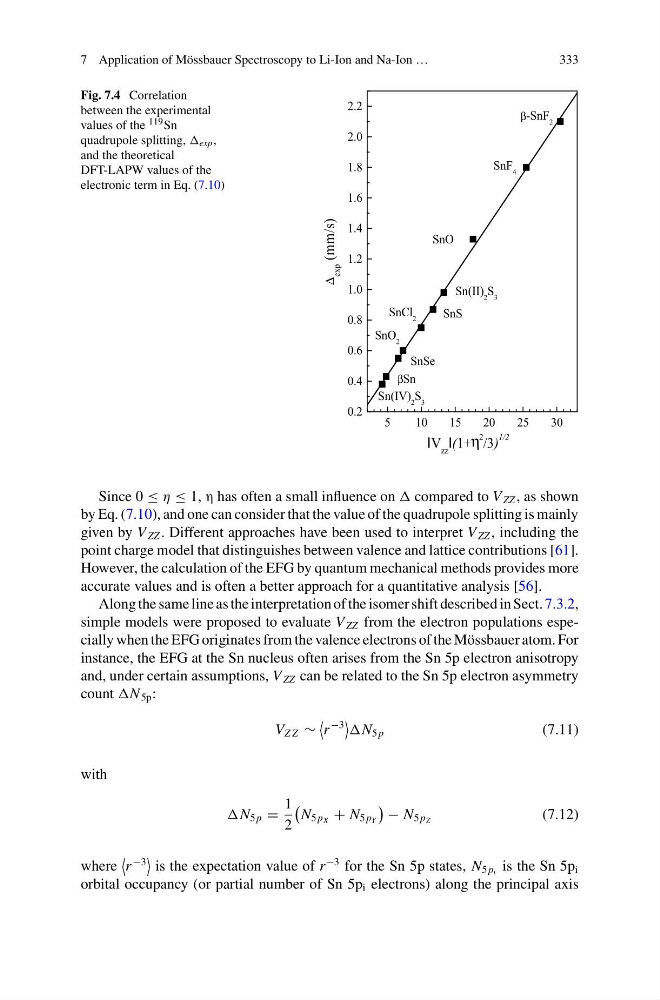
Fig. 7.4 Correlation
between the experimental
values of the 119 Sn
quadrupole splitting, exp ,
and the theoretical
DFT-LAPW values of the
electronic term in Eq. (7.10)
5
10
15
20
25
30
0.2
0.4
0.6
0.8
1.0
1.2
1.4
1.6
1.8
2.0
2.2
-SnF 2
SnF 4
Sn(II) 2 S 3
Sn(IV) 2 S 3
SnO 2
Sn
SnCl 2
SnSe
SnS
SnO
exp
(mm/s)
IV zz I(1+
2
/3)
1/2
η
β
β
Δ
Since 0 ≤ η ≤ 1, η has often a small influence on compared to V ZZ , as shown
by Eq. (7.10), and one can consider that the value of the quadrupole splitting is mainly
given by V ZZ . Different approaches have been used to interpret V ZZ , including the
point charge model that distinguishes between valence and lattice contributions [61].
However, the calculation of the EFG by quantum mechanical methods provides more
accurate values and is often a better approach for a quantitative analysis [56].
Along the same line as the interpretation of the isomer shift described in Sect. 7.3.2,
simple models were proposed to evaluate V ZZ from the electron populations especially when the EFG originates from the valence electrons of the Mössbauer atom. For
instance, the EFG at the Sn nucleus often arises from the Sn 5p electron anisotropy
and, under certain assumptions, V ZZ can be related to the Sn 5p electron asymmetry
count 5p :
V Z Z ∼
r
−3
5 p
(7.11)
with
5 p =
1
2
N 5 p X + N 5 p Y
− N 5 p Z
(7.12)
where
r
−3
is the expectation value of r
−3 for the Sn 5p states, N 5 p i is the Sn 5p i
orbital occupancy (or partial number of Sn 5p i electrons) along the principal axis
333
Fig. 7.4 Correlation
between the experimental
values of the 119 Sn
quadrupole splitting, exp ,
and the theoretical
DFT-LAPW values of the
electronic term in Eq. (7.10)
5
10
15
20
25
30
0.2
0.4
0.6
0.8
1.0
1.2
1.4
1.6
1.8
2.0
2.2
-SnF 2
SnF 4
Sn(II) 2 S 3
Sn(IV) 2 S 3
SnO 2
Sn
SnCl 2
SnSe
SnS
SnO
exp
(mm/s)
IV zz I(1+
2
/3)
1/2
η
β
β
Δ
Since 0 ≤ η ≤ 1, η has often a small influence on compared to V ZZ , as shown
by Eq. (7.10), and one can consider that the value of the quadrupole splitting is mainly
given by V ZZ . Different approaches have been used to interpret V ZZ , including the
point charge model that distinguishes between valence and lattice contributions [61].
However, the calculation of the EFG by quantum mechanical methods provides more
accurate values and is often a better approach for a quantitative analysis [56].
Along the same line as the interpretation of the isomer shift described in Sect. 7.3.2,
simple models were proposed to evaluate V ZZ from the electron populations especially when the EFG originates from the valence electrons of the Mössbauer atom. For
instance, the EFG at the Sn nucleus often arises from the Sn 5p electron anisotropy
and, under certain assumptions, V ZZ can be related to the Sn 5p electron asymmetry
count 5p :
V Z Z ∼
r
−3
5 p
(7.11)
with
5 p =
1
2
N 5 p X + N 5 p Y
− N 5 p Z
(7.12)
where
r
−3
is the expectation value of r
−3 for the Sn 5p states, N 5 p i is the Sn 5p i
orbital occupancy (or partial number of Sn 5p i electrons) along the principal axis