

6 Molecular Magnetism of Metal Complexes and Light-Induced …
309
to behave like a magnet below a blocking temperature in the case of the presence of strong uniaxial magnetic anisotropy. Such compounds are categorized as
SCMs, where slow relaxation dynamics of magnetization follows the Arrhenius law
[Eq. (6.6)]. Dynamics of spin reversal for Ising chain systems is formulated by
Glauber [84], whose model manages to explain quantitatively experimental results
for some tangible SCMs. There are currently some practical reviews for SCMs [85,
86], interpreting anisotropic Heisenberg model applicable to the real materials, based
on Glauber dynamics of 1D Ising chain. The spin system can be described by the
following Hamiltonian:
H = −2J
L
i=1
S i · S i+1 + D
L
i=1
S
2
i − gμ B H
L
i=1
S
2
i ,
(6.7)
where J is the exchange coupling constant between adjacent spins and L the effective
chain length. In the case of |D/J| > 4/3 (Ising limit), the spin system can be considered
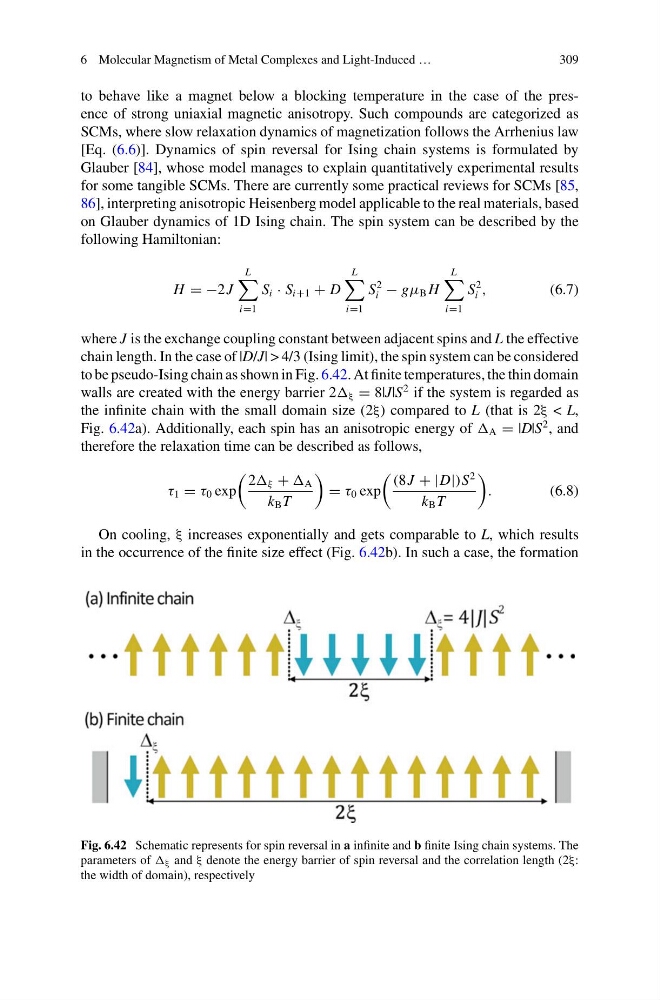
to be pseudo-Ising chain as shown in Fig. 6.42. At finite temperatures, the thin domain
walls are created with the energy barrier 2 ξ = 8|J|S
2 if the system is regarded as
the infinite chain with the small domain size (2ξ) compared to L (that is 2ξ < L,
Fig. 6.42a). Additionally, each spin has an anisotropic energy of A = |D|S
2 , and
therefore the relaxation time can be described as follows,
τ 1 = τ 0 exp
2 ξ + A
k B T
= τ 0 exp
(8J + |D|)S
2
k B T
.
(6.8)
On cooling, ξ increases exponentially and gets comparable to L, which results
in the occurrence of the finite size effect (Fig. 6.42b). In such a case, the formation
Fig. 6.42 Schematic represents for spin reversal in a infinite and b finite Ising chain systems. The
parameters of ξ and ξ denote the energy barrier of spin reversal and the correlation length (2ξ:
the width of domain), respectively
309
to behave like a magnet below a blocking temperature in the case of the presence of strong uniaxial magnetic anisotropy. Such compounds are categorized as
SCMs, where slow relaxation dynamics of magnetization follows the Arrhenius law
[Eq. (6.6)]. Dynamics of spin reversal for Ising chain systems is formulated by
Glauber [84], whose model manages to explain quantitatively experimental results
for some tangible SCMs. There are currently some practical reviews for SCMs [85,
86], interpreting anisotropic Heisenberg model applicable to the real materials, based
on Glauber dynamics of 1D Ising chain. The spin system can be described by the
following Hamiltonian:
H = −2J
L
i=1
S i · S i+1 + D
L
i=1
S
2
i − gμ B H
L
i=1
S
2
i ,
(6.7)
where J is the exchange coupling constant between adjacent spins and L the effective
chain length. In the case of |D/J| > 4/3 (Ising limit), the spin system can be considered
to be pseudo-Ising chain as shown in Fig. 6.42. At finite temperatures, the thin domain
walls are created with the energy barrier 2 ξ = 8|J|S
2 if the system is regarded as
the infinite chain with the small domain size (2ξ) compared to L (that is 2ξ < L,
Fig. 6.42a). Additionally, each spin has an anisotropic energy of A = |D|S
2 , and
therefore the relaxation time can be described as follows,
τ 1 = τ 0 exp
2 ξ + A
k B T
= τ 0 exp
(8J + |D|)S
2
k B T
.
(6.8)
On cooling, ξ increases exponentially and gets comparable to L, which results
in the occurrence of the finite size effect (Fig. 6.42b). In such a case, the formation
Fig. 6.42 Schematic represents for spin reversal in a infinite and b finite Ising chain systems. The
parameters of ξ and ξ denote the energy barrier of spin reversal and the correlation length (2ξ:
the width of domain), respectively