

294
N. Kojima and A. Okazawa
hyperfine field of H int = ~45.0 T are observed in the spectra of n = 3 and 4. The
former can be assigned to the diamagnetic state of Fe
II (S = 0) and the latter is
typical of the magnetically ordered state of Fe
III (S = 5/2). From the analysis of
57 Fe
Mössbauer spectra for (n-C n H 2n+1 ) 4 N[Fe
II Fe
III (dto) 3 ], it is obvious that the charge
transfer between the Fe
II and Fe
III sites takes place between 200 and 77 K for n = 3
and 4. At 4 K, in addition to the
57 Fe Mössbauer spectra corresponding to the Fe
II (S
= 0) and Fe
III (S = 5/2) sites, the sextets of the Fe
II (S = 2) and Fe
III (S = 1/2) sites
corresponding to the HTP are also required as the relative area of ca. 15% (for n =
3) or 30% (for n = 4). In the case of n = 4, two ferromagnetic phases with T C = 7
and 13 K are clearly observed in the magnetization measurement, being consistent
with the large area of the HTP at 4 K in the
57 Fe Mössbauer spectra.
The
57 Fe Mössbauer spectra in the ferromagnetic phases for n = 5 and 6 are
completely different from those for n = 3 and 4. In the cases of n = 5 and 6, the
CTPT does not take place, so that the spectra of n = 5 and 6 at 4 K can be assigned
to the Fe
II (S = 2) and Fe
III (S = 1/2) sites in the magnetically ordered phase. The
sextets of the Fe
III (S = 1/2) sites have relatively large H int of 24.6 T (for n = 5) and
24.8 T (for n = 6) at 4 K, while the Fe
II (S = 2) sites have relatively small H int of
7.3 T (for n = 5) and 9.9 T (for n = 6).
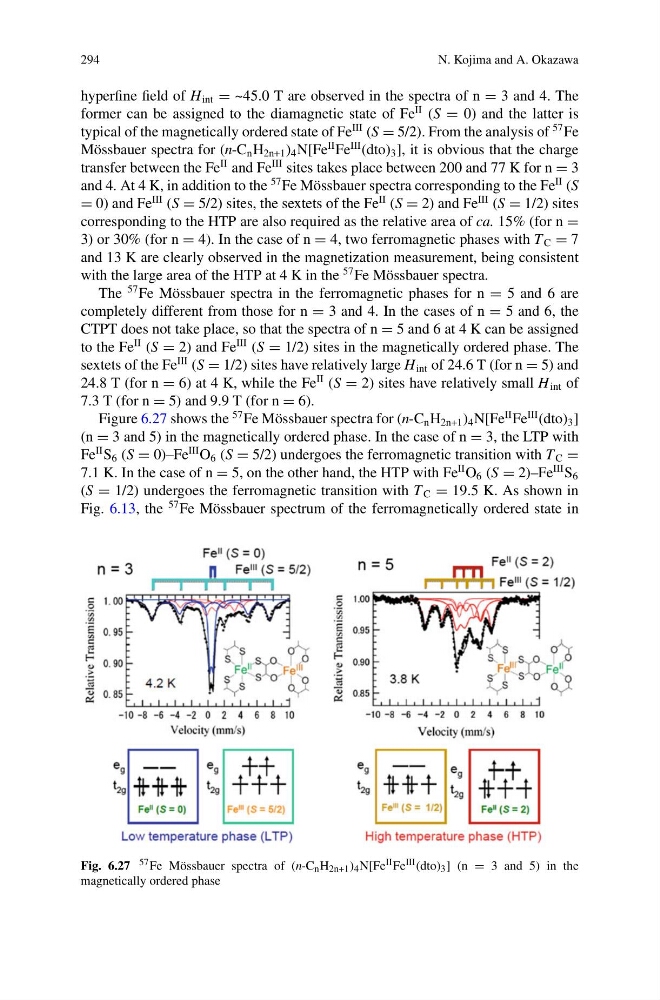
Figure 6.27 shows the
57 Fe Mössbauer spectra for (n-C n H 2n+1 ) 4 N[Fe
II Fe
III (dto) 3 ]
(n = 3 and 5) in the magnetically ordered phase. In the case of n = 3, the LTP with
Fe
II S 6 (S = 0)–Fe
III O 6 (S = 5/2) undergoes the ferromagnetic transition with T C =
7.1 K. In the case of n = 5, on the other hand, the HTP with Fe
II O 6 (S = 2)–Fe
III S 6
(S = 1/2) undergoes the ferromagnetic transition with T C = 19.5 K. As shown in
Fig. 6.13, the
57 Fe Mössbauer spectrum of the ferromagnetically ordered state in
Fig. 6.27 57 Fe Mössbauer spectra of (n-C n H 2n+1 ) 4 N[Fe II Fe III (dto) 3 ] (n = 3 and 5) in the
magnetically ordered phase
N. Kojima and A. Okazawa
hyperfine field of H int = ~45.0 T are observed in the spectra of n = 3 and 4. The
former can be assigned to the diamagnetic state of Fe
II (S = 0) and the latter is
typical of the magnetically ordered state of Fe
III (S = 5/2). From the analysis of
57 Fe
Mössbauer spectra for (n-C n H 2n+1 ) 4 N[Fe
II Fe
III (dto) 3 ], it is obvious that the charge
transfer between the Fe
II and Fe
III sites takes place between 200 and 77 K for n = 3
and 4. At 4 K, in addition to the
57 Fe Mössbauer spectra corresponding to the Fe
II (S
= 0) and Fe
III (S = 5/2) sites, the sextets of the Fe
II (S = 2) and Fe
III (S = 1/2) sites
corresponding to the HTP are also required as the relative area of ca. 15% (for n =
3) or 30% (for n = 4). In the case of n = 4, two ferromagnetic phases with T C = 7
and 13 K are clearly observed in the magnetization measurement, being consistent
with the large area of the HTP at 4 K in the
57 Fe Mössbauer spectra.
The
57 Fe Mössbauer spectra in the ferromagnetic phases for n = 5 and 6 are
completely different from those for n = 3 and 4. In the cases of n = 5 and 6, the
CTPT does not take place, so that the spectra of n = 5 and 6 at 4 K can be assigned
to the Fe
II (S = 2) and Fe
III (S = 1/2) sites in the magnetically ordered phase. The
sextets of the Fe
III (S = 1/2) sites have relatively large H int of 24.6 T (for n = 5) and
24.8 T (for n = 6) at 4 K, while the Fe
II (S = 2) sites have relatively small H int of
7.3 T (for n = 5) and 9.9 T (for n = 6).
Figure 6.27 shows the
57 Fe Mössbauer spectra for (n-C n H 2n+1 ) 4 N[Fe
II Fe
III (dto) 3 ]
(n = 3 and 5) in the magnetically ordered phase. In the case of n = 3, the LTP with
Fe
II S 6 (S = 0)–Fe
III O 6 (S = 5/2) undergoes the ferromagnetic transition with T C =
7.1 K. In the case of n = 5, on the other hand, the HTP with Fe
II O 6 (S = 2)–Fe
III S 6
(S = 1/2) undergoes the ferromagnetic transition with T C = 19.5 K. As shown in
Fig. 6.13, the
57 Fe Mössbauer spectrum of the ferromagnetically ordered state in
Fig. 6.27 57 Fe Mössbauer spectra of (n-C n H 2n+1 ) 4 N[Fe II Fe III (dto) 3 ] (n = 3 and 5) in the
magnetically ordered phase