

6 Molecular Magnetism of Metal Complexes and Light-Induced …
275
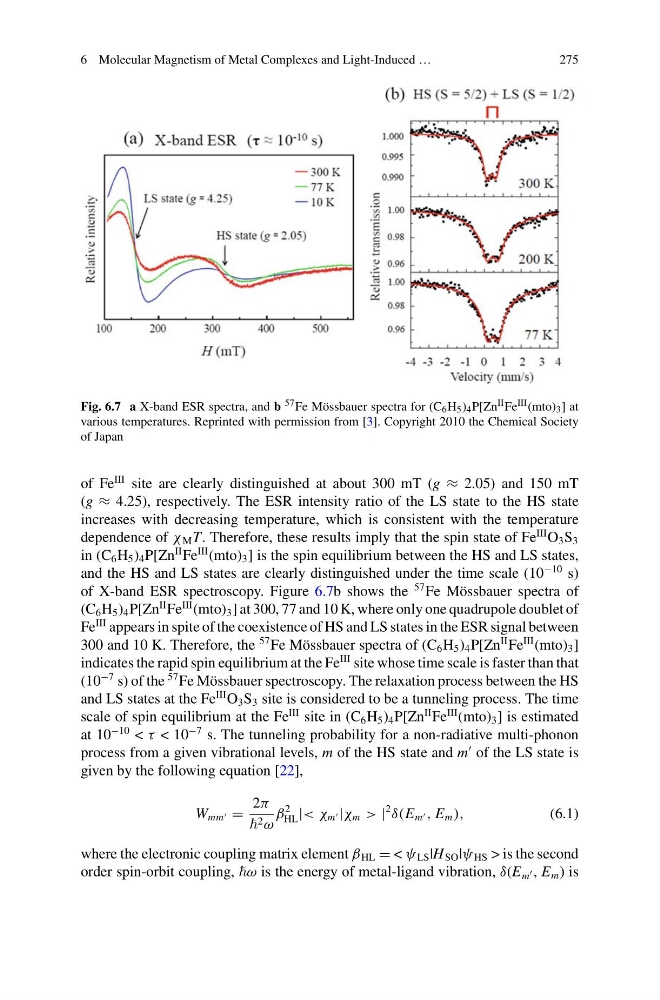
Fig. 6.7 a X-band ESR spectra, and b 57 Fe Mössbauer spectra for (C 6 H 5 ) 4 P[Zn II Fe III (mto) 3 ] at
various temperatures. Reprinted with permission from [3]. Copyright 2010 the Chemical Society
of Japan
of Fe
III site are clearly distinguished at about 300 mT (g ≈ 2.05) and 150 mT
(g ≈ 4.25), respectively. The ESR intensity ratio of the LS state to the HS state
increases with decreasing temperature, which is consistent with the temperature
dependence of χ M T. Therefore, these results imply that the spin state of Fe
III O 3 S 3
in (C 6 H 5 ) 4 P[Zn
II Fe
III (mto) 3 ] is the spin equilibrium between the HS and LS states,
and the HS and LS states are clearly distinguished under the time scale (10
−10 s)
of X-band ESR spectroscopy. Figure 6.7b shows the
57 Fe Mössbauer spectra of
(C 6 H 5 ) 4 P[Zn
II Fe
III (mto) 3 ] at 300, 77 and 10 K, where only one quadrupole doublet of
Fe
III appears in spite of the coexistence of HS and LS states in the ESR signal between
300 and 10 K. Therefore, the
57 Fe Mössbauer spectra of (C 6 H 5 ) 4 P[Zn
II Fe
III (mto) 3 ]
indicates the rapid spin equilibrium at the Fe
III site whose time scale is faster than that
(10
−7 s) of the
57 Fe Mössbauer spectroscopy. The relaxation process between the HS
and LS states at the Fe
III O 3 S 3 site is considered to be a tunneling process. The time
scale of spin equilibrium at the Fe
III site in (C 6 H 5 ) 4 P[Zn
II Fe
III (mto) 3 ] is estimated
at 10
−10 < τ < 10
−7 s. The tunneling probability for a non-radiative multi-phonon
process from a given vibrational levels, m of the HS state and m
of the LS state is
given by the following equation [22],
W mm =
2π
2 ω
β
2
HL |< χ m |χ m > |
2
δ(E m , E m ),
(6.1)
where the electronic coupling matrix element β HL = < ψ LS |H SO |ψ HS > is the second
order spin-orbit coupling, ω is the energy of metal-ligand vibration, δ(E m , E m ) is
275
Fig. 6.7 a X-band ESR spectra, and b 57 Fe Mössbauer spectra for (C 6 H 5 ) 4 P[Zn II Fe III (mto) 3 ] at
various temperatures. Reprinted with permission from [3]. Copyright 2010 the Chemical Society
of Japan
of Fe
III site are clearly distinguished at about 300 mT (g ≈ 2.05) and 150 mT
(g ≈ 4.25), respectively. The ESR intensity ratio of the LS state to the HS state
increases with decreasing temperature, which is consistent with the temperature
dependence of χ M T. Therefore, these results imply that the spin state of Fe
III O 3 S 3
in (C 6 H 5 ) 4 P[Zn
II Fe
III (mto) 3 ] is the spin equilibrium between the HS and LS states,
and the HS and LS states are clearly distinguished under the time scale (10
−10 s)
of X-band ESR spectroscopy. Figure 6.7b shows the
57 Fe Mössbauer spectra of
(C 6 H 5 ) 4 P[Zn
II Fe
III (mto) 3 ] at 300, 77 and 10 K, where only one quadrupole doublet of
Fe
III appears in spite of the coexistence of HS and LS states in the ESR signal between
300 and 10 K. Therefore, the
57 Fe Mössbauer spectra of (C 6 H 5 ) 4 P[Zn
II Fe
III (mto) 3 ]
indicates the rapid spin equilibrium at the Fe
III site whose time scale is faster than that
(10
−7 s) of the
57 Fe Mössbauer spectroscopy. The relaxation process between the HS
and LS states at the Fe
III O 3 S 3 site is considered to be a tunneling process. The time
scale of spin equilibrium at the Fe
III site in (C 6 H 5 ) 4 P[Zn
II Fe
III (mto) 3 ] is estimated
at 10
−10 < τ < 10
−7 s. The tunneling probability for a non-radiative multi-phonon
process from a given vibrational levels, m of the HS state and m
of the LS state is
given by the following equation [22],
W mm =
2π
2 ω
β
2
HL |< χ m |χ m > |
2
δ(E m , E m ),
(6.1)
where the electronic coupling matrix element β HL = < ψ LS |H SO |ψ HS > is the second
order spin-orbit coupling, ω is the energy of metal-ligand vibration, δ(E m , E m ) is