

252
C. McCammon
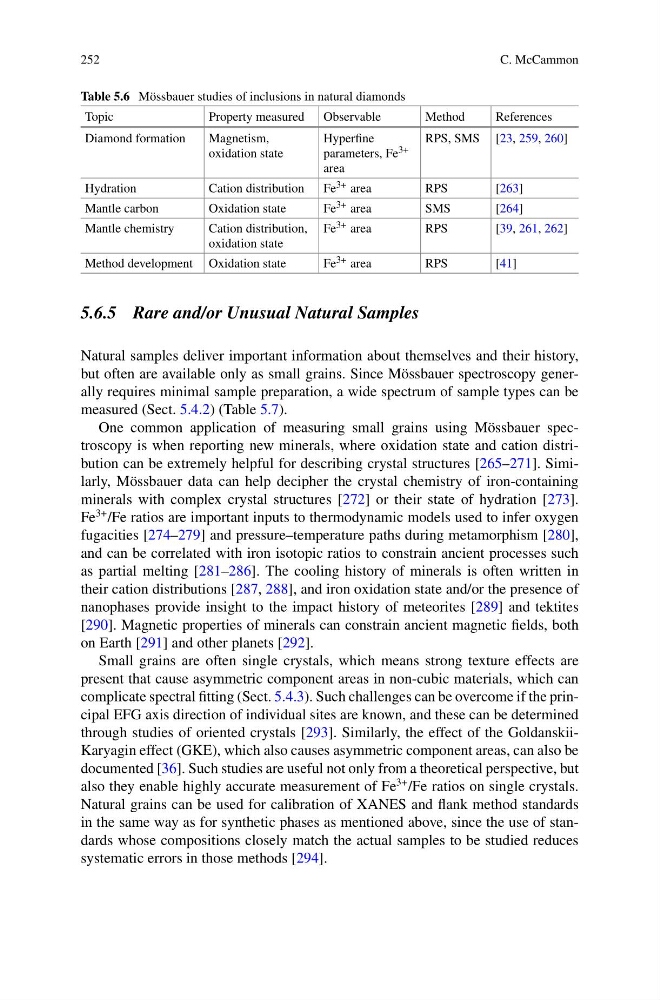
Table 5.6 Mössbauer studies of inclusions in natural diamonds
Topic
Property measured Observable
Method
References
Diamond formation
Magnetism,
oxidation state
Hyperfine
parameters, Fe 3+
area
RPS, SMS [23, 259, 260]
Hydration
Cation distribution
Fe 3+ area
RPS
[263]
Mantle carbon
Oxidation state
Fe 3+ area
SMS
[264]
Mantle chemistry
Cation distribution,
oxidation state
Fe 3+ area
RPS
[39, 261, 262]
Method development Oxidation state
Fe 3+ area
RPS
[41]
5.6.5 Rare and/or Unusual Natural Samples
Natural samples deliver important information about themselves and their history,
but often are available only as small grains. Since Mössbauer spectroscopy generally requires minimal sample preparation, a wide spectrum of sample types can be
measured (Sect. 5.4.2) (Table 5.7).
One common application of measuring small grains using Mössbauer spectroscopy is when reporting new minerals, where oxidation state and cation distribution can be extremely helpful for describing crystal structures [265–271]. Similarly, Mössbauer data can help decipher the crystal chemistry of iron-containing
minerals with complex crystal structures [272] or their state of hydration [273].
Fe
3+ /Fe ratios are important inputs to thermodynamic models used to infer oxygen
fugacities [274–279] and pressure–temperature paths during metamorphism [280],
and can be correlated with iron isotopic ratios to constrain ancient processes such
as partial melting [281–286]. The cooling history of minerals is often written in
their cation distributions [287, 288], and iron oxidation state and/or the presence of
nanophases provide insight to the impact history of meteorites [289] and tektites
[290]. Magnetic properties of minerals can constrain ancient magnetic fields, both
on Earth [291] and other planets [292].
Small grains are often single crystals, which means strong texture effects are
present that cause asymmetric component areas in non-cubic materials, which can
complicate spectral fitting (Sect. 5.4.3). Such challenges can be overcome if the principal EFG axis direction of individual sites are known, and these can be determined
through studies of oriented crystals [293]. Similarly, the effect of the GoldanskiiKaryagin effect (GKE), which also causes asymmetric component areas, can also be
documented [36]. Such studies are useful not only from a theoretical perspective, but
also they enable highly accurate measurement of Fe
3+ /Fe ratios on single crystals.
Natural grains can be used for calibration of XANES and flank method standards
in the same way as for synthetic phases as mentioned above, since the use of standards whose compositions closely match the actual samples to be studied reduces
systematic errors in those methods [294].
C. McCammon
Table 5.6 Mössbauer studies of inclusions in natural diamonds
Topic
Property measured Observable
Method
References
Diamond formation
Magnetism,
oxidation state
Hyperfine
parameters, Fe 3+
area
RPS, SMS [23, 259, 260]
Hydration
Cation distribution
Fe 3+ area
RPS
[263]
Mantle carbon
Oxidation state
Fe 3+ area
SMS
[264]
Mantle chemistry
Cation distribution,
oxidation state
Fe 3+ area
RPS
[39, 261, 262]
Method development Oxidation state
Fe 3+ area
RPS
[41]
5.6.5 Rare and/or Unusual Natural Samples
Natural samples deliver important information about themselves and their history,
but often are available only as small grains. Since Mössbauer spectroscopy generally requires minimal sample preparation, a wide spectrum of sample types can be
measured (Sect. 5.4.2) (Table 5.7).
One common application of measuring small grains using Mössbauer spectroscopy is when reporting new minerals, where oxidation state and cation distribution can be extremely helpful for describing crystal structures [265–271]. Similarly, Mössbauer data can help decipher the crystal chemistry of iron-containing
minerals with complex crystal structures [272] or their state of hydration [273].
Fe
3+ /Fe ratios are important inputs to thermodynamic models used to infer oxygen
fugacities [274–279] and pressure–temperature paths during metamorphism [280],
and can be correlated with iron isotopic ratios to constrain ancient processes such
as partial melting [281–286]. The cooling history of minerals is often written in
their cation distributions [287, 288], and iron oxidation state and/or the presence of
nanophases provide insight to the impact history of meteorites [289] and tektites
[290]. Magnetic properties of minerals can constrain ancient magnetic fields, both
on Earth [291] and other planets [292].
Small grains are often single crystals, which means strong texture effects are
present that cause asymmetric component areas in non-cubic materials, which can
complicate spectral fitting (Sect. 5.4.3). Such challenges can be overcome if the principal EFG axis direction of individual sites are known, and these can be determined
through studies of oriented crystals [293]. Similarly, the effect of the GoldanskiiKaryagin effect (GKE), which also causes asymmetric component areas, can also be
documented [36]. Such studies are useful not only from a theoretical perspective, but
also they enable highly accurate measurement of Fe
3+ /Fe ratios on single crystals.
Natural grains can be used for calibration of XANES and flank method standards
in the same way as for synthetic phases as mentioned above, since the use of standards whose compositions closely match the actual samples to be studied reduces
systematic errors in those methods [294].