

250
C. McCammon
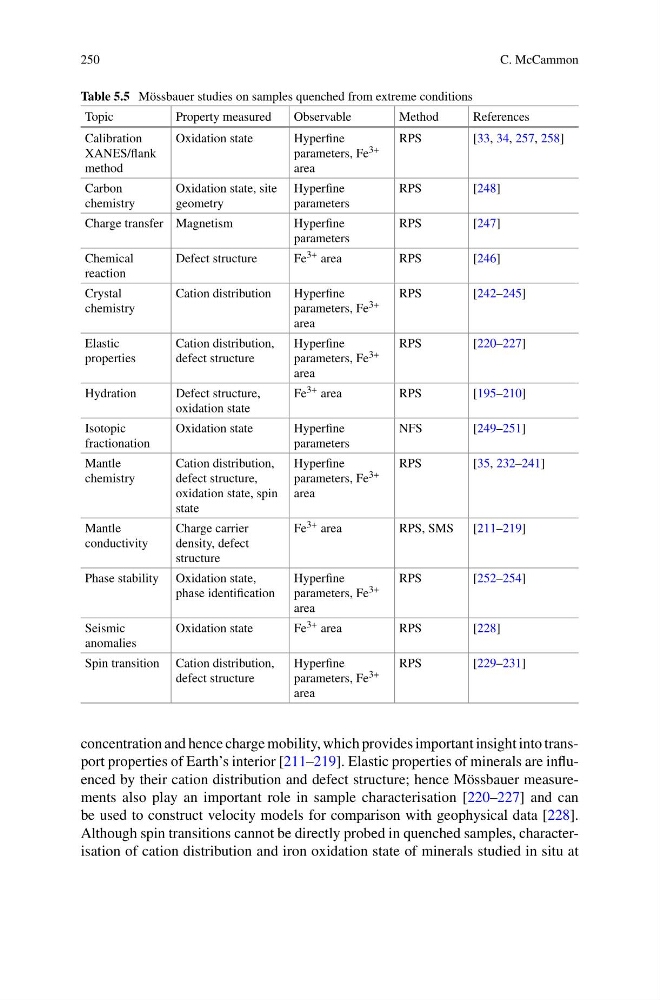
Table 5.5 Mössbauer studies on samples quenched from extreme conditions
Topic
Property measured
Observable
Method
References
Calibration
XANES/flank
method
Oxidation state
Hyperfine
parameters, Fe 3+
area
RPS
[33, 34, 257, 258]
Carbon
chemistry
Oxidation state, site
geometry
Hyperfine
parameters
RPS
[248]
Charge transfer Magnetism
Hyperfine
parameters
RPS
[247]
Chemical
reaction
Defect structure
Fe 3+ area
RPS
[246]
Crystal
chemistry
Cation distribution
Hyperfine
parameters, Fe 3+
area
RPS
[242–245]
Elastic
properties
Cation distribution,
defect structure
Hyperfine
parameters, Fe 3+
area
RPS
[220–227]
Hydration
Defect structure,
oxidation state
Fe 3+ area
RPS
[195–210]
Isotopic
fractionation
Oxidation state
Hyperfine
parameters
NFS
[249–251]
Mantle
chemistry
Cation distribution,
defect structure,
oxidation state, spin
state
Hyperfine
parameters, Fe 3+
area
RPS
[35, 232–241]
Mantle
conductivity
Charge carrier
density, defect
structure
Fe 3+ area
RPS, SMS
[211–219]
Phase stability Oxidation state,
phase identification
Hyperfine
parameters, Fe 3+
area
RPS
[252–254]
Seismic
anomalies
Oxidation state
Fe 3+ area
RPS
[228]
Spin transition Cation distribution,
defect structure
Hyperfine
parameters, Fe 3+
area
RPS
[229–231]
concentration and hence charge mobility, which provides important insight into transport properties of Earth’s interior [211–219]. Elastic properties of minerals are influenced by their cation distribution and defect structure; hence Mössbauer measurements also play an important role in sample characterisation [220–227] and can
be used to construct velocity models for comparison with geophysical data [228].
Although spin transitions cannot be directly probed in quenched samples, characterisation of cation distribution and iron oxidation state of minerals studied in situ at
C. McCammon
Table 5.5 Mössbauer studies on samples quenched from extreme conditions
Topic
Property measured
Observable
Method
References
Calibration
XANES/flank
method
Oxidation state
Hyperfine
parameters, Fe 3+
area
RPS
[33, 34, 257, 258]
Carbon
chemistry
Oxidation state, site
geometry
Hyperfine
parameters
RPS
[248]
Charge transfer Magnetism
Hyperfine
parameters
RPS
[247]
Chemical
reaction
Defect structure
Fe 3+ area
RPS
[246]
Crystal
chemistry
Cation distribution
Hyperfine
parameters, Fe 3+
area
RPS
[242–245]
Elastic
properties
Cation distribution,
defect structure
Hyperfine
parameters, Fe 3+
area
RPS
[220–227]
Hydration
Defect structure,
oxidation state
Fe 3+ area
RPS
[195–210]
Isotopic
fractionation
Oxidation state
Hyperfine
parameters
NFS
[249–251]
Mantle
chemistry
Cation distribution,
defect structure,
oxidation state, spin
state
Hyperfine
parameters, Fe 3+
area
RPS
[35, 232–241]
Mantle
conductivity
Charge carrier
density, defect
structure
Fe 3+ area
RPS, SMS
[211–219]
Phase stability Oxidation state,
phase identification
Hyperfine
parameters, Fe 3+
area
RPS
[252–254]
Seismic
anomalies
Oxidation state
Fe 3+ area
RPS
[228]
Spin transition Cation distribution,
defect structure
Hyperfine
parameters, Fe 3+
area
RPS
[229–231]
concentration and hence charge mobility, which provides important insight into transport properties of Earth’s interior [211–219]. Elastic properties of minerals are influenced by their cation distribution and defect structure; hence Mössbauer measurements also play an important role in sample characterisation [220–227] and can
be used to construct velocity models for comparison with geophysical data [228].
Although spin transitions cannot be directly probed in quenched samples, characterisation of cation distribution and iron oxidation state of minerals studied in situ at